Affiliate Disclosure: This article contains affiliate links. If you purchase through these links, I may earn a commission at no extra cost to you.
Last year, I made an embarrassing $37 from my first AI-generated ebook.
Fast forward to today? I’m clearing $5,800 monthly with AI-powered digital products. The secret wasn’t working harder — it was finding the right products to create at the right time.
Here’s the thing most people miss: AI moved fast in 2025. But 2026? It’s a completely different game.
Agentic AI is now the baseline. No-code tools let you build real SaaS products from a single prompt. Text-to-video costs dropped 40% between 2025 and 2026. And buyers? They’re smarter. They can spot lazy AI content from a mile away.
Most beginners think they need to be tech geniuses to profit from AI.
The reality is, you just need to solve one specific problem for one specific audience.
That’s exactly what this guide covers — 17 profitable digital products to create with AI that are working right now in 2026. Not theory. Not hype. Real products with real buyers.
Let’s dive in.
1. AI-Enhanced Ebooks and Guides That Stand Out
When I created my first AI-written ebook on productivity hacks, it bombed.
Why? Because it read like every other generic AI content out there.
The game-changer was when I started using AI as a research and drafting tool, not the sole creator. If you’re new to creating digital products with AI, check out our beginner’s guide to AI tools to get started.
Here’s my process now:
First, I use Claude or ChatGPT to research niche topics people actually pay for. Last month, I asked AI to analyze trending Kindle categories with low competition but high search volume. It pointed me toward “intermittent fasting for shift workers” — a goldmine I would’ve never considered!
For deeper keyword research and finding those low-competition niches, I use Keysearch. It’s the most affordable SEO tool that actually delivers — way better than guessing what people search for.

Find Keywords That Actually Rank
Stop guessing what to write. KeySearch helps you discover low-competition keywords, analyze competitors, and create SEO content that drives long-term organic traffic.
For more tips on leveraging AI tools effectively, visit our list of best AI tools for 2026.
I then use what I call the “content sandwich” method:
- AI creates the initial draft and research
- I inject my personal stories and expertise in the middle
- AI helps polish and optimize the final product
Before creating any AI-generated ebooks now, I run it through my 3-step validation process:
- Create a landing page with the concept and collect email sign-ups (if I get fewer than 50 interested people, I pivot)
- Survey my email list about specific pain points
- Pre-sell the ebook at 50% off to validate market demand
For digital product pricing strategy, I’ve found the sweet spot is $17–$27 for niche guides. When I dropped my “Remote Work Setup Guide” from $47 to $27, sales tripled overnight. People want valuable information but still need that psychological “impulse buy” price point.
Pro tip: In 2026, the fastest-growing ebook category is AI skills and automation guides for non-technical people. Searches for AI-related content have doubled year-on-year.
2. Custom AI Prompt Libraries and Templates
This was the biggest surprise of my AI business journey.
My prompt collections sell better than almost any other digital products I’ve created with AI.
I’ve packaged specialized prompt engineering templates for:
- Real estate agents writing property descriptions
- Therapists creating client homework exercises
- Etsy sellers writing product descriptions
- Course creators developing curriculum outlines
My “Ultimate Content Creator’s Prompt Pack” contains 85 prompts I’ve refined over months of testing. It sells for $37, and I’ve moved over 400 copies with virtually zero marketing besides sharing results on social media.
The key is creating ChatGPT prompt libraries that solve specific problems, not general ones.
Nobody wants “10 prompts for better writing.” They want “10 prompts that will help you write high-converting email sequences for SaaS products.”
For packaging AI knowledge products, I use Notion or simple PDF templates with clear categories and examples of output for each prompt. This perceived value is crucial — people need to see what they’ll get.
The unexpected platforms where these AI digital products sell best? Surprisingly not just Gumroad or your own site. Etsy has been a goldmine for prompt collections, and creative marketplaces like Creative Market have performed exceptionally well. Find out where to sell AI-generated products here.
3. AI-Generated Online Courses and Workshops
My first AI-assisted course on “Pinterest Marketing for Small Businesses” earned $1,700 in its first week.
But I made some critical mistakes you can avoid.
The ideal AI course creation mix I’ve discovered:
- Use AI to create comprehensive outlines and research (about 40% of the work)
- Record video modules yourself (the personal touch matters enormously)
- Let AI generate worksheets, checklists, and supplementary materials
- Add YOUR unique case studies and examples (this is what people really pay for)
For AI-assisted content creation, I rely on a simple tech stack:
- Claude / ChatGPT for content planning and script drafts
- Descript for easily editing my talking-head videos
- Canva Pro with its AI features for professional-looking slides
- Notion AI for creating supplementary materials
To learn more about using Canva for AI design, check out our Canvas digital templates guide.
I’ve discovered something counter-intuitive about pricing AI knowledge products: my lower-priced courses ($97–$197) actually generate more total revenue than my premium offerings.
Why? The barrier to entry is lower, and upselling becomes easier once people experience your teaching style.
The fatal mistake I made early on? Creating courses on topics I wasn’t genuinely interested in just because AI could help me create them quickly. Learners can sense this lack of authenticity immediately.
Build Your Email List Today
Every successful online business owns its audience.
Start building yours with Kit (formerly ConvertKit). It’s the simplest way to capture leads, send automated sequences, and sell digital products — all in one place.
4. AI Art and Design Products That Sell While You Sleep
When I first experimented with Midjourney, I created generic “inspirational quote” posters that nobody wanted.
The breakthrough came when I discovered niche art markets most creators completely overlook.
Some profitable digital products to create with AI art include:
- Custom pet portrait templates (pet owners spend absurdly)
- Industry-specific wall art (accounting office decor, therapy waiting room art)
- Educational posters with unique visual styles
- Custom Tarot and oracle card designs
For selling these creations, consider our guide on where to sell AI-generated products.
My “style recipe” approach involves creating consistent, distinctive visual styles that customers pay premium prices for. I developed a recognizable “vintage botanical sci-fi” style that became my signature, commanding $45–$75 per print versus the $15–$20 for generic AI art products.
The legal considerations for AI art monetization are crucial here. I:
- Never use specific artist names in my prompts
- Focus on creating original conceptual combinations
- Use only commercial-licensed models
- Am transparent about AI usage in my product descriptions
For AI design resources packaging and licensing, I offer different tiers:
| Tier | What’s Included | Price |
| Digital Download | High-res files for personal use | $15 |
| Print-on-Demand | Physical products shipped to buyer | $35–$75 |
| Commercial License | Business use in their own materials | $150 |
Learn more about AI content legal rights in our essential legal guide.
5. AI-Powered Micro-SaaS Tools and Applications
“But I can’t code!” was my excuse for years.
Then I built a simple AI email responder tool using nothing but no-code tools. It now generates $1,200 monthly on a $29 subscription model.
In 2026, this opportunity exploded. Tools like Lovable, Bolt.new, and Bubble let you build functional web apps from a single text prompt. No coding required.
The no-code AI applications that made this possible:
- Bubble for the application framework
- Zapier for connecting APIs
- GPT API for the AI functionality
- Stripe for subscription management
The surprisingly simple AI tool that became my biggest income source? An AI-powered Instagram caption generator specifically for fitness professionals.
When creating digital products with AI, niche down, friends!
Before building any AI SaaS tools, I validate my ideas by:
- Creating a simple landing page describing the tool
- Running $100 worth of Facebook ads to the target audience
- Measuring click-through and sign-up rates for interest
- Personally interviewing 5–10 potential users about their needs
After testing 5 different approaches, I’ve found the subscription AI products sweet spot is between $17–$39 monthly for niche professional tools. Anything higher drastically reduces conversion; anything lower isn’t worth the customer support.
6. AI-Enhanced Templates and Frameworks
My collection of Notion templates with AI components has generated over $18,000 in the past year alone.
The beauty of these digital products to create with AI? Once they’re created, they sell without additional effort.
My best-selling AI writing templates include:
- AI-powered content calendar for marketers ($49)
- Client management system for freelancers with automated follow-ups ($79)
- Product launch framework with integrated AI feedback loops ($129)
The secret to successful templates isn’t just good design — it’s building in AI tool automation that creates ongoing value. For example, my content calendar template includes custom GPT prompts that help users generate content ideas based on their specific niche.
I’ve found that platforms like Notion, Coda, and even Google Docs are perfect for creating templates with embedded AI functionality through simple integrations.
When pricing AI productivity templates, I’ve discovered the magic of bundles:
| Option | Price | Conversion Rate |
| Individual Template | $29–$49 | 12% |
| Bundle of 3 | $79–$149 | 34% |
Most people opt for the perceived value of the bundle.
7. AI Voice and Audio Products
This category was completely off my radar until I experimented with voice synthesis tools.
In 2026, ElevenLabs delivers the most expressive, human-sounding voice on the market — handling pacing, breath, and emotional inflection well enough to keep a dramatic story’s natural pauses and tone.
Profitable AI asset creation with voice include:
- Guided meditation packs with customizable AI voices
- Audiobook creation services for self-published authors
- Voice-over packages for YouTube creators
- Custom podcast intros and outros
The production process for AI audio digital products is straightforward:
- Write quality scripts (I use AI for the initial draft, then heavily edit)
- Generate the audio using ElevenLabs
- Add subtle background music and effects
- Package into downloadable bundles
For my guided meditation pack, I offer different voice options and background soundscapes. Priced at $37, it’s sold over 250 copies with minimal marketing.
The biggest challenge here is the ethical considerations for AI products — I’m always transparent about AI voice usage and never attempt to mimic specific celebrities or voice actors.
8. AI-Powered Email Sequences and Copywriting Templates
After writing countless sales emails for my products, I realized I could package my frameworks and AI prompts as standalone digital products.
My “E-commerce Email Engine” product includes:
- 52 pre-written email sequence templates for online stores
- Custom AI prompts to personalize each email
- A strategy guide for implementation
- A/B testing frameworks to optimize results
Priced at $197, it’s targeted at Shopify store owners who need ongoing email content but don’t want to hire a copywriter. The value proposition is clear: “Pay once, generate unlimited emails.”

Start Your Online Store with Shopify
Turn your idea into a profitable online business with Shopify. Create a professional store, sell digital or physical products, manage payments, and grow your brand with powerful e-commerce tools trusted by millions of entrepreneurs.
I sell these AI content repurposing tools through a combination of my own website and as a premium offering on marketplaces like AppSumo, where one-time lifetime deals perform exceptionally well.
The ongoing challenge is keeping the templates fresh and effective as language models evolve. I now include quarterly updates as part of the package, which has increased perceived value and reduced refund requests.
9. AI Research Reports and Industry Analyses
This has become one of my highest-margin AI knowledge products.
Using AI for content creation to help compile and analyze information, I create industry-specific research reports that sell for $299–$499 each.
My process:
- Identify trending topics within specific industries
- Use AI to gather and synthesize information from multiple sources
- Add original insights and interviews with actual experts
- Create professional data visualizations
- Package everything into a premium PDF with interactive elements
My “Future of Remote Work Technology” report sold 89 copies at $349, with minimal production costs beyond my time. The key was positioning it as an essential strategic tool for HR directors and company leadership.
What makes these AI digital products valuable isn’t just the information — it’s the analysis and actionable recommendations. AI helps me process vast amounts of data, but my interpretation makes it worth the premium price.
10. Custom AI Agents and Autonomous Assistants
This is the biggest new opportunity in 2026.
77% of enterprises already have AI agents running in production. The AI services market is set to reach $515 billion by 2029. And small creators? We’re just starting to tap into this.
The difference between a chatbot and an AI agent is like the difference between a calculator and an accountant. One responds to instructions. The other can manage a process.
Some successful custom AI agents I’ve built:
- An onboarding assistant for SaaS companies
- A patient intake chatbot for wellness practitioners
- A sales qualification bot for real estate agents
- A custom recipe suggester for food bloggers
These typically sell for $500–$2,500 as a one-time build fee, with optional monthly maintenance packages ranging from $50–$200.
The development process requires no coding in 2026:
- Deeply research the specific use case and user needs
- Develop comprehensive prompts and knowledge bases
- Train the AI on company-specific information
- Create a simple interface using no-code tools like Lindy or Gumloop
- Set up analytics to track performance
The key selling point is ROI — these AI business models sell better than most digital products because they save businesses substantial time and improve conversion rates.
11. AI-Generated Stock Content Libraries
Creating niche-specific content libraries has become a consistent revenue stream.
These AI digital products include:
- Industry-specific stock photo collections
- Social media quote packs with consistent visual styles
- Background patterns and textures for designers
- Custom icon sets for specific industries
My “Healthcare Social Media Pack” includes 200 AI-generated images with pre-written captions specifically for medical practices. It sells for $127 and has been purchased by dozens of clinics and practitioners.
The workflow:
- Research specific content needs in the target industry
- Create style guidelines and prompt frameworks
- Generate base content using AI tools
- Manually curate and edit for quality control
- Package with usage instructions and best practices
What makes these valuable isn’t just the raw content — it’s the curation, organization, and industry-specific relevance. Generic AI content has little value; contextually-appropriate, ready-to-use content commands premium prices.
12. Educational Resources and Learning Materials
Using AI to create educational digital products has been particularly rewarding.
Successful AI-generated worksheets and educational products:
- Language learning flashcard systems
- Interactive study guides for professional certifications
- Specialized educational worksheets for teachers
- Exam preparation materials with AI practice questions
My “CPA Exam AI Study System” includes practice questions, flashcards, and study schedules tailored to individual learning patterns. Priced at $197, it’s helped hundreds of accounting students prepare for their exams.
The development approach:
- Use AI to create comprehensive outlines and identify key concepts
- Develop varied question types and learning exercises
- Create spaced repetition systems for effective retention
- Incorporate feedback loops and adaptive learning elements
The most successful AI knowledge products aren’t just information dumps — they’re complete learning systems that adapt to different learning styles and provide clear paths to measurable outcomes.
13. Niche AI Decision-Making Tools
Some of my highest-converting digital products are simple decision-making tools powered by AI logic.
These include:
- Investment property analyzers for real estate
- Product recommendation engines for specific hobbies
- Diet and workout plan generators
- Career path recommendation tools
My “Rental Property ROI Calculator” uses AI to evaluate potential real estate investments based on dozens of variables. Priced at $149, it’s popular with beginner real estate investors.
These AI tool automation products typically combine:
- Structured data input interfaces
- AI processing of user-provided information
- Personalized recommendations and outputs
- Detailed explanations of the reasoning
What makes these AI digital products valuable is the specialized knowledge embedded in the decision logic. They essentially package expert judgment into an accessible format.
14. AI-Enhanced Consulting and Service Packages
This hybrid approach combines digital products with service elements — and commands the highest prices.
Examples:
- Website audit packages enhanced with AI analysis
- Social media strategy blueprints with AI-generated content calendars
- Business naming services with AI brainstorming
- Product validation packages with AI market analysis
My “Launch Accelerator Package” combines AI-generated market research, positioning strategy, and launch materials with two consulting calls. Priced at $997, it offers significant value while remaining scalable through the AI components.
The structure typically includes:
- Digital resources and templates (the product component)
- AI-generated custom analysis or content
- Limited 1:1 support or consulting time
- Implementation guides and frameworks
This approach lets you leverage both the efficiency of digital products and the premium pricing of services.
15. Niche Communities with AI-Powered Features
My newest and potentially most sustainable AI business model involves creating paid communities enhanced with specialized AI tools.
My “Creator Economy Collective” is a paid community ($37/month) that includes:
- Access to specialized AI tools I’ve developed for creators
- Community interaction and networking
- Weekly AI strategy updates
- Member-only workshops and trainings
The AI content bundling components include:
- A custom-trained audience analysis tool
- Content optimization systems
- Personalized growth strategy generators
- Monetization opportunity analyzers
What makes these AI product ecosystem communities valuable is the combination of human connection and specialized AI tools that members can’t get elsewhere. The recurring revenue model is also far more predictable than one-off product sales.
16. AI Video Products and Short-Form Content Packs
Here’s something I wish I’d started sooner.
Text-to-video costs dropped 40% between 2025 and 2026. Tools like Runway Gen-3, Sora, and Veo now render production-ready clips in under a minute.
Profitable AI video digital products:
- Social media video template packs for Reels, TikTok, and Shorts
- AI-generated intro sequences for YouTube channels
- Custom stock video libraries for specific niches
- Faceless video course modules with AI avatars
I use Synthesia for AI avatar videos and Descript for editing. My “30 Faceless YouTube Scripts + Video Pack” sells for $67 and moves consistently.
The key is providing the complete package — not just raw clips, but scripts, editing templates, and publishing guides that save buyers hours of work.
17. AI Agent Workflows and Automation Blueprints
This is the product category I’m most excited about for 2026.
Instead of selling prompts, you’re selling complete automation systems — step-by-step blueprints that let buyers deploy AI agents for specific business tasks.
Examples that are selling right now:
- “AI Customer Support Agent Setup” — complete blueprint for automating 70% of support tickets
- “AI Content Repurposing Machine” — workflow that turns one blog post into 20 social assets
- “AI Lead Qualification System” — agent that scores and nurtures leads automatically
I package these as Notion guides + downloadable workflow files for Zapier, Make, or n8n. Priced at $149–$297, they attract business owners who want results without figuring it out themselves.
The demand is massive because 77% of enterprises are already running AI agents — but most small businesses have no idea where to start.
The 5-Step System Behind Every Product on This List
Whichever of these 17 you pick, the process behind it is always the same five steps. Skip one and you’ll waste weeks building something nobody wants.
1. Research the demand first. Before you open any AI tool, check that people are actually searching for this. I use Keysearch for this — it’s the same tool that pointed me toward “intermittent fasting for shift workers” instead of a generic ebook nobody needed.
2. Define the one problem you’re solving. Not “an ebook about productivity” — “a 5-minute morning routine for shift workers who can’t do intermittent fasting the normal way.” Specificity is what separates a $37 product from a $370 one.
3. Build it with AI, then edit it like a human. AI gets you 70% of the way. The other 30% — your voice, your examples, your edits — is what buyers are actually paying for.
4. Pre-sell before you finish building. Landing page, email list, or a post in a niche Facebook group. If you can’t get 3 people to commit before the product exists, AI won’t fix a demand problem.
5. Scale what sells, kill what doesn’t. Track which of your products convert and double down. Everything else gets archived, not endlessly tweaked.
The Best Platforms to Sell Your Digital Products to Create with AI
Making the product is only half the battle.
You need to put it in front of hungry buyers.
Here are the best platforms right now:
| Platform | Best Product Type | Traffic Source | Fees |
|---|---|---|---|
| Etsy | Planners, Printables | Built-in Search | $0.20 listing + 6.5% |
| Gumroad | Notion Templates, B2B | Your own audience | 10% flat fee |
| Shopify | Full Brand Stores | Paid Ads / SEO | $39/mo + processing |
- Etsy: Best for planners, printables, and wedding stationery. The search traffic is built-in.
- Gumroad: Perfect for Notion templates, swipe files, and B2B marketing assets.
- Shopify: Ideal once you have a brand and want full control over your customer data.
- Amazon KDP: Great for turning your AI workbooks and journals into physical printed books on demand.
Setting Up Your Digital Product Business Infrastructure
Before you create your first product, you need a solid foundation. Here’s what I use:
Your Website & Hosting
I run my entire digital product store on WordPress hosted with Hostinger. It’s fast, affordable, and handles everything from landing pages to checkout. For under $3/month, you get everything you need to start selling.
If you’re selling physical or digital products at scale, Shopify is the gold standard. The built-in payment processing and app ecosystem make it dead simple to automate your store.
Managing Your Affiliate Links
Once you start recommending tools in your products (like I’m doing in this article), you’ll need a way to manage and cloak those links. I use ThirstyAffiliates on my WordPress site. It turns ugly affiliate URLs into clean branded links, tracks clicks, and even auto-inserts links into old blog posts. If you plan to monetize through affiliate marketing at all, this plugin pays for itself immediately.
Stop digging through old posts every time an affiliate URL changes. With ThirstyAffiliates, you can manage all your affiliate links in one place, create branded links, and update them across your entire website in minutes.

Email Marketing & CRM
For nurturing leads and selling products, HubSpot offers a generous free CRM with email marketing tools that scale as you grow. I use it to track every lead, automate follow-ups, and see exactly which products each subscriber is interested in. When you’re ready to upgrade, their automation features are powerful enough to run a six-figure business.
SEO & Keyword Research
I mentioned Keysearch earlier, but it’s worth repeating — this is the tool that helped me find the niches making me money today. Before you build anything, validate that people are actually searching for it.

Find Keywords That Actually Rank
Stop guessing what to write. KeySearch helps you discover low-competition keywords, analyze competitors, and create SEO content that drives long-term organic traffic.
How to Price Your AI Digital Products
Most people price based on how long something took to make. That’s backwards — price based on the transformation your buyer gets, not your effort.
Cost-Plus Pricing (add a margin on top of your costs) is the simplest approach: total cost + markup = price. It’s easy to calculate but ignores what buyers are actually willing to pay, and it’s a fast way to underprice a product that took you an hour but saves someone ten.
Value-Based Pricing sets the price around the outcome the buyer gets, not your time. To use it: identify the specific benefit, estimate the dollar or time value of that benefit to the buyer, and price as a fraction of it. This is why a $149 rental-property ROI calculator sells fine — it’s cheap next to a bad investment decision.
Two real examples of this in action:
- OpenAI’s GPT-5 API combines tiered subscriptions with usage-based pricing (pay per API call). It scales from solo developers to enterprises without forcing everyone onto one price point.
- Canva uses a freemium model — core AI features free, advanced ones behind a subscription, plus one-off add-on purchases. The free tier drives adoption; the paid tier captures the users who get real value.
Where I’ve found the sweet spots by product type:
| Product type | Price range |
| Ebooks, prompt packs, templates | $17–$49 |
| Courses, toolkits, template bundles | $97–$197 |
| AI agent builds, consulting packages | $500–$2,500 |
Whatever you land on, disclose it clearly and don’t bury fees — transparent pricing converts better than clever pricing.
How to Choose the Right AI Product for You
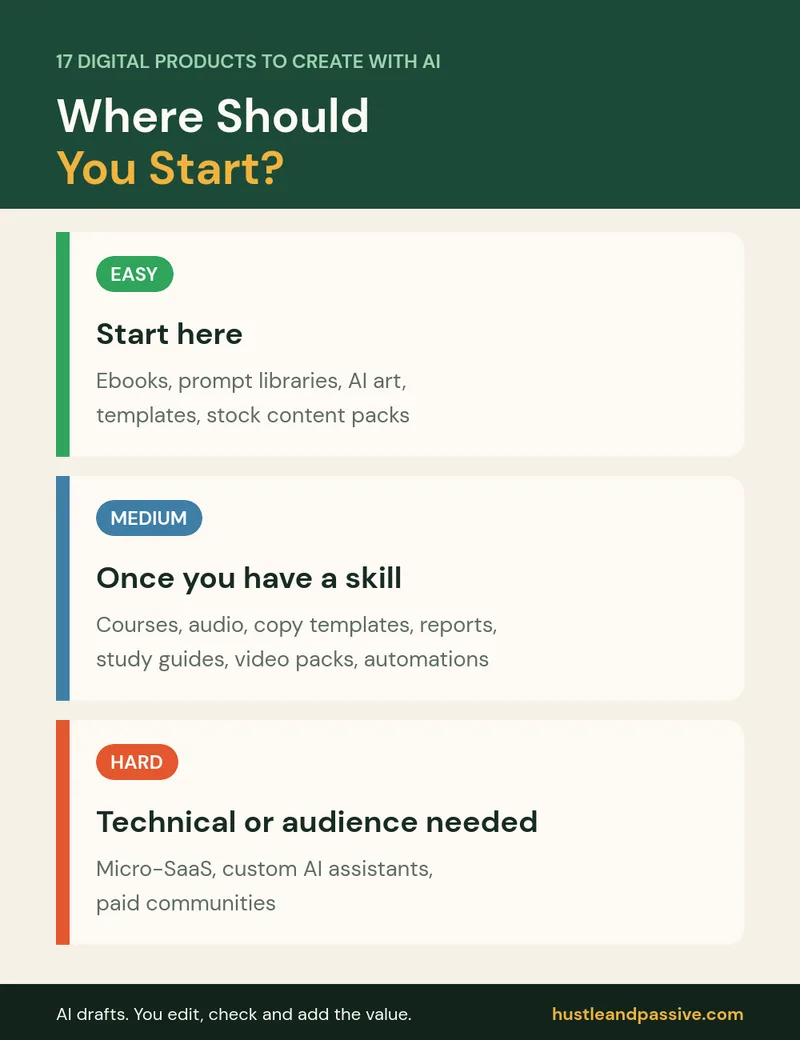
With 17 options, analysis paralysis is real. Here’s the decision framework I use with coaching clients:
If you have $0 budget and 5 hours/week: Start with AI-enhanced ebooks or prompt libraries. These require no paid tools beyond ChatGPT Plus and can be sold on marketplaces without your own website.
If you have $50/month and 10 hours/week: Move into templates, courses, or audio products. You’ll want basic hosting for your own site and Canva Pro for design assets.
If you have $200/month and 20+ hours/week: Build AI agents, SaaS micro-apps, or consulting packages. This is where the real money lives, but it requires systems thinking and customer support infrastructure.
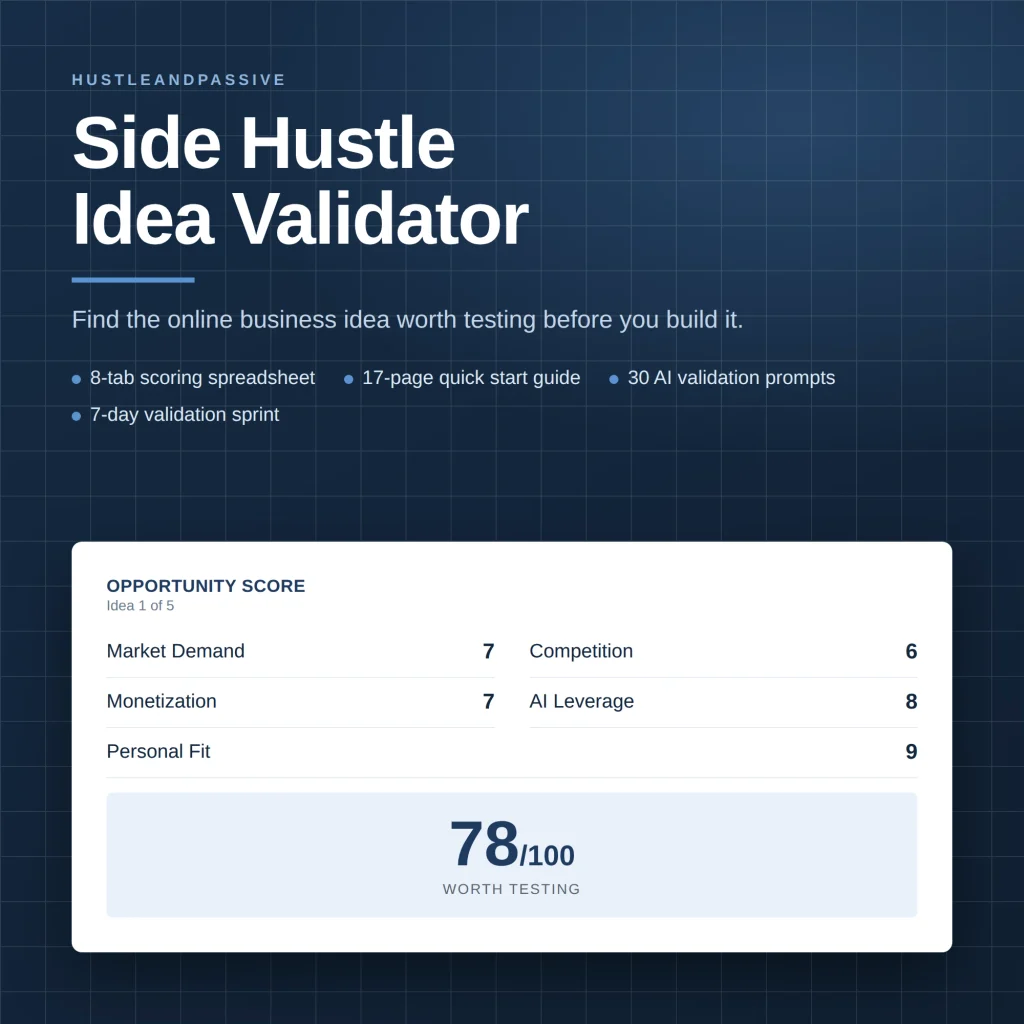
The validation rule I never break: Before investing more than 10 hours into any product, I verify search demand, check Gumroad/Etsy to confirm people are already buying similar items, and pre-sell 3 copies to friends or in niche Facebook groups. If I can’t sell 3 copies manually, AI won’t fix the demand problem.
Your existing skills matter more than the “hottest” product type. Writers should start with ebooks and email templates. Designers should lean into art and templates. Tech-savvy creators should explore agents and SaaS. Match the product to your unfair advantage.
Common Mistakes Beginners Make with AI Digital Products
I’ve made every mistake on this list. Learn from my failures so you don’t repeat them:
Mistake #1: Selling generic AI output without curation. In 2026, buyers expect polish. AI gets you 70% of the way there. The final 30% — editing, formatting, adding your voice — is what separates $37 products from $370 products.
Mistake #2: Ignoring legal and ethical boundaries. Always verify commercial usage rights for AI tools. Midjourney’s basic plan doesn’t include commercial rights for some use cases. ChatGPT outputs can’t be trademarked. When in doubt, disclose your AI usage and consult our AI content legal rights guide.
Mistake #3: Pricing based on creation time, not value. I once sold a 40-hour AI research report for $47 because “it was mostly AI-generated.” Big mistake. Price based on the transformation your customer gets, not your effort input.
Mistake #4: Building before validating. I spent three weeks building an AI meal planner that exactly zero people wanted. Now I pre-sell everything. If people won’t pay for the promise, they won’t pay for the product.
Mistake #5: Trying to sell on your own site immediately. Unless you have an existing audience, start on Gumroad, Etsy, or marketplaces with built-in traffic. Your own site comes later, and when it does, invest in reliable hosting and professional email follow-up systems to nurture buyers toward your next offer.
Mistake #6: Neglecting post-purchase experience. The easiest money you’ll make is from repeat buyers. Include a “what’s next” guide in every product, and set up automated email sequences that nurture customers toward your next offer.
The Future of AI Digital Products
The AI product landscape is changing faster than I can update this article — but the principles remain the same. Start small, validate quickly, and focus on solving real problems with digital products created with AI.
Emerging opportunities I’m personally investing in for 2026:
- Hybrid products that combine AI efficiency with human expertise
- Specialized AI tools for regulated industries
- Products that make AI accessible to non-technical users
- Subscription-based access to continuously updated AI resources
- AI agent workflows that require zero technical setup
Digital products to create with AI that will likely disappear within 12 months:
- Generic content generators without specialized focus
- Basic prompt collections without frameworks or guidance
- Simple AI art products without unique positioning
- Any product claiming to “replace humans” entirely
To future-proof your AI product scalability:
- Focus on solving specific problems for defined audiences
- Build systems and frameworks, not just content
- Continuously incorporate user feedback
- Stay educated on AI developments, but don’t chase every trend
My prediction for the biggest AI product opportunity of 2026? Personalized AI agent systems that can be “trained” on an individual’s or company’s unique data, voice, and requirements — without requiring technical expertise.
FAQ
What’s the easiest digital product to create with AI for beginners?
Custom prompt libraries or Notion templates. They require minimal technical skills, can be created in a weekend, and sell consistently on platforms like Etsy and Gumroad. Start with a problem you personally understand.
How much money can you realistically make with AI digital products?
Most creators earn $500–$2,000 in their first three months. With consistent effort and proper validation, $3,000–$8,000 monthly is realistic within 12 months. My own journey went from $37 to $5,800 monthly over 18 months.
Do I need to know how to code to create AI-powered products?
Not anymore. In 2026, no-code tools like Lovable, Bolt.new, Bubble, and Zapier let you build functional products without writing a single line of code. The barrier to entry has never been lower.
Is it still legal to sell AI-generated content in 2026?
Yes, but transparency matters. Always disclose AI usage in your product descriptions, avoid using specific artist names in prompts, and use only commercial-licensed AI models. See our AI content legal rights guide for the full breakdown.
What’s the best platform to sell AI digital products?
It depends on your product. Etsy works great for templates and art. Gumroad and Payhip are perfect for ebooks and courses. Your own website (I recommend Hostinger for hosting) gives you the most control and highest margins. Read our complete platform guide for detailed comparisons.
How do I price my AI-generated digital products?
Start with impulse-buy pricing ($17–$27) for ebooks and templates. Mid-tier products like courses and toolkits perform well at $97–$197. Premium offerings like consulting packages or AI agent builds can command $500–$2,500.
Conclusion
Creating digital products with AI opens up endless possibilities. Whether you choose to dive into AI-enhanced ebooks, custom prompt libraries, AI agents, or niche communities, the key lies in solving real problems for defined audiences.
To stay ahead, keep exploring emerging opportunities such as personalized AI systems and hybrid products combining AI efficiency with human expertise.
Stay updated with the latest trends and tools by checking out our comprehensive list of best AI tools for 2026. Remember, the most successful digital products combine artificial intelligence efficiency with your unique human perspective.
Which of these 17 profitable AI tools will you create first? Start with the one that matches your skills and interests, validate it with real buyers, and build from there.