Here is the part most “passive income” posts skip: passive income is almost never free money. Someone worked for it, usually a lot, usually before the first dollar came in. So when you compare active vs passive income, the real question isn’t “which one is better”. It’s “when do I pay with time, and when do I pay with money or risk?”
This guide is for you if you have a job or a side hustle and you keep hearing that you should “build passive income”.
I’ll show you the plain difference, give examples of each, explain what the IRS (the US tax agency) actually calls passive, and help you decide what to build first. I haven’t built every example below myself, so I won’t quote my own earnings.
What I did was read three official IRS pages and work out what they mean for active vs passive income in practice.
Some links on hustle&passive may be affiliate links. If you purchase through one of these links, we may earn a commission at no additional cost to you. Affiliate Disclosure
Last updated: October 2026. Tax rules change, so check the IRS pages linked below before you file anything.
Key Takeaways
- In active vs passive income, active income needs your time every time you earn it. Wages, freelance work and a job you run yourself all stop when you stop.
- Passive income usually needs work or money first, the big catch in active vs passive income. After that it can keep paying with less effort, but it is rarely zero effort.
- The IRS definition of active vs passive income is narrower than the everyday one. Under its rules, wages and self-employment income you work for are not passive, and neither are interest and dividends.
- Rental income is generally passive for tax purposes. The IRS says that holds even if you work on the rental yourself, unless you qualify as a real estate professional.
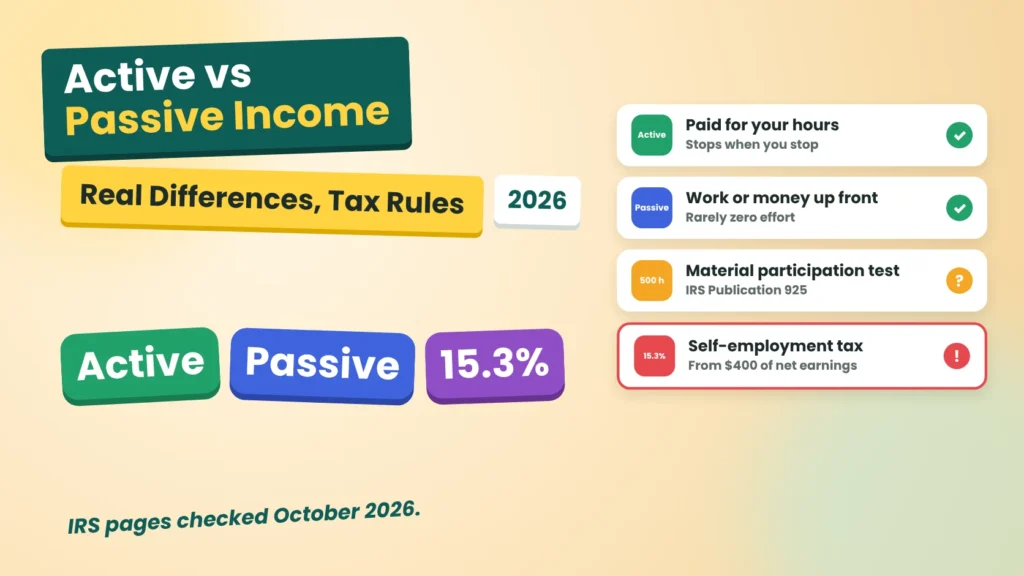
- Self-employment tax is 15.3%. The IRS page lists 12.4% for Social Security and 2.9% for Medicare, and it applies from $400 of net self-employment earnings.
What Is the Difference Between Active and Passive Income?
Active income is money you earn by doing the work, and it stops when you stop. Passive income is money that keeps coming in with little ongoing effort after the setup is done. That’s the everyday meaning, and it’s the one most people use when they compare active vs passive income.
| Active income | Passive income | |
|---|---|---|
| Time needed | Ongoing, hour by hour | Heavy at the start, lighter later |
| Stops if you stop? | Yes, right away | Not right away, but it can fade |
| Main cost | Your time | Time or money up front, plus risk |
| Speed to first dollar | Fast | Often slow |
| Examples | Salary, freelancing, tutoring | Rent, dividends, a blog, a digital product |
My read on active vs passive income: neither one is the grown-up choice. Active income pays the bills now. Passive income is a slow build that, if it works, buys back some of your time later. Most people need both for a while.
What Counts as Active Income?
In active vs passive income terms, active income is anything you’re paid for working, including your wages, tips and the profit from a business you run day to day. Some examples:
- A job. Salary or hourly pay. You get paid for the hours you give.
- Freelancing. Writing, design, bookkeeping or virtual assistant work. Each client is another stretch of hours.
- Gig work. Delivery, rides or one-off shifts. My guide to side hustles that pay daily lists the quick ones.
- Tutoring or coaching. One hour sold is one hour gone.
- A business where you do the work. If the shop closes when you take a week off, that income is still active.
The catch in active vs passive income: active income has a ceiling, because there are only so many hours in a week. That’s exactly why people look for the other kind.
What Counts as Passive Income?
In everyday use, passive income is money that arrives without you working on it each time. Some examples for the active vs passive income comparison, each with its honest catch:
- Rental property. Rent keeps arriving, but you still deal with repairs, tenants and vacancies, or you pay someone to.
- Dividends and interest. They arrive with no work, but you need money invested first, and the amount can go down as well as up.
- A blog or niche website. Traffic can pay you through ads or affiliate links for years, but the build takes months of writing before it earns much. My niche blog guide shows the steps, and if you start one you will need hosting. I run this site on Hostinger, so that is the host I would point you to.

Skip the marketplace cut entirely. Hostinger runs everything from landing pages to checkout, fast enough to handle a launch spike without falling over.
- Digital products. You make a template, guide or course once and sell it many times. You still have to market it. My list of digital product ideas is a good place to start.
- Apps that pay you. Cash-back and reward apps can add a little, but it’s small money. See my guide to passive income apps for what it realistically adds up to.
Here is an illustration (an example, not a promise). Say a guide takes you 40 hours to write and design, and then sells with almost no extra work. That’s one big block of active work that turns into something passive. The hours didn’t disappear, they moved to the front.
That’s the pattern behind almost every real passive income stream, and it’s the heart of active vs passive income. If you want the full beginner version, my guide to making passive income goes deeper.
What Does the IRS Call Passive Income?
The tax definition of active vs passive income is stricter than the everyday one, and it surprises people. According to IRS Topic 425, passive activities include trade or business activities where you don’t materially participate, plus rental activities. The same page says rental real estate is generally passive even if you do take part in running it, unless you qualify as a real estate professional.
IRS Publication 925 goes further and lists what is not passive:
- Personal service income: salaries, wages, commissions, and self-employment income from a business in which you materially participated.
- Portfolio income: interest, dividends, annuities and royalties not earned in the ordinary course of a trade or business.
So here’s the twist. In everyday talk, dividends feel passive. For the specific IRS passive activity rules, they’re listed as portfolio income, not passive activity income. I’m not a tax professional, and this matters mostly if you have rental losses, so check your own case with one.
What does “materially participate” mean? Publication 925 gives seven tests. The first is simple: you took part for more than 500 hours during the year. Another: you took part for more than 100 hours and at least as much as anyone else involved. Meeting any one of the seven counts.
How Does Tax Differ for Active vs Passive Income?
Active vs passive income is treated differently in a few specific ways. I’ll stick to what the IRS pages state.
Self-employment tax. If you work for yourself, you pay it on top of regular income tax. The IRS self-employment tax page gives a rate of 15.3%, made of 12.4% for Social Security and 2.9% for Medicare. You must pay it and file Schedule SE once your net self-employment earnings reach $400. That page doesn’t say whether rental income or dividends are subject to it, so I won’t guess.
Passive losses. Under Topic 425, passive activity losses that exceed passive activity income are disallowed for the current year, but they can be carried forward to the next year. In other words, a rental that loses money on paper can’t always be deducted against your salary.
The rental allowance. Publication 925 describes a special allowance of up to $25,000 of rental loss against non-passive income if you actively participate. It requires owning at least 10% of the activity. The allowance shrinks by 50% of modified adjusted gross income above $100,000, and is generally unavailable at $150,000 or more.
My advice: if you freelance, set money aside for the 15.3% from the first payment, not from tax season. My guide to financial planning for gig workers shows a simple way to do it. And if you want a tool to send invoices and track expenses for your freelance income, FreshBooks is one option I’d look at.

Spend less time managing invoices and expenses and more time growing your online business. Try FreshBooks and streamline your accounting today.
Active vs Passive Income: Which Should You Build First?
Build active income first, then turn part of it into passive income. That’s my honest answer on active vs passive income for most people. Passive streams need either time or capital to get started, and active income is where both usually come from.
| Your situation | Start with | Why |
|---|---|---|
| You need cash this month | Active (gig, freelance, extra hours) | It pays fastest |
| You have a job and 5 to 10 spare hours | Active side hustle with a path to passive | Turns hours into something reusable |
| You have savings to invest | Passive, with care | Money does the work, but it can lose value |
| You have time but no money | A site or digital product | Costs hours, not cash |
If you’re still choosing what to build, my side hustles guide compares options, and my guide to extra income while working full-time covers fitting it around a job. You can also score an idea before you spend weeks on it with my Side Hustle Idea Validator, or grab the free 50 AI side hustle ideas list for more to compare.
My Side Hustle Idea Validator ($9) scores each idea on demand, competition, startup cost and personal fit, so you build the one with the best odds first.

How Do You Move From Active to Passive Income?
You don’t switch between active vs passive income, you convert. Here is the order I’d follow.
- Start with income you can earn now. A freelance skill or a few gigs. This funds the rest.
- Spot what you repeat. The thing you explain to every client is a guide waiting to happen.
- Package it once. A template, checklist or short course.
- Pick one channel. Search traffic, a newsletter or one marketplace. Not five.
- Track hours and income. If it takes 40 hours and earns $20 a month, you’ll know in a month, not a year.
- Reinvest. Put part of the active income toward the passive project.
- Keep the active income going. Don’t quit until the passive side covers a real share of your costs.
Don’t treat any of it as guaranteed. Results from active vs passive income plans vary a lot, and many passive projects earn little.
What Mistakes Should You Avoid?
The common ones when comparing active vs passive income are quitting too early, expecting speed and ignoring tax. Here is what I’d watch for.
- Believing “passive” means “no work”. It means the work comes first.
- Quitting your job for an unproven stream. Test it on the side.
- Chasing five streams at once. Pick one and give it months.
- Ignoring the tax rules. Self-employment tax and passive loss limits are real.
- Trusting guaranteed-return pitches. If someone promises steady passive income with no risk, walk away.
FAQ
What is the difference between active and passive income?
Active income comes from work you do continuously, like wages or freelancing, and it stops when you stop. Passive income continues with little ongoing effort after setup, like rent or digital product sales, though it usually needs time or money first.
Is rental income passive income?
For tax purposes, the IRS says rental activities are generally passive even if you take part in running them, unless you qualify as a real estate professional. In practice, rentals still take work or management fees.
Are dividends passive income?
In everyday language, yes, because they arrive without work. In IRS Publication 925, dividends and interest are listed as portfolio income, which is separate from passive activity income. Check your own tax situation with a professional.
Is active income taxed differently from passive income?
Yes, in some ways. Self-employed active income is subject to self-employment tax of 15.3%, while passive activity losses face limits that can carry forward to later years. The details depend on your situation.
The Bottom Line
The difference between active vs passive income comes down to when you pay: with your hours now, or with hours and money up front for something that may pay later. The honest picture: active income is reliable and capped, passive income is slower and uncertain, and the IRS definition is narrower than most people expect.
My advice on active vs passive income: keep earning actively while you build one passive stream, track your hours, and set tax money aside from the first payment. And if an IRS rule has changed by the time you read this, send me a message through the contact page so I can update the guide.

I write every guide on hustle&passive. I test what I can, and when I have not tried something myself, I say so and cite my sources.