Here is the awkward truth about a computer repair side hustle: nobody publishes an official pay figure for it. The government numbers cover employees at companies, and the Bureau of Labor Statistics (BLS) says its pay data exclude self-employed workers.
So any list that promises a number for a job fixing computers is guessing. What you can know are the field’s numbers, the tax rules and the one trap that catches new repair techs, which is that customers have learned to distrust anyone offering computer help.
This guide is for you if you’re the person friends call when their laptop freezes, and you want to know whether you can make money fixing computers on the side. I haven’t repaired computers professionally myself, so I won’t quote my own earnings.
What I did was read the BLS page for computer support specialists, the Federal Trade Commission (FTC) page on tech support scams, the Small Business Administration (SBA) page on licenses and the IRS rules for self-employed people, then work out what they mean for a few hours a week.
Some links on hustle&passive may be affiliate links. If you purchase through one of these links, we may earn a commission at no additional cost to you. Affiliate Disclosure
Last updated: October 2026. Pay data and rules change, so check each source before you rely on a number.
Key Takeaways
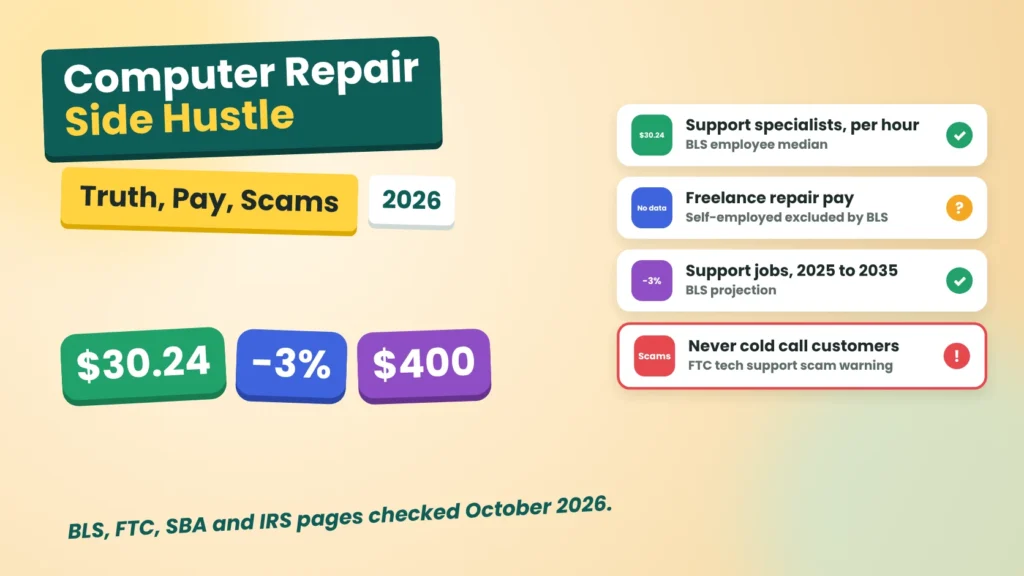
- There is no official pay figure for freelance repair. BLS lists a median of $30.24 an hour for computer support specialists, but says its pay data exclude self-employed workers.
- You may not need a degree. BLS says user support specialists typically need some college courses, and that a high school diploma plus IT certifications can also qualify you.
- The field isn’t growing. BLS projects a 3% decline in computer support jobs from 2025 to 2035, with about 48,700 openings a year from people who leave.
- Trust is the real product. The FTC says legitimate tech companies don’t contact you by phone, email or text about computer problems, so how you find customers matters.
- Taxes apply from your first profits. The IRS says you generally must file a return once net self-employment earnings reach $400.
What Does a Computer Repair Side Hustle Involve?
Mostly diagnosing problems and explaining the fix in plain words. The BLS computer support specialists page describes user support work as diagnosing computer problems, guiding people through solutions, setting up or repairing equipment, installing software and training users. It also says recurring problems get reported to managers, which, for you, means keeping notes on what keeps breaking.
That matches what a side hustle looks like: a slow laptop, a printer that won’t connect, a new router, a virus scare, a family that wants help setting up a new device. My read: the technical part is the easy half. The hard half is being someone a stranger will let near their files.
How Much Does a Job Fixing Computers Pay?
Nobody can say for sure, and here is why. The BLS page lists a median of $62,890 a year, or $30.24 an hour, for computer support specialists in May 2025. It also gives $76,220 for network support specialists and $61,860 for user support specialists.
But those are employees, and the page notes that its pay data exclude self-employed workers. So a freelancer’s rate is your own choice, set by your skills, your area and your customers.
Here is an illustration (an example, not a promise, and not a market rate). Say you work 5 hours a week, which is about 22 hours a month, and charge one of three example rates.
| Example hourly rate | Roughly per month, before taxes and costs |
|---|---|
| $30 (near the BLS employee median) | $650 |
| $50 | $1,080 |
| $75 | $1,620 |
Those are before taxes, software, parts and any time you spend finding customers. If you want a small first target, my guide to making $1,000 fast shows how to plan it.
Do You Need Certifications or a Degree?
Not always, though employers may ask for them. BLS says user support specialists typically need some college courses, network support specialists typically need an associate’s degree, and candidates can also qualify with a high school diploma and relevant IT certifications. It adds that some employers require certifications in the products they use, and that certification programs come from vendors and from vendor-neutral organizations.
That’s for jobs at companies. For your own computer repair side hustle, no source I read says customers require a certificate. But a credential can help you look trustworthy, which matters a lot in this field. I didn’t compare certification costs for this guide, so check what each program charges.
Do You Need a License to Start a Computer Repair Side Hustle?
Maybe, and the rule depends on where you live. The SBA page on licenses and permits says federal licenses apply to regulated industries, that states regulate a broader range of activities and that counties and cities may require their own.
For state rules it points you to your Secretary of State, and for city or county rules to your local government. It also says some licenses expire, so track renewal dates.
I didn’t find a rule that names computer repair specifically, and the page doesn’t mention home-based businesses. So the safe move is a short call to your city or county office before your first paid job. Ask whether a business license is needed for repair work done at a customer’s home or from yours.
How Do You Find Customers for a Computer Repair Side Hustle Without Looking Like a Scammer?
Let them come to you. The FTC’s page on tech support scams says these scams often start with a fake pop-up telling you to call a number, or an unexpected call, text or email from someone posing as a technician.
The scammer asks for remote access, claims to find malware and charges a fee to remove it. The FTC also says legitimate tech companies don’t contact you by phone, email or text about computer problems.
So the customers you want have been warned about exactly the pitch a new repair tech might make. Here is how I’d handle it, as my own opinion:
- Never cold call or cold text. Wait for people to ask you, through friends, neighbors, local groups or a simple listing.
- Don’t ask for remote access first. If a job needs it, only do it when the customer asks and watches.
- Quote the price before you start. A scammer’s fee appears after the “scan”.
- Take normal payment. The FTC lists gift cards, wire transfers, cryptocurrency and payment apps as the methods scammers favor, since they’re hard to recover. A normal invoice looks different.
If you want other places to find work, my guides to Fiverr jobs and where to find virtual assistant clients show how marketplaces and client searches work, and Instawork covers shift-based gigs if you’d rather not run your own listing.
What Taxes Apply to a Computer Repair Side Hustle?
The same ones as any self-employed work. The IRS self-employed tax center says you generally have to file a return once net self-employment earnings reach $400, and that you subtract business expenses from business income to find your net profit. The IRS self-employment tax page lists a rate of 15.3%, covering Social Security and Medicare, on top of regular income tax.
So keep every receipt for tools, software and parts. My guide to financial planning for gig workers shows how to set money aside as you earn.
Is a Computer Repair Side Hustle Still Worth Starting?
It can be, for the right person, but don’t expect a growing market. BLS projects employment of computer support specialists to fall 3% from 2025 to 2035, a loss of 24,300 jobs from 903,100. It also projects about 48,700 openings a year, all from workers who change jobs or leave the workforce. So the field is steady, not booming.
I haven’t found an official source on how many people pay for freelance repair, or on how much, so I can’t tell you whether demand in your town is strong. That’s why I’d test small before spending anything. Help three people for a modest fee, ask what they’d pay again for, and decide from that.
How Do You Start a Computer Repair Side Hustle?
Start small and keep it local. Here is the order I’d follow.
- List what you can fix today. Slow computers, printers, Wi-Fi, software setup. Don’t promise what you can’t do.
- Check your city or county rules. Ask about licenses before the first paid job.
- Set a price. Pick a rate or a flat fee for common jobs, and write it down.
- Find your first three customers through people you know. Skip cold outreach.
- Write a short receipt for every job. It protects both of you and helps at tax time.
- Track income and costs every week. You’ll need it for the IRS.
- Review after a month. Keep the jobs you enjoyed and that paid well.
Not sure repair beats other side income for your hours? My Side Hustle Idea Validator lets you score an idea on demand, competition and startup cost, and the free 50 AI side hustle ideas list gives you more to compare.
My Side Hustle Idea Validator ($9) scores each idea on demand, competition, startup cost and personal fit, so you build the one with the best odds first.

Who Should Skip a Computer Repair Side Hustle?
Based on what I read, a computer repair side hustle fits you if you:
- Already fix computers for friends and enjoy it.
- Can explain technical problems in plain language.
- Are comfortable handling customers’ private files with care.
Skip it, or choose another idea, if you:
- Need money within days. Building trust takes time.
- Don’t want to handle customer complaints or warranty questions.
- Are hoping for a quick, guaranteed income.
If you’d rather compare more options, see my side hustles guide and my list of side hustles that pay daily.
What Are the Risks and Mistakes to Avoid?
The main risks are lost trust, hidden rules and tax surprises. Here are the mistakes I’d watch for.
- Looking like a scammer. Cold calls, pop-ups and surprise fees match what the FTC warns about.
- Touching private data carelessly. You’ll see personal files, so don’t copy, keep or share anything.
- Skipping local rules. A short call to your city or county office is cheap.
- Quoting a price after the work starts. Agree on it first.
- Ignoring taxes. Net earnings of $400 trigger a filing requirement.
FAQ
Is computer repair a good side hustle?
It can be if you already have the skills and people ask you for help. No official source gives a pay figure for freelance repair, so test a few jobs before you invest in tools or ads.
How much can you make fixing computers on the side?
For a computer repair side hustle, it depends on your rate and hours. BLS lists a median of $30.24 an hour for computer support specialists, but those are employees, and BLS pay data exclude self-employed workers.
Do you need a certification to fix computers?
Not always. BLS says user support specialists typically need some college courses, and that a high school diploma plus IT certifications can also qualify you. Some employers require certifications in the products they use.
How do you avoid looking like a tech support scammer?
Don’t cold call, don’t ask for remote access first and agree on the price before you start. The FTC says legitimate tech companies don’t contact you by phone, email or text about computer problems.
For the wider view, see my guide to the best gig economy jobs that pay instantly.
The Bottom Line
A computer repair side hustle can add useful money if people already ask you for help, but no source I read gives a freelance pay figure. The honest picture: the skills are the easy part, trust is the hard part and the field isn’t growing.
My advice: help a few people you know, set your price before each job and never cold call. And if BLS data or any rule has changed by the time you read this, send me a message through the contact page so I can update the guide.

I write every guide on hustle&passive. I test what I can, and when I have not tried something myself, I say so and cite my sources.