This is general information, not financial or tax advice. I’m not an accountant, and gig-work tax rules vary considerably by country and by state. Get an hour with a professional before making decisions that matter.
Financial planning for gig workers starts with an uncomfortable fact: the hardest part of gig work isn’t earning the money. It’s that nobody is doing the invisible administration an employer used to do for you.
An employer withholds your tax before you ever see the money, contributes to a pension, provides insurance, and smooths a full year of income into twelve identical payments. Take all of that away and the same annual earnings feel completely different: some months are excellent, some are frightening, and the tax bill arrives as a lump sum when you’d already spent the money.
None of this is hard, exactly. It’s just that no one hands you the checklist. So this is the checklist: the thresholds that actually apply, the accounts worth opening, and the specific things that catch gig workers out in year one.
US rules throughout, since that’s where most readers are. The structure applies anywhere; the numbers don’t.
TL;DR
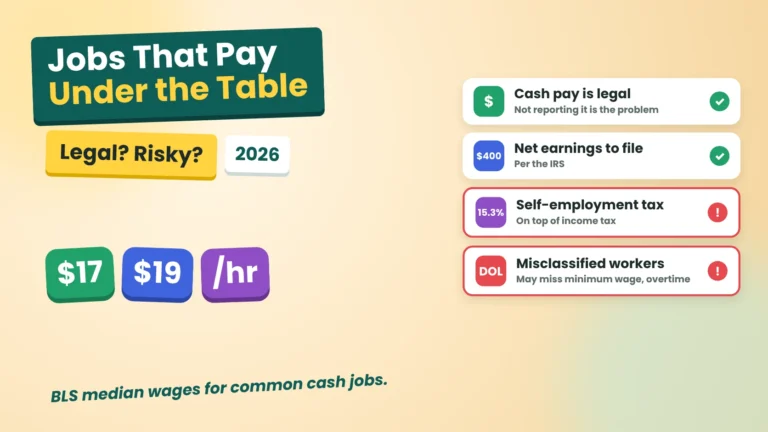
- Self-employment tax is 15.3% (12.4% Social Security, 2.9% Medicare), and it kicks in at just $400 of net self-employment earnings, per the IRS.
- Set aside 25–30% of every payout the day it lands. Not at year end, not when you remember. The day it lands.
- You likely owe quarterly estimated taxes if you expect to owe $1,000 or more for the year. Missing them means penalties even if you pay in full in April.
- The safe harbour rule protects you: pay 100% of last year’s tax liability across the four quarters and you generally avoid an underpayment penalty, whatever this year turns out to be.
- Gig workers need a bigger emergency fund than employees. Six months, not three, because your income can halve without you being fired.
Why gig income breaks normal financial advice
Standard personal finance assumes a predictable monthly number. Almost every rule you’ve read (the 50/30/20 split, “spend less than you earn,” automatic transfers on payday) quietly depends on that assumption. Gig income has no payday and no fixed number, so the rules need rebuilding around variability rather than around a budget.
Three things change specifically.
Your income has a floor and a ceiling, not an average. Planning around your average month means overspending in bad months. Plan around your realistic worst month instead, and treat everything above it as surplus to be allocated deliberately.
Nobody withholds your tax. This is the single biggest trap and it catches nearly everyone once. A $4,000 month is not $4,000. It’s roughly $2,800 after tax and self-employment tax, and the difference is not yours to spend. This applies to cash-paid work too, as explained in our guide to cash jobs and the tax rules that still apply.
There’s no employer match, no pension, no sick pay. Every one of those is now a line item you fund yourself, or a risk you carry uninsured.
How to budget on irregular income
Forget percentage-based budgeting. It assumes a stable denominator you don’t have.
Step 1: Find your real floor. Look back over the last 6 to 12 months of income and find your lowest month, not your average. That’s your planning number.
Step 2: Build the budget on the floor. Rent, utilities, food, insurance, minimum debt payments. If your fixed costs exceed your worst month, that’s the actual problem, and it’s a cost problem or an income problem rather than a budgeting one.
Step 3: Run a one-month buffer. This is the change that makes everything else work. Instead of spending this month’s income this month, hold it and spend it next month. You pay September’s bills with August’s earnings. Suddenly your income is fixed and known, because it already happened.
Getting to that buffer takes a good month or two of discipline, and it’s the highest-value thing on this list. Once you’re a month ahead, irregular income stops feeling irregular.
Step 4: Give surplus a job before it arrives. Decide the split for anything above your floor while you’re calm rather than while you’re holding it. A workable default: tax reserve first, then emergency fund until it’s full, then long-term savings, then the rest. The automatic saving system covers how to make that happen without relying on willpower each month.
Self-employment tax: the number that surprises people
Here’s the part employed people never see.
As an employee, you and your employer split Social Security and Medicare between you. Self-employed, you pay both halves. The IRS sets self-employment tax at 15.3%: 12.4% for Social Security and 2.9% for Medicare, with an additional 0.9% Medicare surcharge above $200,000 single / $250,000 married filing jointly.
That’s on top of ordinary income tax.
Two details worth knowing:
The threshold is $400. Net self-employment earnings of $400 or more triggers a filing requirement. That’s a weekend of delivery driving, and the same applies to Amazon Flex drivers, who are independent contractors too. There’s no “it’s just a side hustle” exemption.
Half of it is deductible. You can deduct the employer-equivalent portion when calculating adjusted gross income. It reduces your taxable income, though it doesn’t reduce the self-employment tax itself.
What to actually do: set aside 25–30% of every payment, in a separate account, the day it arrives. Higher if you’re in a state with income tax or earning above the basic bracket. Money that isn’t in your spending account doesn’t get spent, and this one habit prevents most first-year disasters.
Quarterly estimated taxes
Employees pay tax continuously through withholding. Self-employed people are expected to do the same thing manually, four times a year.
The IRS requires estimated tax payments if you expect to owe $1,000 or more after withholding and credits. For most people earning meaningfully from gig work, that’s a yes.
The rule that makes this manageable is the safe harbour. You generally avoid an underpayment penalty if you either:
- pay at least 90% of the current year’s tax, or
- pay 100% of the prior year’s tax, whichever is smaller
The second one is the useful version, because last year’s number is a fact and this year’s is a guess. Take last year’s total tax, divide by four, pay that each quarter, and you’re protected regardless of how this year goes.
If your income is genuinely lumpy (a huge Q4, nothing in Q1) the IRS allows annualising your income and making unequal payments via Form 2210, so you’re not penalised for a quarter you didn’t earn in.
Missing quarterly payments and settling the whole bill in April still incurs a penalty. That surprises people every year.
Retirement, without an employer
This is where gig workers most often do nothing, because there’s no default and no HR department to nudge you.
The options, roughly in order of who they suit:
Roth or Traditional IRA. Simplest entry point. Lower contribution limit, available to anyone with earned income, and the Roth version is particularly well suited to gig workers in lower-income years, since you pay tax now at a low rate rather than later.
SEP IRA. Higher limits, minimal paperwork, contributions based on a percentage of net earnings. Good for someone earning well from self-employment who wants simplicity.
Solo 401(k). The highest-capacity option for someone with no employees. The IRS describes it as a one-participant plan covering a business owner with no common-law employees, or that person and their spouse, and you contribute in two capacities: as employee (elective deferrals up to the annual limit) and as employer (up to 25% of compensation, using the special computation in Publication 560 if you’re self-employed).
The one catch: if you also participate in an employer’s 401(k) at a day job, the elective deferral limit applies across all plans combined, not per plan. That trips up people running a side hustle alongside employment.
Contribution limits change annually, so check the current figures on the IRS pages rather than trusting a number in any article, including this one.
The practical advice: open something, contribute a small percentage automatically, and increase it when a good month happens. The gap between “no retirement account” and “an IRA with $50/month going in” is far larger than the gap between an IRA and a Solo 401(k).
Health, insurance and the risks you now carry alone
Employment bundles risk protection you don’t notice until it’s gone.
Health insurance is the big one in the US, and marketplace subsidies are based on projected annual income, which is exactly the number a gig worker can’t predict. Estimate conservatively and update the marketplace when your income changes, because a large underestimate creates a reconciliation bill at tax time.
Disability insurance is the one gig workers most often skip and most need. Your income depends entirely on your ability to work. Break a wrist as a delivery driver and there’s no sick pay. Individual disability cover is not cheap, and it is the correct answer to “what’s the one insurance I should look at.”
Liability cover matters if you’re doing anything in someone’s home or driving commercially. Personal auto insurance often excludes commercial use, which is a discovery nobody wants to make after an accident.
If you deliver food or drive for apps, our guide to driving for Uber Eats explains the requirements and costs you should plan for.
Building credit and getting a loan without payslips
Lenders are built around W-2s. Without one, expect to be asked for two years of tax returns rather than three months of payslips.
What helps, in rough order:
- File properly and show the income. Aggressive deduction of every possible expense lowers your tax bill and lowers the income a lender sees. There’s a real trade-off there, and it matters in the two years before a mortgage application.
- Keep business and personal accounts separate. It makes your finances legible to an underwriter and to yourself.
- Keep credit utilisation low and payment history clean. This matters more when income is harder to verify.
- Build a relationship with one bank rather than spreading across five apps.
Financial planning for gig workers: the systems worth setting up
You need less software than you think, and the free tiers cover it. What matters is that the money moves without you deciding each time.
Four accounts, minimum:
- Income account: everything lands here, nothing is spent from here
- Tax reserve: 25–30% transferred the day money arrives
- Spending account: one month’s budgeted amount, moved once a month
- Emergency fund: separate, boring, and slightly annoying to access
That structure does most of the work, and a simple spreadsheet or your bank’s budgeting app is enough to track it.
The bigger problem: gig income doesn’t compound
Everything above manages the money. None of it fixes the structural issue, which is that gig platform work has no rate progression and stops the moment you stop.
The financial plan that actually changes a gig worker’s position has two halves: manage the irregular income well, and build one thing that earns without an hourly. That second half is slow and it’s the part that gets postponed indefinitely, usually because the first half is stressful enough.
If you’re at the point where the budgeting is under control and you want to start the other half, the 32 ways to make money online is sorted by exactly that distinction, and the guide to passive income for beginners covers what building an asset actually involves.
Most of those routes need somewhere of your own to publish. Hosting and a domain run a few dollars a month. Hostinger’s Premium plan is $2.99/month promotionally, $10.99 on renewal, with a free domain for the first year.

Launch Your Website Today Without Breaking the Bank
Get fast, secure, and beginner-friendly hosting with Hostinger. Set up your website in minutes and start building your online business today.
👉 Set up a domain and hosting with Hostinger when you’re ready to start the second half.
If you’re still stabilising the first half, ignore that and come back to it. The tax reserve matters more this month than a website does.
FAQ
How much should gig workers set aside for taxes? Between 25% and 30% of every payment, transferred to a separate account the day it arrives. Self-employment tax alone is 15.3% per the IRS, and ordinary income tax sits on top of that. Higher earners and those in states with income tax should budget above 30%.
Do I have to pay taxes on gig work under $600? Yes. The $600 figure is the threshold for a platform issuing you a 1099, not the threshold for owing tax. The IRS requires you to file and pay self-employment tax once net self-employment earnings reach $400, whether or not any form was issued.
Do gig workers need to pay quarterly taxes? If you expect to owe $1,000 or more for the year, yes. Paying the full amount in April instead still incurs an underpayment penalty. The simplest protection is the safe harbour: pay 100% of last year’s total tax across the four quarters.
What’s the best retirement account for a gig worker? A Roth IRA for most people starting out, because it’s simple and suits lower-income years. A SEP IRA or Solo 401(k) once earnings are higher, since both allow much larger contributions. The Solo 401(k) has the highest capacity if you have no employees.
How big should a gig worker’s emergency fund be? Six months of essential expenses rather than the standard three. Employed people generally lose income in one discrete event; gig income can halve gradually without anything identifiable happening, and it can stay halved for a season.
More guides in this series:
Where to start this week
If you do nothing else from this guide to financial planning for gig workers, do these two things.
Open a separate savings account today and move 25% of your next payment into it. Then work out last year’s total tax, divide by four, and diarise the quarterly dates.
That covers the two failures that do the most damage in a gig worker’s first year. The buffer, the retirement account and the insurance can follow next month.

Writes and tests every guide on hustle&passive. Everything here is something we have actually run — including the parts that did not work.