Disclosure: some links in this guide are affiliate links, so I may earn a commission if you buy through them, at no extra cost to you. Last updated: October 2026.
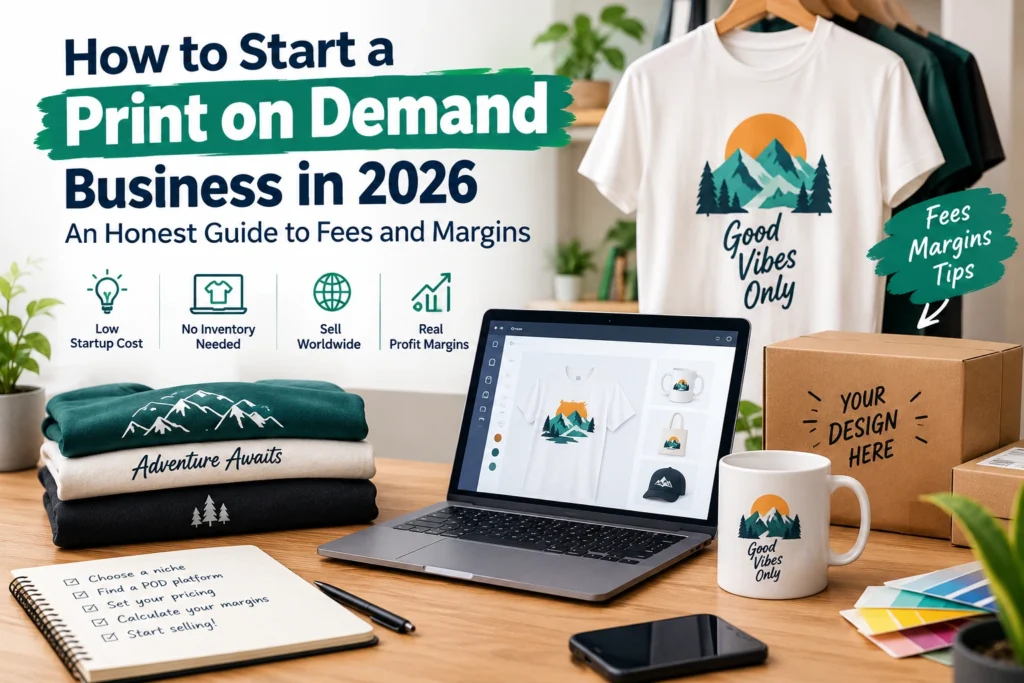
A print on demand business lets you sell t-shirts, mugs, posters and other products with your designs without buying stock, printing anything or packing a single box. A print partner makes each item after a customer orders it and ships it for you. That’s the appeal. The part most guides skip is the math: on a typical $25 t-shirt, you keep around $5 to $6.
This guide shows you how to start a print on demand business with real numbers: what each platform charges, what you keep per sale, the Etsy rules you have to follow, where AI designs are allowed, and a realistic first 90 days. Costs come from Printful, Printify, Redbubble, Etsy and Shopify’s own pages.
Key Takeaways
- You design, a partner prints and ships. There’s no inventory, but you also have no control over production costs, which set your margin.
- Expect about $3 to $8 profit per t-shirt. Printful’s own May 2026 breakdown puts a $25 Bella + Canvas tee sold on Etsy at $5.73 net.
- You can start for about $5 (Etsy listing fees) with a free Printful or Printify account, but ordering samples (about $16 per tee) is worth the money.
- AI designs are allowed on Etsy if they come from your own prompts and you disclose it, but trademarks and artist names in prompts are not.
- Niche beats volume. Designs for a specific group of buyers sell better than generic “funny” shirts competing with thousands of others.
What Is a Print on Demand Business?
In a print on demand business, you upload designs to products in a print partner’s catalog, list those products in a store, and set your own retail price. When a customer orders, the partner prints the item, packs it and ships it under your shop name. You pay the partner’s base cost only after the sale, and your profit is whatever is left after that cost, shipping and platform fees.
A print on demand side hustle works because the time goes into designs, listings and marketing, not into packing orders. It is not passive at the start, though. A new print on demand business usually needs dozens of listings and a few months of testing before sales become regular.
What You Actually Keep per Sale
Here’s a real example from Printful’s May 2026 cost breakdown for a size M Bella + Canvas 3001 t-shirt sold on Etsy for $25, with the seller covering US shipping.
| Line | Amount |
|---|---|
| Retail price | $25.00 |
| Printful production cost | −$11.69 |
| US shipping (first item) | −$4.75 |
| Etsy listing fee | −$0.20 |
| Etsy transaction fee (6.5%) | −$1.63 |
| Etsy payment processing (3% + $0.25) | −$1.00 |
| What you keep | $5.73 (about 23%) |
In the same breakdown, a Gildan 5000 tee at $20 left $3.65 and a Comfort Colors 1717 at $30 left $6.66, while an organic Stanley/Stella tee at $30 left only $0.85. The lesson: a premium blank needs a premium price, and a cheap price leaves almost nothing to spend on ads or discounts.
There are only three ways to raise that margin: charge more (a niche design supports a higher price), lower production cost (a paid plan with product discounts, once you have volume), or sell on your own store to avoid marketplace fees. Want to test your own numbers? Our side hustle income calculator shows how many sales a month you’d need to hit a target.
Print on Demand Platforms Compared
Every print on demand business needs two pieces: a print partner that makes the products and a place to sell them. Some platforms, like Redbubble and Amazon Merch on Demand, combine both.
| Platform | Type | Cost to start | Paid option | Best for |
|---|---|---|---|---|
| Printful | Print partner | Free plan | Growth $24.99/mo (free at $12,000 yearly sales): up to 33% off products | Consistent quality and branding |
| Printify | Print partner | Free plan (up to 5 stores) | Premium $39/mo or $24.99/mo yearly: up to 20% off all products | Lower base costs, many print providers |
| Etsy | Marketplace | $0.20 per listing | Fees on each sale: 6.5% + 3% + $0.25 (US) | Buyers already searching for gifts |
| Shopify | Your own store | 3 days free, then $1/mo for 3 months | Basic $39/mo ($29 yearly), 2.9% + 30¢ card rate | Building a brand you own |
| Redbubble | All-in-one marketplace | Free | Your markup (10% default), minus a platform fee by tier | Uploading art with zero setup |
| Amazon Merch on Demand | All-in-one marketplace | Free, approval needed | Royalties set by Amazon per product and price | Huge audience, if accepted |
Printful or Printify? Printful makes most products in its own facilities, which keeps quality consistent. Printify connects you to a network of independent print providers, so base costs are often lower but quality varies by provider. Both have free plans and both connect to Etsy and Shopify, so many sellers order samples from each and decide from the actual products.
Redbubble’s fee trap: your earnings are your markup on the base price, and Standard accounts pay a platform fee of 50% of monthly earnings, Premium accounts 20% and Pro accounts nothing, according to Redbubble’s help center. Redbubble caps total account fees at $150 per payment period, but at a 10% markup on a Standard account the fee takes half of an already small margin.
Amazon Merch on Demand gives you access to Amazon shoppers, but you have to apply and be accepted, new accounts can only upload a limited number of designs at first, and Amazon sets the royalty for each product and price. Treat it as a second channel rather than your whole plan.
How to Start a Print on Demand Business in 7 Steps
1. Pick a niche, not a product
“T-shirts” isn’t a niche. “Shirts for night-shift nurses”, “mugs for retired teachers” or “posters for bouldering gyms” are. A niche gives you a buyer you can picture, inside jokes and words they use, and search terms with less competition. Good niches share three traits: people identify strongly with them, they buy gifts for each other, and you understand them well enough to design for them.
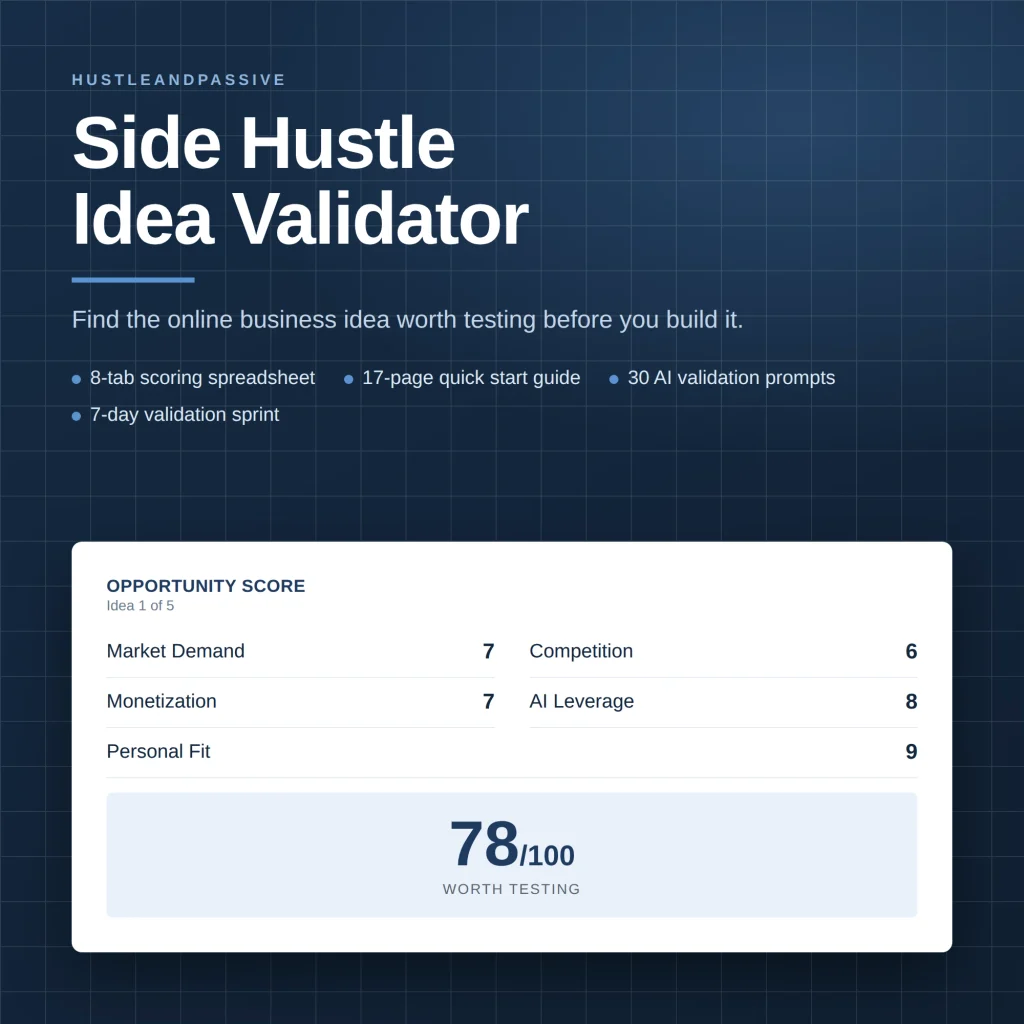
Our Side Hustle Idea Validator ($9) is a spreadsheet that scores each idea on eight weighted criteria out of 100, so you commit to the strongest one before designing a single product.
2. Check demand with keyword research
Before designing, check what buyers actually type. Start free with Etsy’s search bar suggestions and the “people also search” terms, then look at how many listings each phrase has. If you want search volume and competition scores for Google as well, Keysearch starts at $24 a month, enough to research a few niches in one month and cancel.

Find Keywords That Actually Rank
Stop guessing what to write. KeySearch helps you discover low-competition keywords, analyze competitors, and create SEO content that drives long-term organic traffic.
3. Check every phrase for trademarks
This is the step that closes print on demand shops. Search every slogan and name you plan to use in the USPTO’s free Trademark Search before listing it. Brand names, sports teams, film quotes, song lyrics and famous characters are off limits, and Etsy removes listings that infringe and can suspend repeat offenders under its intellectual property policy.
4. Create your designs
Simple designs sell well in print on demand: a clear phrase, one strong illustration, readable from a distance. Free tools like Canva or Printful’s Design Maker are enough to start. Aim for 10 to 20 designs in one niche before judging results, since a few listings rarely get enough views to tell you anything.
5. Order samples
Order your best two or three products to your own address before listing them. At Printful’s rates, a Bella + Canvas tee sample costs about $16.44 with US shipping ($11.69 plus $4.75), and Printful Growth members get 25% off samples. Samples show you print quality, sizing and color accuracy, and they give you real photos for your listings, which usually convert better than mockups alone.
6. Open your store and list your products
Most beginners start on Etsy because buyers are already searching there, and the only upfront cost is $0.20 per listing. Connect Printful or Printify to your shop, and each order goes to the print partner automatically. Write titles and tags around the phrases from step 2, and use all the photo slots, mixing mockups with your sample photos.
Once some designs sell, a second channel makes sense. A Shopify store costs 3 days free, then $1 a month for 3 months, then $39 a month ($29 billed yearly), and you skip Etsy’s listing and transaction fees (card processing still applies), though you have to bring your own traffic. Our guide to starting an e-commerce store from scratch walks through the setup.
Start Your Online Store with Shopify
Turn your idea into a profitable online business with Shopify. Create a professional store, sell digital or physical products, manage payments, and grow your brand with powerful e-commerce tools trusted by millions of entrepreneurs.
7. Market consistently
Pinterest is a natural fit for print on demand because people search it for gift and decor ideas, and every product image can link back to a listing. Add a few pins per design, share in niche communities where self-promotion is allowed, and ask your first buyers for photos. Then watch which designs get views and sales and make variations of the winners.
AI Print on Demand: What’s Allowed and What’s Risky
AI print on demand is where many new sellers start, because image tools make designs fast. The rules depend on where you sell.
- Etsy: designs from your own AI prompts, printed by a partner, fit Etsy’s “designed by a seller” category, and Etsy asks you to disclose AI use in the listing.
- Prompts with brands, characters or artist names: risky everywhere. An AI image of a famous character is still that character, and styles tied to living artists invite takedowns.
- Copyright: in the US, purely AI-generated images generally can’t be registered for copyright, so others may copy your design. Adding your own editing, text and layout helps. Our guide to AI content legal rights explains what you can and can’t own.
- Quality: AI images often have odd hands, garbled text and low resolution. Printful recommends at least 150 DPI at print size, so upscale and clean up images before uploading.
The sellers who do well with AI treat it as a starting point: they generate ideas, redraw or edit the result, add their own text, and design for one niche. For platform-by-platform rules on selling AI work, see where to sell AI-generated products.
Etsy Rules for a Print on Demand Business
Etsy allows print on demand, but you have to describe how your items are made. When you create a listing with a print partner:
- Under “Who made it?”, choose another company or person, not “I did”.
- Add your print partner (for example Printful or Printify) as a production partner and describe their role: you design, they produce and ship.
- Your listing then shows a “Designed by” note for your shop, so buyers know a partner produced the item.
- Disclose AI use if your designs were made with AI tools.
Skipping these steps can get listings removed. For product ideas beyond apparel, see our list of the best products to sell on Etsy.
How Much Does a Print on Demand Business Cost to Start?
| Budget | What it covers | Trade-off |
|---|---|---|
| About $5 | Free Printful or Printify account, free design tool, 25 Etsy listings ($5) | No samples, so you list products you’ve never seen |
| About $22 | 25 Etsy listings ($5) and one sample tee (about $16.44) | You check quality on one product |
| About $80 | 3 samples (about $49), 25 listings ($5) and one month of Keysearch ($24) | Real photos plus proper keyword research |
Note that Etsy charges the $0.20 listing fee when you publish, and each listing lasts four months or until it sells. Keep costs low until you see which designs get views.
A Realistic First 90 Days
| When | Focus | Goal |
|---|---|---|
| Weeks 1–2 | Pick a niche, keyword research, trademark checks | 20 design ideas checked |
| Weeks 3–4 | Create designs, order samples | 10 finished designs, samples ordered |
| Month 2 | List on Etsy, start Pinterest | 20 or more listings live |
| Month 3 | Review views and sales, make variations of what works | First sales and a clear direction |
These are planning targets for a new print on demand business, not promises. Some shops sell in the first week and many take longer. The signal to watch in the first months is views and favorites per listing: designs that get attention and no sales usually need a better price, photo or title, while designs that get no views need better keywords.
How Much Can a Print on Demand Business Make?
What a print on demand business makes depends on volume and margin, so do the math before dreaming big. At about $5.73 per $25 tee, 100 sales a month is about $573 profit, before ads, samples or tools. That’s why many sellers raise their average order value with higher-priced products like hoodies, blankets and wall art, or with bundles.
If you earn more than $400 in net profit in a year in the US, you owe self-employment tax (15.3%), according to the IRS, and you may need to pay estimated taxes quarterly. Etsy collects and remits sales tax on US orders as a marketplace, but on your own Shopify store, sales tax is your responsibility.
Mistakes That Sink New Print on Demand Sellers
- Using trademarked phrases. One takedown is an inconvenience; repeated ones can close your shop.
- Pricing too low. A $19.99 tee with shipping absorbed may leave you under $4, with nothing left for a sale or an ad.
- Skipping samples. Colors, sizing and print placement often differ from the mockup, and bad reviews are expensive.
- Designing for everyone. Generic designs compete with millions of listings; niche designs compete with dozens.
- Giving up after 10 listings. A handful of listings rarely gets enough views to show what works.
- Paying for a plan too early. Printful Growth and Printify Premium only pay off once product discounts are larger than the monthly fee.
Print on Demand Business FAQ
Is a print on demand business still profitable in 2026?
It can be, but margins are thin. Printful’s May 2026 breakdown shows about $3 to $8 profit per t-shirt after production, shipping and Etsy fees, so profit comes from niche designs that justify a higher price and from selling many listings, not from one product.
How do I start a print on demand business with no money?
Open a free Printful or Printify account, create designs in a free tool like Canva, and connect an Etsy shop. The only unavoidable cost is Etsy’s $0.20 listing fee, and your print partner is only paid after a customer orders. Ordering a sample (about $16 for a tee) is the first expense worth making.
Can I use AI designs for print on demand?
Yes on Etsy, as long as the designs come from your own prompts and you disclose AI use. Avoid prompts with brand names, characters or living artists’ names, and edit the result, since purely AI-generated images generally can’t be copyrighted in the US.
Printful or Printify: which is better for beginners?
Both are free to start and connect to Etsy and Shopify. Printful offers more consistent quality from its own facilities, while Printify often has lower base costs through a network of print providers. Ordering samples from both is the most reliable way to decide.
Do I need an LLC to start a print on demand business?
Not usually in the US: you can start as a sole proprietor and report the income on your tax return. Many sellers form an LLC later for liability protection or when income grows. Check your state and local rules, and remember that self-employment tax applies once net profit passes $400 a year.
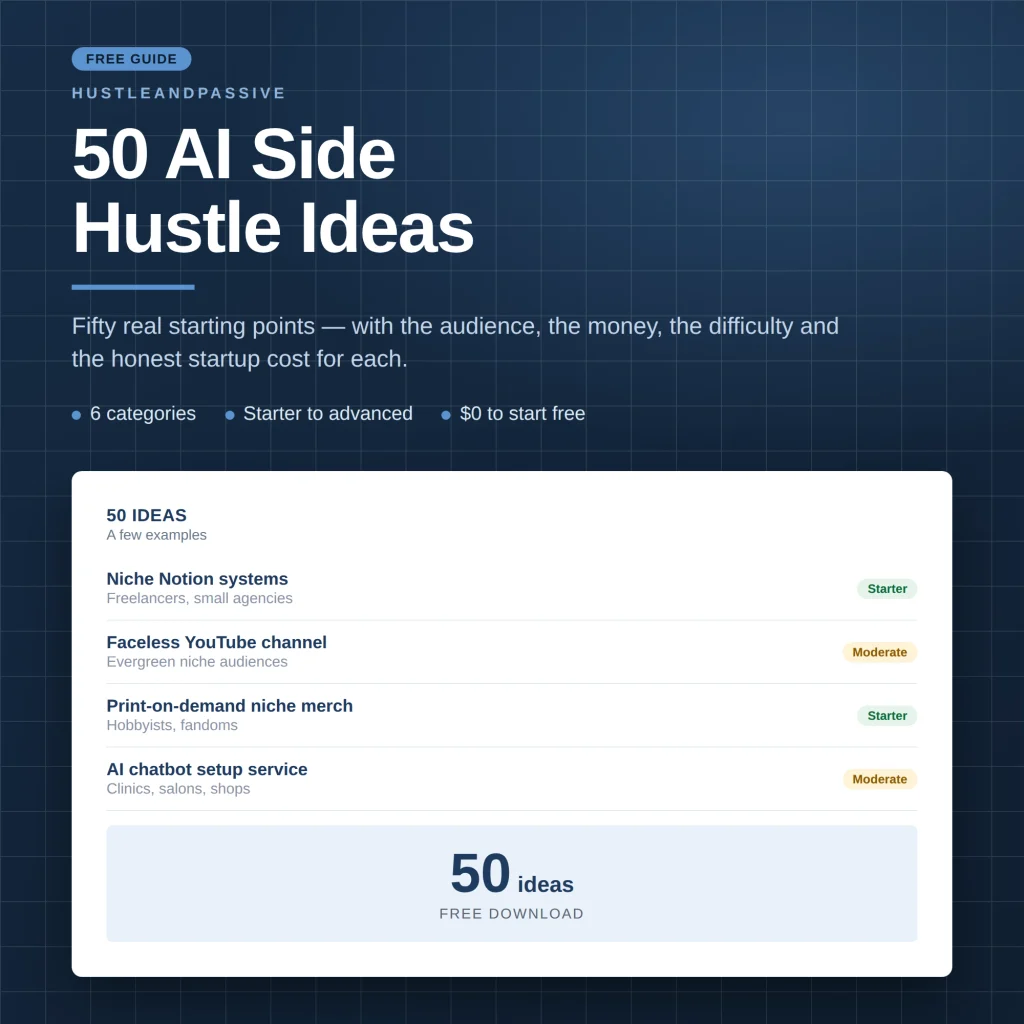
Not sure print on demand is the right fit? The free 50 AI Side Hustle Ideas list gives you fifty other starting points to compare, and our digital product ideas guide covers products with no printing or shipping costs at all.
Start with one asset. The free 50 AI Side Hustle Ideas list gives you fifty to choose from.

Writes and tests every guide on hustle&passive. Everything here is something we have actually run — including the parts that did not work.