Here’s the surprise with side hustle taxes: you can owe tax on income that never came with a form. The IRS says gig income must be reported even if it isn’t on a 1099, and even if it’s paid in cash. So “nobody sent me anything” isn’t a defense.
This guide is for you if you earn money outside a main job in the US and you want the rules in plain English before filing season. I’m not a tax professional, so I won’t tell you what to deduct or file. I read the IRS’s own pages and added a labeled example, and I tell you where I couldn’t read a page.
Some links on hustle&passive may be affiliate links. If you purchase through one of these links, we may earn a commission at no additional cost to you. Affiliate Disclosure
Last updated: October 2026. Tax rules and thresholds change each year, so check the IRS pages or ask a tax professional before you file. This is general information, not tax or legal advice, and it covers US federal rules only.
Key Takeaways
- Report all of it. The IRS says you must report gig economy income on a tax return, even from part-time or side work, and even if no form arrives.
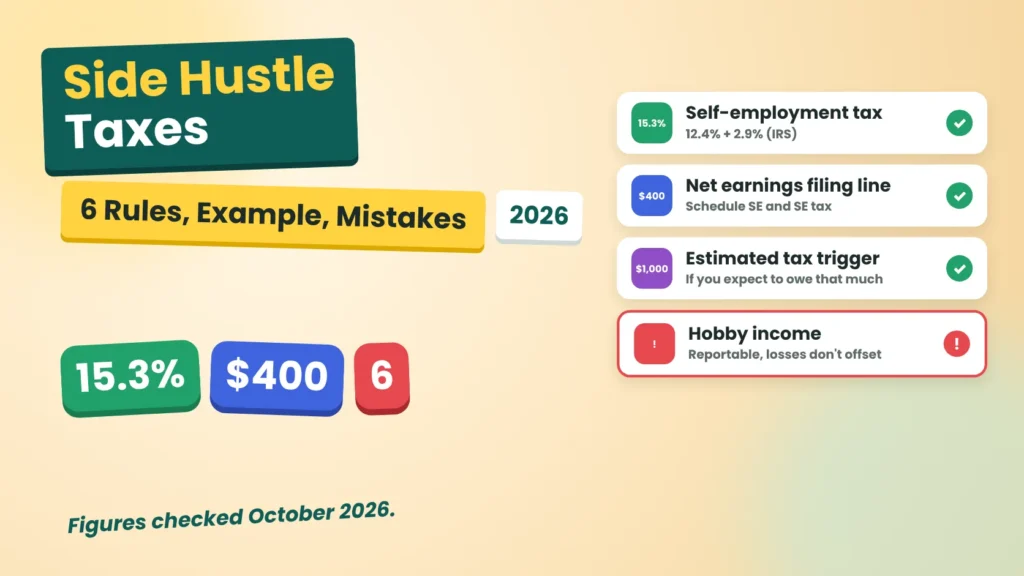
- The filing line is low. You must pay self-employment tax and file Schedule SE if net self-employment earnings are $400 or more.
- Self-employment tax is 15.3%. The IRS says that’s 12.4% for Social Security plus 2.9% for Medicare.
- Payments may be quarterly. You generally need to pay estimated tax if you expect to owe $1,000 or more when you file.
- A hobby isn’t safe. The IRS says hobby income is still reportable, and hobby losses can’t offset other income.
What Counts as Side Hustle Income for Side Hustle Taxes?
Side hustle income is money you earn outside your main job, such as freelancing, delivery, selling online or pet care. The IRS gig economy tax center describes gig work as on-demand work, services or goods, often through an app or website. It lists examples like driving for rides or deliveries, renting out property, selling goods online and running errands.
Here’s the quick view before the details.
| Rule | What the IRS says |
|---|---|
| Must report gig income | Yes, even if part-time or unreported on a form |
| Self-employment tax | 15.3% (12.4% + 2.9%) |
| Filing threshold | $400 net self-employment earnings |
| Estimated tax | Generally if you expect to owe $1,000 or more |
| Form 1099-K | Platforms report above $20,000 and 200 transactions |
6 Side Hustle Taxes Rules to Know
1. You must report it, form or no form
The gig economy tax center says you must report income from the gig economy on a tax return, even if it comes from part-time, temporary or side work, even if it isn’t reported on a 1099-K, 1099-MISC, 1099-NEC or W-2, and even if it’s paid in cash, property, goods or virtual currency.
2. The $400 rule triggers self-employment tax on side hustle income
The IRS self-employment tax page says you must pay self-employment tax and file Schedule SE if your net self-employment earnings are $400 or more. Net means what’s left after business expenses, not what clients paid you.
3. Self-employment tax is 15.3%
The same page says the rate is 15.3%, made up of 12.4% for Social Security and 2.9% for Medicare. This is separate from income tax. It says you can deduct the employer-equivalent portion of the tax when figuring your adjusted gross income, and that you calculate it on Schedule SE.
The page also lists an Additional Medicare Tax of 0.9% above certain income thresholds. I didn’t rely on its Social Security wage base figure, because the page showed a 2024 number, so check the current one.
4. You may need to pay estimated tax
Nobody withholds tax from freelance pay, so the IRS expects you to pay as you go. The estimated taxes page says individuals generally must pay if they expect to owe $1,000 or more when their return is filed, and that estimated tax covers income tax and self-employment tax.
The year is split into four payment periods, and the page doesn’t list the dates, so check Publication 505 or the IRS “pay as you go” guide.
To avoid an underpayment penalty, the page says you generally need to owe less than $1,000 after withholding and credits, or pay at least 90% of this year’s tax or 100% of last year’s, whichever is smaller. You can pay online, by phone, through the IRS app or by mailing Form 1040-ES.
5. Form 1099-K has a threshold, but your duty doesn’t
Payment apps and marketplaces may send you Form 1099-K. The IRS 1099-K announcement says the threshold reverted to the earlier rule, so third-party settlement organizations don’t need to file unless payments to you exceed $20,000 and the number of transactions is more than 200. A missing form doesn’t cancel the duty in rule 1, so keep your own records.
6. Hobby or business? It matters
The IRS page on the difference between a hobby and a business says the line isn’t clear cut, and it looks at factors such as keeping accurate records and whether you run the activity to make a profit. It says income from a hobby is still reportable, and losses from a hobby can’t offset other income. Treat your side hustle like a business from day one.
A Worked Example of Side Hustle Taxes
Here’s an example, not a promise. Say you net $5,000 from freelancing in a year after expenses. Applying the 15.3% rate straight to that gives $765, a rough upper estimate. Schedule SE does the real calculation, so your figure can differ. That’s before income tax, which depends on your total income and situation.
So setting aside around a quarter of each payment is a common rule of thumb, not an IRS rule. Ask a tax professional for a number that fits you.
How to Stay Organized for Side Hustle Taxes
Good records make side hustle taxes far easier. Open a separate account for the side hustle, save every invoice and receipt, and log your income as it arrives. FreshBooks can track invoices and expenses, and a spreadsheet works too.
For the bigger picture of money planning, read my guide to financial planning for gig workers. If you’re new to all this, my guide on how to start a side hustle shows when to set up the money side, and my freelancer guide covers fees and records for service work.

Spend less time managing invoices and expenses and more time growing your online business. Try FreshBooks and streamline your accounting today.
State and local taxes also exist. I didn’t read state rules for this guide, so check your state’s tax agency.
What Records Should You Keep for Side Hustle Taxes?
The IRS recordkeeping page says you can use any system that clearly shows your income and expenses, and that the law generally doesn’t require a special type of record.
It says to keep records as long as needed to prove the income or deductions on a return, and that you must be able to substantiate what you claim. It gives no single number of years for general records, so ask a tax professional how long to keep yours.
My suggestion, not an IRS rule: keep everything that shows money moving. That means payout statements, invoices, receipts and a simple log of business miles if you drive. A spreadsheet is enough to start. The point is that when someone asks “how do you know?”, you have an answer.
What Is a Simple Monthly Routine for Side Hustle Taxes?
A routine beats a good intention. Here’s the one I’d use.
- Weekly: log every payment and every business cost in one place.
- With each payout: move a set share into a separate savings account, so it never feels like spending money.
- Each quarter: check the IRS estimated tax rules and your payment dates, since this guide doesn’t list them.
- Each December: review your totals and ask a tax professional what’s left to do before the year ends.
When Should You Talk to a Tax Professional About Side Hustle Taxes?
Sooner than you think. I’m not a tax professional, and side hustle taxes depend on details I can’t see: your other income, your state, whether you drove or worked from home, whether you lost money.
If any of those apply, a short session with a qualified preparer can save more than it costs. Go in with your income log, your costs and your questions written down, and you’ll get far more out of the hour.
Costly Mistakes With Side Hustle Taxes
- Waiting for a form. Report income even if no 1099 arrives.
- Ignoring estimated payments. You may owe a penalty for paying too little during the year.
- Spending the full payout. Set money aside from the first payment.
- Treating it as a hobby. Hobby income is still reportable, and losses don’t offset other income.
- Skipping records. You can’t deduct what you can’t show.
My Verdict on Side Hustle Taxes
Side hustle taxes aren’t scary once you know the few rules, but they punish ignoring them. If I were starting, I’d open a separate account, log every payment and ask a tax professional about estimated payments before my first quarter ended. I’d skip guessing, because the rules are year-specific.
My advice: this week, open a tracking sheet and write down your income so far. If you’re still choosing what to sell, my Side Hustle Idea Validator scores ideas on demand, competition, startup cost and personal fit.
My Side Hustle Idea Validator ($9) scores each idea on demand, competition, startup cost and personal fit, so you build the one with the best odds first.

Not sure how much of this income to save for taxes? The self-employment tax calculator estimates your self-employment, federal and state tax and what to set aside each quarter.
FAQ
Do I have to pay taxes on a side hustle?
Generally yes. The IRS says you must report gig economy income on a tax return, even from part-time or side work, and even without a form.
How much is self-employment tax on a side hustle?
The IRS says it’s 15.3%, made up of 12.4% for Social Security and 2.9% for Medicare. You must pay it if your net self-employment earnings are $400 or more.
Do I have to pay estimated taxes on side hustle income?
Generally if you expect to owe $1,000 or more when you file, according to the IRS. It covers income tax and self-employment tax. Ask a tax professional about your case.
What if I don’t get a 1099 for my side hustle?
You still have to report the income. The IRS says gig income is reportable even if it isn’t on a 1099-K, 1099-MISC, 1099-NEC or W-2.
Are side hustle taxes different for a hobby?
The IRS says hobby income is still reportable, and hobby losses can’t offset other income. It looks at factors such as record keeping and whether you act to make a profit.
Related guides
- Financial planning for gig workers
- How to start a side hustle
- How to become a freelancer
- Extra income while working full time

I am a geotechnical engineer and I write every guide on hustle&passive. I check pay, fees and rules on official pages, and when I have not tried something myself, I say so and cite my sources.