Here’s the uncomfortable truth about how to start a side hustle: the idea is the easy part. Most people stall because they never decide what to do in the first week. So they read another list of ideas and nothing happens.
This guide on how to start a side hustle is for you if you want extra income around a job or classes and you’d like a clear order of steps, not another list of 50 ideas. I haven’t run every kind of side hustle myself, so I won’t invent earnings stories.
I built the steps around what the IRS, the Small Business Administration (SBA) and the FTC publish, then added the math with labeled examples.
Some links on hustle&passive may be affiliate links. If you purchase through one of these links, we may earn a commission at no additional cost to you. Affiliate Disclosure
Last updated: October 2026. Tax and licensing rules change, so check each official page before you rely on it. This is general information, not tax or legal advice.
Key Takeaways
- How to start a side hustle begins with a limit, not an idea. Decide your weekly hours and your startup budget first, then pick something that fits.
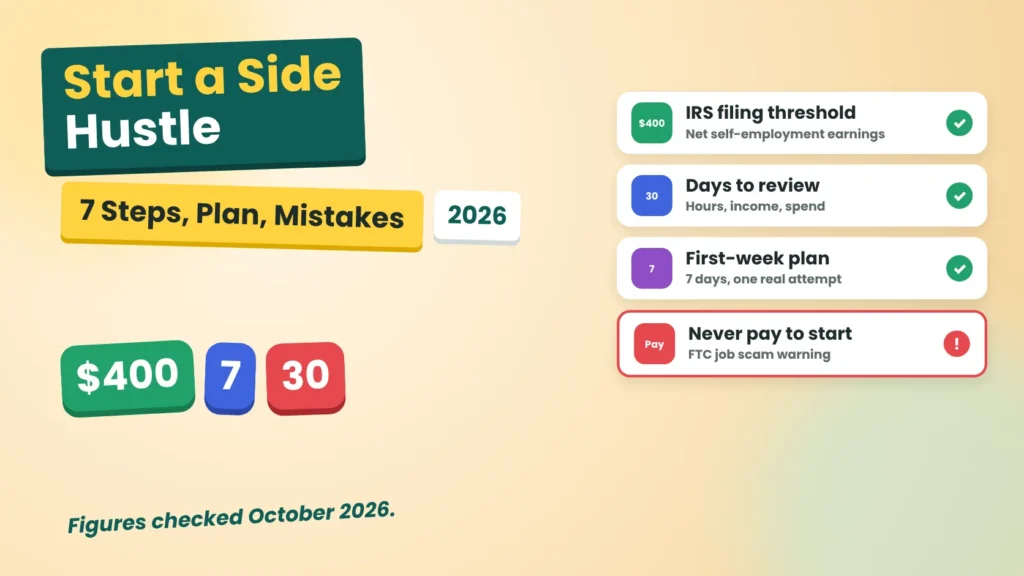
- Taxes apply from your first dollar of profit. The IRS says you must file if your net self-employment earnings are $400 or more.
- Licenses depend on the activity. The SBA says requirements vary by federal, state and local rules.
- Never pay to get started. The FTC says to never pay for the promise of a job.
- Judge it after 30 days. Look at hours, income and how you felt, then keep, change or drop it.
What Does It Mean to Start a Side Hustle?
A side hustle is income you earn outside your main job or studies. The IRS says you’re generally self-employed if you run a business for yourself, including part-time or as a gig worker. That one sentence matters, because it means a “small” side hustle can come with tax duties.
Here’s the quick plan for how to start a side hustle, before the details.
| Step | What you decide | Time it takes |
|---|---|---|
| 1. Set your limits | Weekly hours and budget | 30 minutes |
| 2. Pick one idea | One option that fits the limits | 1 to 2 hours |
| 3. Test demand | Would anyone pay for this? | 1 to 2 days |
| 4. Check the rules | Licenses, local rules, scams | 1 hour |
| 5. Set up the money side | Separate account, records, taxes | 1 hour |
| 6. Get a first customer | One pitch, one listing or one order | Week one |
| 7. Review at 30 days | Keep, change or stop | 1 hour |
Prefer to watch? Here’s my short video on how to start a side hustle with no money.
How to Start a Side Hustle in 7 Steps
1. Set your limits before you pick anything
Count the hours you can honestly give each week, and the money you can lose without stress. Here’s an example, not a promise. If you have 5 hours a week and $50 to spend, that rules out anything that needs equipment or long training. My guide to a weekly side hustle system shows how to fit this around a busy schedule.
2. Pick one idea, not five
Choose the simplest option that fits your limits and your skills. If you have a skill people pay for, start there. If not, look at my side hustles guide for ideas by budget, or my list of side hustle ideas you can do from home. The goal isn’t the perfect idea. It’s one you’ll actually test this week.
3. Test demand before you spend money
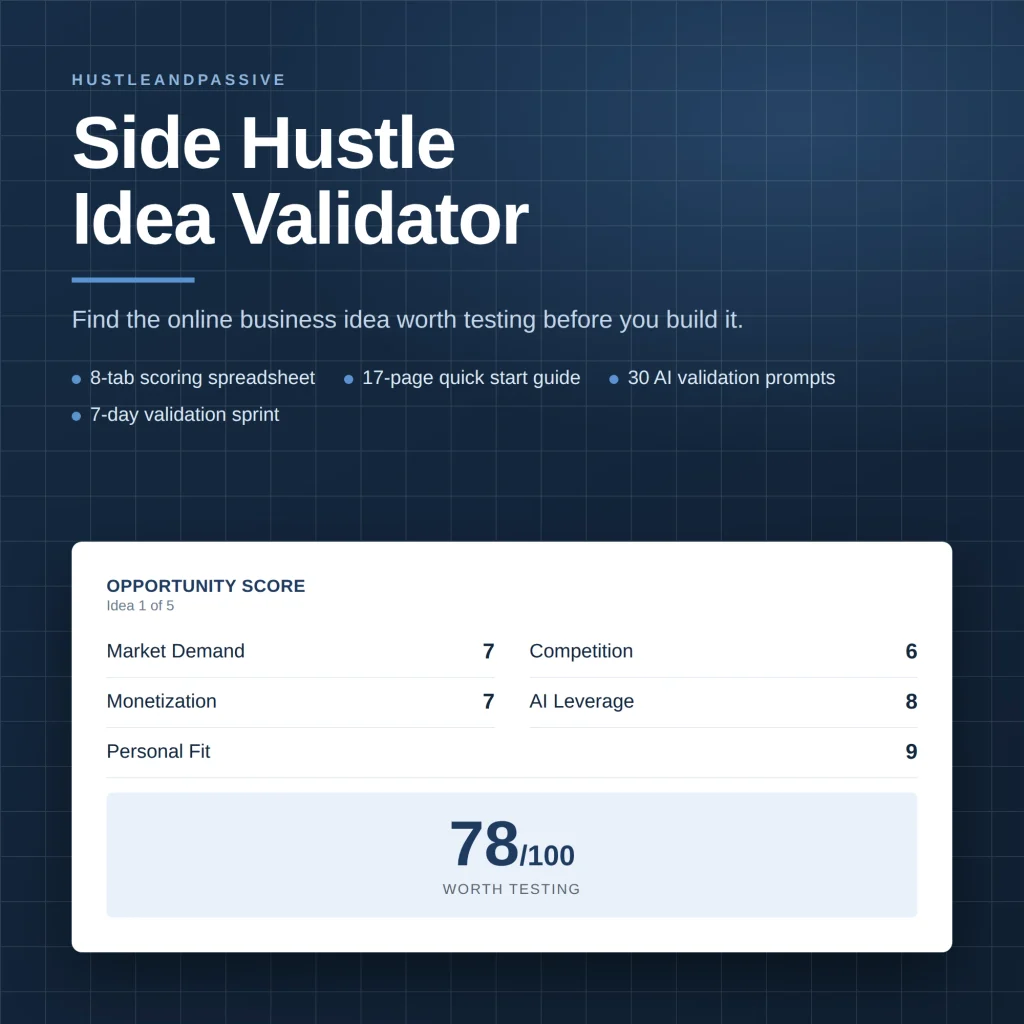
Before you build anything, check whether people already pay for it. Search for the service on a freelance marketplace, look at what others charge and read what buyers ask for. My Side Hustle Idea Validator scores an idea on demand, competition, startup cost and personal fit, which saves guesswork.
My Side Hustle Idea Validator ($9) scores each idea on demand, competition, startup cost and personal fit, so you build the one with the best odds first.
4. Check the rules and the scams
Licenses depend on what you do and where you live. The SBA’s page on licenses and permits says most small businesses need licenses or permits from federal, state or local agencies, and that requirements differ by activity and location. If you work from home, check your local zoning rules too, since the SBA page doesn’t cover them.
Then protect yourself. The FTC’s job scams guidance says real jobs don’t charge for starter kits, training or certifications, and that reshipping packages is never a real job. If a “side hustle” asks you to pay first or to deposit a check and send money back, walk away.
5. Set up the money side
Open a separate account for the side hustle and keep every receipt. The IRS self-employed individuals tax center says you must file a return if your net earnings from self-employment are $400 or more, and that you generally pay estimated tax each quarter because no employer withholds it. Business income and expenses go on Schedule C, and Schedule SE covers Social Security and Medicare tax.
A tool like FreshBooks can track invoices and expenses, and a spreadsheet works too. My guide to financial planning for gig workers shows how to set money aside.

Spend less time managing invoices and expenses and more time growing your online business. Try FreshBooks and streamline your accounting today.
There’s one more tax trap. The IRS says the line between a hobby and a business isn’t clear cut, and it looks at factors such as keeping accurate records and whether you run the activity to make a profit.
Its page on the difference between a hobby and a business says income from a hobby is still reportable, and losses from it can’t offset other income. Treat your side hustle like a business from day one.
6. Run a first-week plan
Here’s a simple first week for how to start a side hustle, built for five hours. It’s an example, not a rule.
| Day | Action |
|---|---|
| 1 | Write your offer in one sentence |
| 2 | Check what others charge |
| 3 | Make one sample, listing or profile |
| 4 | Set up your money account and tracking sheet |
| 5 | Send your first three pitches or publish your first listing |
| 6 | Follow up and improve your sample |
| 7 | Count what happened and plan week two |
The aim of week one isn’t income. It’s one real attempt. Even an unanswered pitch teaches you what to change. If you’re not sure which platform to use, my guide on how to become a freelancer explains the fees and tax basics for service work.
7. Review after 30 days
After a month, write down three numbers: hours spent, money earned and money spent. Divide profit by hours to get your real hourly rate. Then decide. Keep it, change the offer or stop. Stopping early isn’t failure. It’s cheaper than six months of a bad fit.
If it works, my guide on going from side hustle to full-time income covers when to scale. If you need cash faster, see my list of side hustles that pay daily.
How Much Does It Cost to Start a Side Hustle?
How to start a side hustle on a small budget is mostly a question of time. It can cost almost nothing. Service work, such as writing, tutoring or virtual assistance, needs a phone or computer and time. Product-based ideas need stock or tools. The costs worth counting are the ones people forget: platform fees, tax and your own time.
Here’s an example of the math. If you earn $400 in a month, spend $60 on tools and set aside about a quarter for tax and fees, you keep about $240. That’s an illustration, not a market rate, and your tax depends on your situation.
Costly Mistakes in How to Start a Side Hustle
- Picking an idea before setting limits. You’ll quit when it doesn’t fit your week.
- Paying to get started. The FTC says to never pay for the promise of a job.
- Ignoring tax until spring. Set money aside from the first payment.
- Treating it like a hobby. Keep records so it’s clear you’re running a business.
- Starting five things at once. One idea tested well beats five half-tried.
- Quitting your job too soon. Prove the income over several months first.
My Verdict on How to Start a Side Hustle
My answer on how to start a side hustle: if I were starting, I’d set my hours and budget, pick one idea, test demand for a day or two and make one real attempt in week one. I’d skip anything that charges me up front, and I’d open a separate account on day one.
My advice: pick your weekly hours today, choose one idea and do the first step of the plan this week.
FAQ
How to start a side hustle with no money?
Choose a service that only needs your time, such as tutoring, proofreading or virtual assistance. Test demand, make one sample and send your first pitches. Avoid anything that asks you to pay for a starter kit.
How to start a side hustle while working full time?
Set a weekly hour limit, usually a few hours, and use fixed blocks. Check your employment contract, and don’t use work time or equipment. Start with one idea so you don’t overload your week.
Do I have to pay taxes on a side hustle?
Generally yes. The IRS says you must file if your net self-employment earnings are $400 or more, and you usually pay estimated tax quarterly. Check the IRS pages or ask a tax professional.
Do I need a license to start a side hustle?
It depends on the activity and your location. The SBA says licenses and permits may be required at the federal, state or local level. Check your state and city before you start.
How long does it take to make money from a side hustle?
It varies a lot by idea. Many people see their first income within weeks with service work, while product-based ideas can take longer. Review your results after 30 days.

I write every guide on hustle&passive. I test what I can, and when I have not tried something myself, I say so and cite my sources.