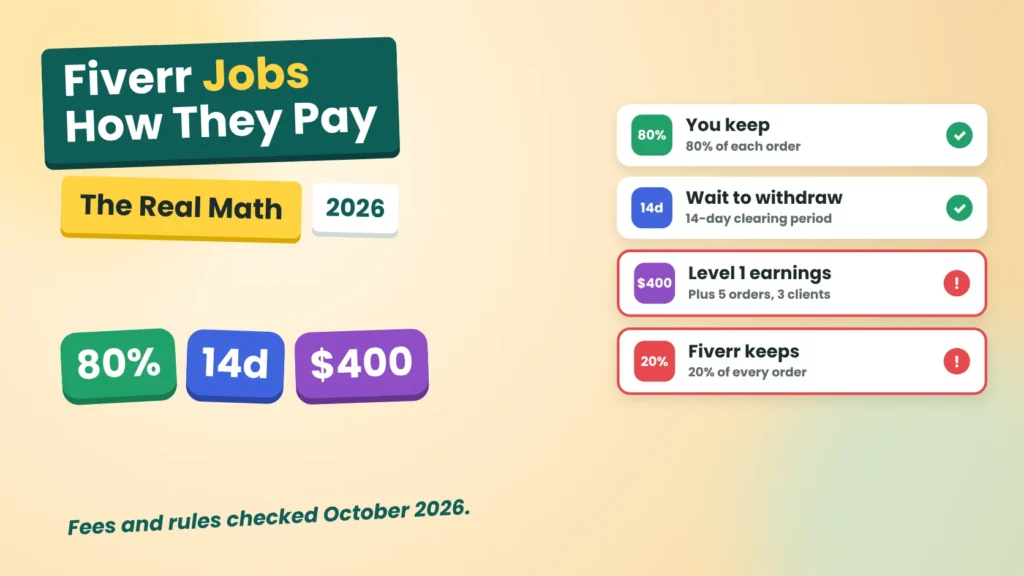
Fiverr jobs are not jobs in the paycheck sense. You list a service (a “Gig”), buyers find it and order it, and Fiverr pays you 80% of the cleared payment after a 14-day wait. That is the whole business model, and the part most beginners miss is the wait and the missing 20%.
This guide is for you if you have a skill someone would pay for and you want to know what Fiverr jobs pay before you spend a weekend building a profile. I haven’t sold on Fiverr myself, so I won’t quote my own earnings. What I did was read Fiverr’s own help pages on fees, levels, payouts and AI use, and I turned the rules into plain English with the math worked out.
Some links on hustle&passive may be affiliate links. If you purchase through one of these links, we may earn a commission at no additional cost to you. Affiliate Disclosure
Last updated: October 2026. Fiverr changes its rules often, so check its help pages before you rely on a number.
Key Takeaways
- Fiverr keeps 20%. Freelancers receive 80% of the client’s cleared payment, according to Fiverr’s help center.
- Money is not instant. Funds have a 14-day clearing period before you can withdraw them.
- New sellers start small. New freelancers can list 4 Gigs, and Level 1 needs 5 orders, 3 unique clients and $400 in earnings.
- Payout fees depend on the method. PayPal withdrawals cost $0 on Fiverr’s side, while a Payoneer account costs $3.
- AI use is allowed, with limits. Generic, unmodified AI output does not meet Fiverr’s quality standards.
What Are Fiverr Jobs Exactly?
Fiverr jobs are services you sell on Fiverr’s marketplace, packaged as Gigs. A Gig might be proofreading 1,000 words, cleaning up a logo file or setting up a spreadsheet. A client orders it, you deliver the work, and Fiverr pays you after the order is complete.
There is no boss and no schedule. There is also no guaranteed income, because nobody orders until your Gig shows up in search and looks trustworthy. My honest read: Fiverr jobs are a small business with a built-in storefront, not a job you apply for.
How Much Do Fiverr Jobs Pay After Fees?
You keep 80% of what the client pays, so a $50 Gig puts $40 in your pocket. Fiverr’s help center says freelancers receive 80% of the client’s cleared payment, and the other 20% is what the platform keeps.
Here is an illustration (an example, not a promise). Say you sell a $40 Gig and finish 10 orders in a month. The gross is $400. After Fiverr’s cut you have $320. If each order takes you two hours, that works out to about $16 an hour before taxes and your own costs. If each one takes four hours, it drops to $8.
The real lever is not the fee. It is how long each order takes you, and how soon you can raise your price once the reviews come in.
How Long Until You Get Paid?
Plan on at least two weeks. Fiverr says funds are subject to a 14-day clearing period before you can withdraw them, and the clock starts after the order is complete. A client has three days to respond and review, and if they stay silent the order is treated as complete.
Top Rated sellers get faster payments, according to Fiverr’s levels page, so the wait shortens as you level up. For a beginner, treat the first month as unpaid. Do not count on Fiverr money for rent.
What Does It Cost to Withdraw Your Earnings?
It depends on the payout method. Fiverr’s help page lists these rules, so check the current numbers before you choose.
| Payout method | Transfer time | Withdrawal fee | Minimum |
|---|---|---|---|
| PayPal | About 24 hours | $0 | $1 |
| Bank transfer (via Payoneer) | 1 to 3 business days local, 5 to 7 days by USD wire | $1 | $20 |
| Payoneer account | Up to 2 business days | $3 | $10 |
The currency can matter too. Fiverr sends the full amount you request, but conversion rates or provider fees can leave you with less on the other end. Withdrawals can’t be undone, so double check the account before you confirm.
How Do Fiverr Seller Levels Work?
Levels unlock more Gigs and more tools, and you earn them with results, not time on the site. Fiverr’s levels page says all six metrics must be met, and that tenure no longer counts directly. Here are the published numbers.
| Level | Success score | Rating | Response rate | Orders | Unique clients | Earnings |
|---|---|---|---|---|---|---|
| Level 1 | 5+ | 4.4+ | 80% | 5 | 3 | $400 |
| Level 2 | 7+ | 4.6+ | 90% | 20 | 10 | $2,000 |
| Top Rated | 9+ | 4.7+ | 90% | 40 | 20 | $10,000 |
New sellers can list 4 Gigs, Level 1 and Level 2 sellers 10, and Top Rated sellers 30. Top Rated also needs a manual review. If your numbers slip, Fiverr applies a 30-day grace period before a downgrade.
My take: the first target is Level 1, and the hard part is not the $400. It is the 3 unique clients, so the first month is about getting three different people to say yes.
What Fiverr Jobs Should a Beginner Start With?
Start with a service where a buyer can describe the result in one sentence. “Proofread my 2,000-word article” is easy to order. “Help me grow my business” is not. I haven’t tested these myself, so treat the list as ideas to validate, not a ranking.
- Writing and editing. Proofreading, product descriptions and short blog posts. My guide to getting paid to write covers the other places writers earn.
- Admin help. Data entry, inbox cleanup and calendar setup. If this fits you, see how to become a virtual assistant with no experience.
- Simple design or formatting. Resizing images, cleaning up slides or building a basic template.
- AI-assisted work that you edit. Drafts, outlines or research summaries that you rework before delivery. More on that rule below.
The pick I’d start with is the one where you already have proof from a past job, class or hobby. A one-line “I did this for X” in your Gig description beats any adjective.
Can You Use AI for Fiverr Jobs?
Yes, with limits. Fiverr’s AI guidelines say freelancers can use AI in all categories, but they stay responsible for the final work. The same page says generic, unmodified or reused AI output does not meet Fiverr’s quality standards.
There is no blanket disclosure rule. But if a client asks for non-AI work, Fiverr says you should disclose your intended workflow and follow the request. Misrepresenting AI use can lead to a cancelled order, a full refund and a permanent account suspension. Read my guide to making money with AI for ways to use AI without cutting corners.
How Do You Get Your First Order With No Reviews?
You get it by making the first order easy to say yes to. Here is the order I’d follow.
- Pick one narrow Gig. One service, one clear deliverable, one price. Resist the urge to list four vague Gigs on day one.
- Write the title and description around the buyer’s result. Say what they get, how long it takes and what you need from them.
- Price low enough to earn the first reviews, high enough to avoid burning out. Do the hours math from the section above.
- Add proof. A portfolio sample, a before and after, or a short intro video. Fiverr says portfolio, intro video and milestone payments are available at every level.
- Reply fast. Response rate counts toward your level, so answer messages quickly.
- Deliver slightly early and ask for the review. Not the tip. Fiverr’s own page advises against asking for one.
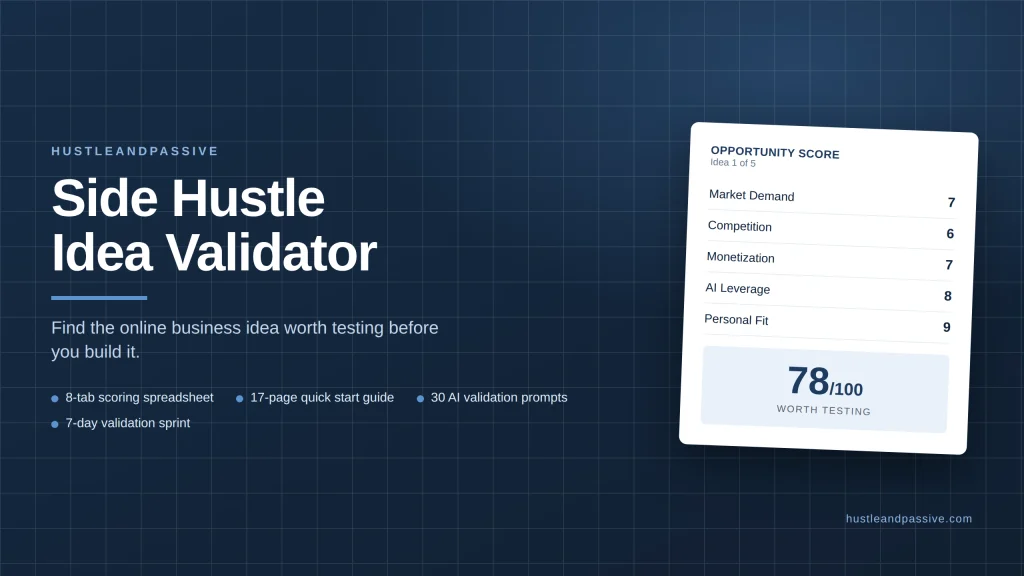
If you are still deciding whether this is the right side hustle, my Side Hustle Idea Validator scores an idea on demand, competition and startup cost before you commit. And if you would rather start with a free list, here are 50 AI side hustle ideas to compare against.
What Are the Risks and Mistakes to Avoid?
The main risks are low pay for the hours, a slow start and a rating that drops after one bad order. Here are the mistakes I’d watch for.
- Underpricing with no exit plan. Cheap Gigs win the first order, but they can trap you at a rate you hate.
- Ignoring the 14-day wait. You may not see cash for two weeks after the first order.
- Selling something you cannot deliver on time. One late order hurts a new profile more than a missing one.
- Handing in raw AI output. Fiverr’s standards say that doesn’t meet its quality bar.
- Forgetting taxes. The IRS says you generally owe self-employment tax when your net earnings from self-employment reach $400 or more, so keep a simple record of what you earn and spend from your first order. For a plan to set money aside, see my guide to financial planning for gig workers.
Need cash sooner than Fiverr allows? Two guides to start with: side hustles that pay daily and remote side jobs.
FAQ
Do you need experience to get Fiverr jobs?
No formal experience is required, but you do need a skill a buyer will pay for and proof that you can do it. Fiverr says new freelancers can list up to 4 Gigs, and a portfolio and intro video are available at every level.
How much does Fiverr take from sellers?
Fiverr’s help center says freelancers receive 80% of the client’s cleared payment, so the platform keeps 20%. Payouts also have their own fees: PayPal is $0, a Payoneer account is $3, and bank transfers via Payoneer are $1.
How long does it take to get paid on Fiverr?
Funds are subject to a 14-day clearing period after the order is complete. Top Rated sellers and some other programs get faster payments, according to Fiverr, and the withdrawal itself takes from about 24 hours to a week depending on the method.
Can you use AI to do Fiverr jobs?
Yes, Fiverr allows AI in all service categories, but generic, unmodified AI output does not meet its quality standards. If a client asks for non-AI work, you should follow the request, and misrepresenting AI use can lead to account suspension.
The Bottom Line
Fiverr jobs are a real way to sell a skill, but they pay slowly, Fiverr keeps 20%, and the first month is mostly about earning trust. The honest picture: a small, steady side income is possible if you pick a narrow service and protect your time, and a big paycheck is not something you should expect from Gig number one.
My advice: choose one Gig you can deliver in under two hours, price it so the math works after the 20% cut, and aim for Level 1 first. And if Fiverr’s fees or level rules have changed by the time you read this, send me a message through the contact page so I can update the guide.

Writes and tests every guide on hustle&passive. Everything here is something we have actually run — including the parts that did not work.