Disclosure: this post contains affiliate links. If you sign up through one I may earn a commission at no extra cost to you.
Almost every guide to how to start a business from scratch puts the same steps in the same order: find an idea, research the market, write a business plan, register the company, build a brand, then finally go find customers.
That order is why so many businesses die before they earn anything. It front-loads months of work and several hundred dollars of costs onto an idea nobody has agreed to pay for yet. By the time you’re allowed to talk to a customer, you’ve already spent the money and the enthusiasm.
The order below for starting a business from scratch is different in one specific way: you get your first paying customer at step 4, before you register anything. Everything formal comes after there’s revenue to formalise. That single change is the difference between a business and an expensive hobby, and it’s the part I got wrong the first time round.
Registration specifics below use US rules, since that’s where most readers are. The sequence works anywhere; only the paperwork step changes.
TL;DR
- Validate with money, not opinions. One person paying you $50 tells you more than fifty people saying “great idea.”
- Registration is a step 6 problem, not a step 1 problem. The SBA puts total registration cost under $300 in most cases, and an EIN from the IRS is free.
- Realistic minimum to launch a service business: about $50 (domain, hosting, and nothing else). A product business runs $300–$1,500 depending on inventory.
- The business plan comes after the first sale, and it’s two pages, not thirty. Nobody reads a thirty-page plan except a bank.
- Expect 60–90 days from idea to first revenue for a service business. Product businesses take longer, mostly because of sourcing.
If you want to keep overhead low, start with one of these home-based businesses.
Working from home? Here’s how to set up a home office that keeps you productive.
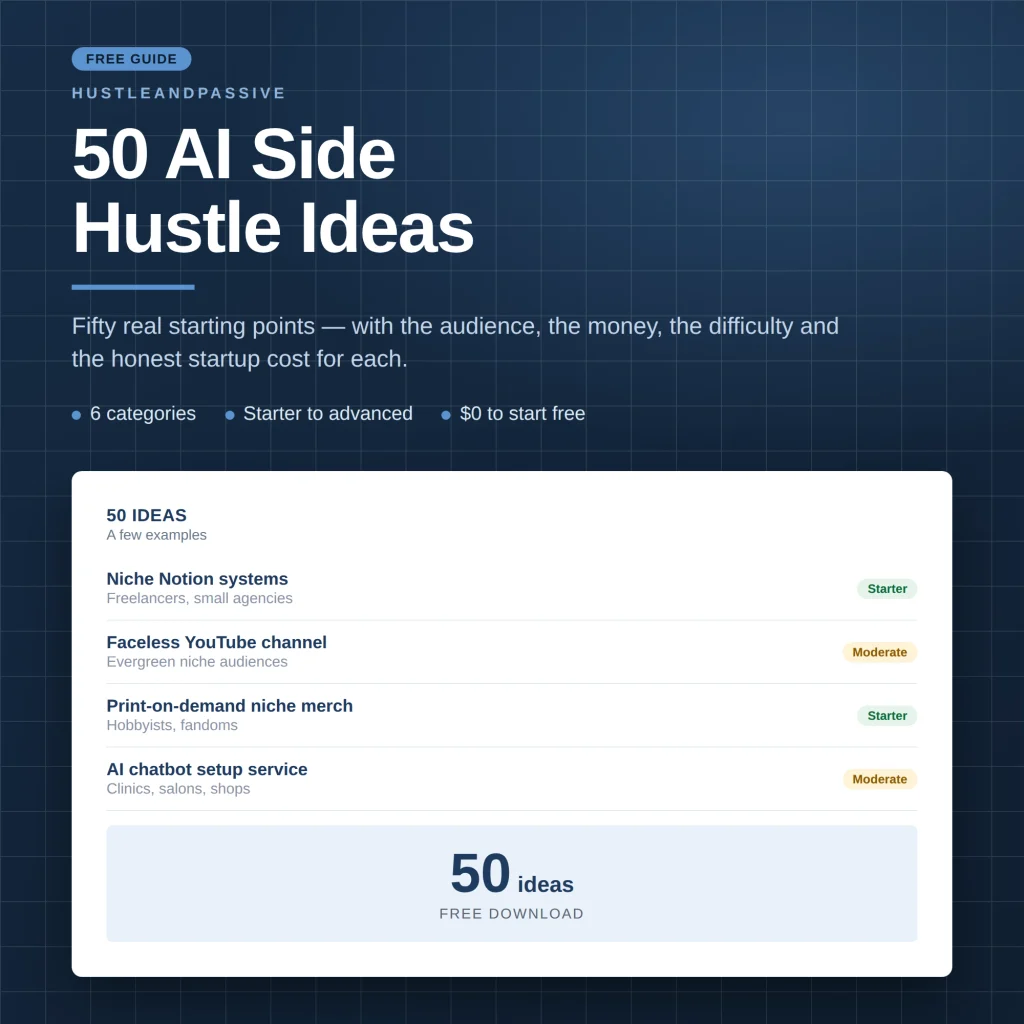
Free guide: 50 AI Side Hustle Ideas. Step 1 is starting from the right problem. If you do not have one yet, begin with fifty ideas, each with the audience, the money, the difficulty and the real startup cost.
Starting a Small Business From Scratch: The 10-Step Checklist
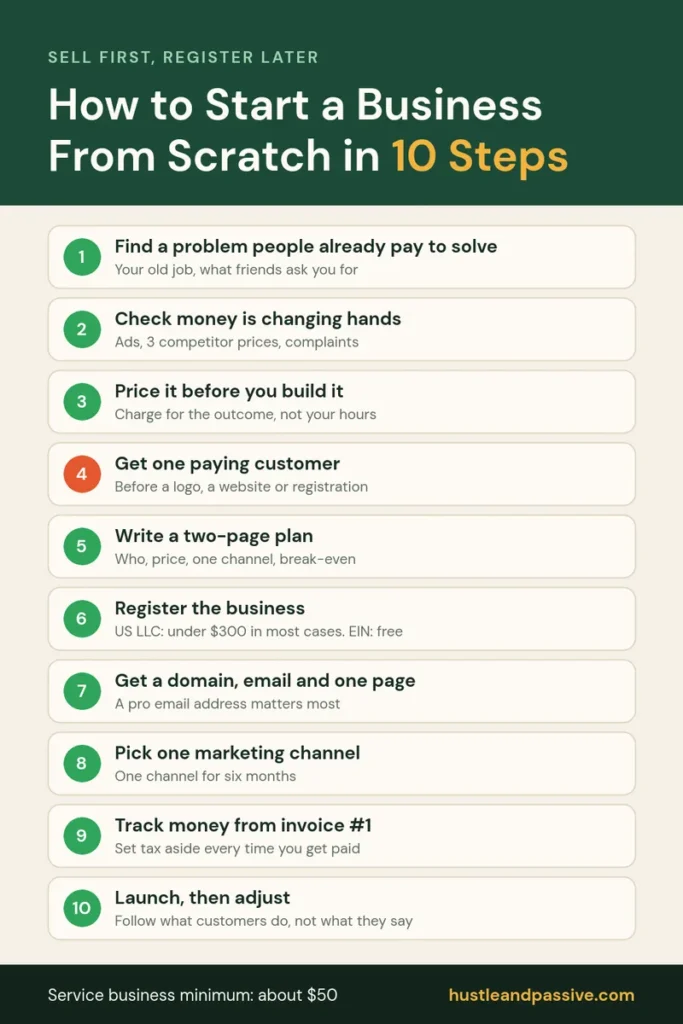
Here is how to start a business from scratch, on one screen. Each step is explained in detail below.
- Find a problem people already pay someone to solve.
- Check that money is changing hands: competitor ads, prices and complaints.
- Set your price before you build anything.
- Get one paying customer before a logo, a website or registration.
- Write a two-page plan: who it is for, price, one channel, break-even.
- Register the business (a US LLC costs under $300 in most cases; an EIN is free).
- Get a domain, a business email and one web page.
- Pick one marketing channel and stay on it for six months.
- Track money from the first invoice and set tax aside every time you are paid.
- Launch, then adjust based on what customers do.
Step 1: Start from a problem you’ve already watched someone pay to solve
When you start a business from scratch, the best ideas aren’t discovered, they’re noticed. Somewhere in your work history or your daily life there’s a task people complain about, do badly, or already pay someone to handle.
Three places to look, in order of how well they work:
Your last job. What did your employer outsource, and what did they pay for it? That’s a validated market you already understand. Somebody is already writing the invoice, which means the budget exists.
What you get asked for free. If three people have asked you to help with the same thing, that’s demand showing up uninvited. Most people dismiss this because it feels too easy to charge for. Charging for it is exactly the point.
Where you personally paid badly. Anything you’ve bought and thought “this could be so much better” is a gap someone will pay to have closed.
What doesn’t work is picking an idea because a listicle said the market is growing. Growing markets attract funded competitors, and you have neither the capital nor the runway to fight them on their terms.
If you’re genuinely stuck on direction rather than execution, the niche and business idea breakdown approaches this from the market side.
Step 2: Check that people are already spending money on it
This is market research, but a much narrower version than the phrase implies. You aren’t producing a report. You’re answering one question: is money already changing hands for something like this?
Four checks, an afternoon total:
- Are competitors advertising? Paid ads mean someone has done the maths and the numbers work. A market with no ads is usually a market with no money, not an untapped opportunity.
- What do they charge? Find three competitors and write down their prices. If nobody publishes prices, that’s a signal too: it usually means custom quoting and higher margins.
- Are people complaining? Reddit threads, one-star reviews, and Facebook group posts are the cheapest customer research available. The complaints tell you what to build.
- Is anyone searching for it? Look up what people type when they need it, such as “bookkeeper for Etsy sellers” or “wedding cake near me”. A keyword tool like Keysearch shows monthly search numbers, so you can see whether demand is steady or tiny.
Find Keywords That Actually Rank
Stop guessing what to write. KeySearch helps you discover low-competition keywords, analyze competitors, and create SEO content that drives long-term organic traffic.
The counterintuitive part: competition is good news. An empty market almost always means nobody’s willing to pay. What you want is a market with obvious competitors doing an unremarkable job.
Step 3: Price it before you build it
Decide what you’ll charge now, while it’s still cheap to change your mind.
Two rules that save a lot of pain later.
Don’t compete on price. It’s the only advantage that anyone can copy instantly, and the customers it attracts are the ones who leave for the next cheaper option. Being the second-cheapest is a worse position than being the most expensive.
Price for the outcome, not your hours. “$500 to set up your booking system” beats “$50/hour” even when it’s the same ten hours, because the client can evaluate the first one and can only worry about the second.
If you genuinely don’t know what to charge, take the middle competitor’s price from step 2 and match it. You’ll adjust after five customers. Precision here is false comfort.
Step 4: Get one paying customer before you build anything
This is the step everyone skips when starting a business from scratch, and it’s the only one that actually de-risks the business.
Before a logo, before a website, before registering, before a business plan: sell it once. Manually, badly, at a discount if you have to. What you need is someone who has moved money in exchange for what you’re offering.
For a service: pitch ten specific people. Not a post on LinkedIn hoping someone bites. Ten individual messages to ten named humans who have the problem. A 10% conversion rate here is normal, which is why the number is ten and not three.
For a product: take pre-orders, or sell a single unit you’ve made by hand. If nobody will pre-order, the inventory you were about to buy would have sat in your spare room.
For anything with a digital component: sell the outcome and deliver it manually first. Every software business you admire started with a founder doing the work by hand for the first ten customers.
The reason this order matters is money. Steps 5 to 8 cost money and time. Doing them for an idea that turns out to have no buyer is the single most common way people lose $1,000 and six months. Doing them after a stranger has paid you means you’re spending revenue rather than savings.
Feedback that isn’t money is not validation. Friends are supportive, and support is not a market.
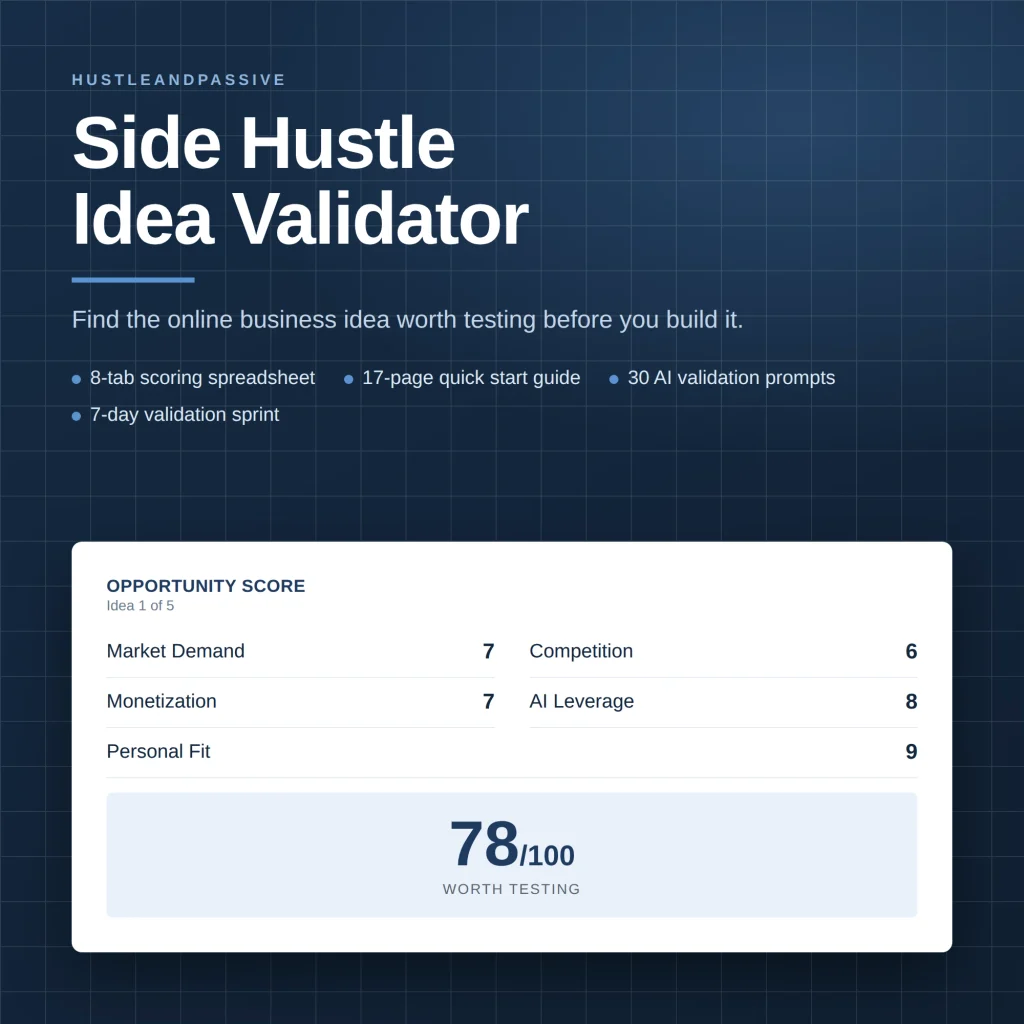
The Side Hustle Idea Validator turns steps 1 through 4 into a structured one-week process — score the idea, research the market, test with real people, then decide instead of winging it.
Step 5: Write the two-page plan (now, not earlier)
Now that someone has paid, write it down. Two pages, and it exists to make you think clearly, not to impress anyone.
What goes in it:
- Who it’s for, specifically enough to name three real people
- What you charge and what it costs you to deliver
- How customers find you (the one channel, not five)
- Break-even: how many sales per month covers your costs
- What kills it: the one assumption that, if wrong, ends the business
The thirty-page version with five-year projections is only needed when a bank or an investor asks. If you’re bootstrapping, it’s procrastination with a template.
Step 6: Register the business (and only now)
With revenue in hand, formalising makes sense. Here’s what it actually costs.
Structure. For most solo businesses starting out, a sole proprietorship (or its equivalent) requires no registration at all. As the SBA puts it, if you conduct business under your own legal name you won’t need to register anywhere. The trade-off is that you get no personal liability protection.
An LLC gives you that protection and costs money. The SBA estimates total registration cost at under $300 in most cases, varying by state and structure. Some states are far cheaper than that; a few are considerably more, plus annual fees.
EIN. Free, and takes minutes. The IRS issues an EIN online at no cost and explicitly warns against sites that charge for one. If a service quotes you $79 for an EIN, they’re charging you for a free form.
Business bank account. Not legally required for a sole proprietor, but do it anyway. Mixing personal and business money is a bookkeeping problem that compounds monthly and an audit problem that arrives all at once.
Licences and permits. Entirely local. Food, childcare, trades, anything health-related, and anything regulated will need one. A software consultancy usually won’t.
The honest version: if you’re earning under a few thousand dollars and not doing anything with liability exposure, sole proprietorship plus good records is fine for a while. Formalise as the numbers grow. Get one hour with an accountant before you decide, because the tax treatment differs meaningfully and it’s cheaper than getting it wrong.
Step 7: Get a domain, an email address, and a single page
To start a business from scratch, you need less of a website than you think, and you need it sooner than you think.
The minimum viable presence is one page: what you do, who it’s for, what it costs, and how to contact you. Not a five-page site with a blog and a team section for a team of one.
The part that actually matters is the email address. A quote from yourname@yourbusiness.com gets treated differently to one from a gmail address, and the difference shows up in what people will pay. It’s the cheapest credibility available.
Hostinger’s Premium plan runs $2.99/month on a 48-month term and $10.99/month on renewal, including a free domain for the first year, SSL, and mailboxes. Whichever host you use, check the renewal price rather than the promo rate, because the gap is usually large.
👉 Set up your domain and business email with Hostinger. A domain and a professional email address is the whole requirement at this stage.
If you’re building an online store rather than a service business, the complete ecommerce store setup guide covers the platform decision in detail. If you want a hosted store running this week without touching hosting, Shopify is the simplest place to start.
Start Your Online Store with Shopify
Turn your idea into a profitable online business with Shopify. Create a professional store, sell digital or physical products, manage payments, and grow your brand with powerful e-commerce tools trusted by millions of entrepreneurs.
Step 8: Pick one marketing channel and stay on it
New businesses fail at marketing by doing a little of everything: a neglected Instagram, three blog posts, a LinkedIn account, an abandoned newsletter. Five channels at 20% effort produce nothing. One channel at 100% produces customers.
Pick based on where your buyers already are:
- Local or trade services → Google Business Profile and referrals. Unglamorous, and it works.
- B2B and professional services → LinkedIn plus direct outreach. Still the highest-converting combination for services over $1,000.
- Consumer products → whichever visual platform your buyers use, plus email.
- Anything people search for → your own content. Slow, and it compounds. The niche blog guide covers this route properly.
One channel. Six months. Then judge it.
The exception worth making early is email. Whatever your main channel is, collect email addresses from day one, because it’s the only audience you own outright. Everything else is rented from a platform that can change the terms. A free CRM and email tool such as HubSpot covers this at your size.
Step 9: Track money from the first invoice
Not because it’s fun, but because reconstructing a year of records in April is genuinely awful and I’ve done it.
Three things, minimum:
- Every invoice, numbered sequentially
- Every expense, with the receipt, categorised
- Money set aside for tax, in a separate account, every time you get paid
That last one catches out almost every first-year business owner. Employment withholds tax before you see the money. Self-employment doesn’t, so a good month feels like more money than it is. Set aside a percentage the day the payment lands, not at year end.
Free tools cover this completely at your size, and the gig worker financial planning guide covers the irregular-income side, which is the harder problem.
Step 10: Launch, then change it based on what customers do
Launch is not an event. It’s the point where you stop preparing and start adjusting.
For the first ten customers, ask two questions after delivery: what nearly stopped you buying, and what did you expect that you didn’t get. The answers reshape the offer faster than any amount of planning.
Then watch behaviour rather than opinions. What people repurchase, what they refer, what they ask you to do more of. That’s the signal. What they say they’d like is noise.
Most people who start a business from scratch and succeed end up somewhere adjacent to where they started. That’s not failure, it’s the process functioning. The plan from step 5 is a hypothesis, and customers are the experiment.
What it actually costs to start a business from scratch
| Item | Realistic cost | Skippable at first? |
|---|---|---|
| Domain + hosting + email | $36–$130/year | No |
| Business registration (LLC) | Under $300 in most US states | Yes, until revenue |
| EIN | $0 | Free, so no reason to skip |
| Business bank account | $0–$15/month | Not really |
| Logo and branding | $0–$300 | Yes |
| Accounting software | $0 (free tiers cover it) | Yes |
| Website beyond one page | $0–$2,000 | Yes |
| Inventory (product businesses) | $300–$5,000 | No, if physical |
Service business, absolute minimum: around $50. A domain, hosting with email, and your time. Everything else on that list can wait until customers are paying for it.
Free: 50 AI Side Hustle Ideas fifty starting points, each with the audience, the money, the difficulty and the honest startup cost.
FAQ: Starting a Business From Scratch
How much money do you need to start a business from scratch?
For a service business, about $50 covers a domain, hosting and a business email address. Registration adds under $300 in most US states, and an EIN is free from the IRS. Product businesses need inventory, which typically puts the realistic floor between $300 and $1,500.
Do I need to register my business before I can take money?
In the US, no. Operating as a sole proprietor under your own legal name requires no registration, though you get no personal liability protection. Registering as an LLC gives you that protection and costs money, which is why it makes more sense once revenue exists.
How long does it take to start a business from scratch?
Roughly 60 to 90 days from idea to first revenue for a service business, if you sell before you build. Product businesses usually take three to six months, mostly because of sourcing and sampling. Guides suggesting two weeks are describing the paperwork, not the business.
What’s the first thing I should do when starting a business from scratch?
Find one person who will pay you for the thing, before spending money on anything. Not a logo, not a website, not registration. A single paying customer validates the idea more reliably than any amount of market research, and it changes every decision that follows.
Is a business plan necessary in 2026?
A two-page one, yes, and write it after your first sale. A thirty-page plan with five-year projections is only needed when a bank or investor asks for one. For a bootstrapped business, the long version is usually procrastination with a template.
The short version
If you remember one thing about how to start a business from scratch: sell first, formalise second. Nearly everything that goes wrong in a first business traces back to reversing that.
If you’re building this toward something that eventually runs without you, the complete guide to passive income for beginners covers what that transition actually requires, and it’s worth reading before you design the business, not after.

Writes and tests every guide on hustle&passive. Everything here is something we have actually run — including the parts that did not work.