Instawork is a legitimate way to pick up shift work, but a star rating can’t show you what decides how much you keep: the payout rules, the cancellation penalties and the rating system. Read this next to any Instawork reviews you find. The app matches workers, which it calls Pros, with businesses that post shifts in warehouses, kitchens, events and similar jobs. Whether it is a good side hustle depends less on the hourly rate than on how you handle those rules.
This is a research-based review. I haven’t worked a shift on Instawork, and I didn’t read user reviews to build this, so I won’t claim worker experiences or earnings. What I did was read Instawork’s own help pages on pay, Instapay, cancellations, performance scores and the Top Pro program, then explain what they mean for someone who wants flexible income.
Quick heads-up: there are no affiliate links in this review. I’m not paid to send you to Instawork, so nothing depends on what you decide.
Last updated: October 2026. Instawork changes its rules and fees, so check the app and help pages before you rely on a number.
Key Takeaways
- Instawork is a shift marketplace. Businesses post shifts, and Pros pick them up, according to Instawork.
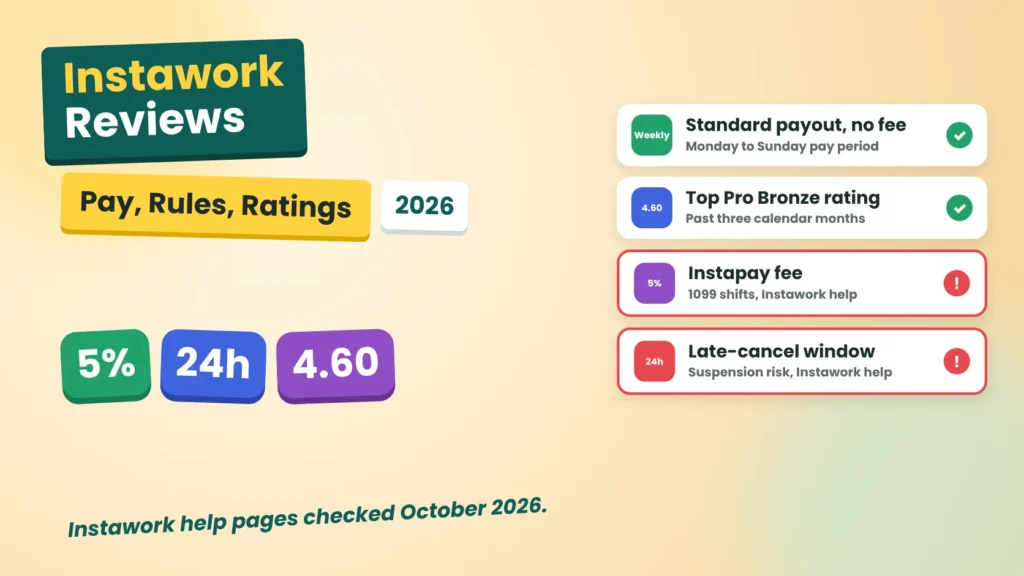
- Pay arrives weekly, or faster for a fee. Instapay costs 5% of the payout on 1099 shifts, and you can use it seven days after your second shift.
- Reliability is the real price. A no-show means a 7-day suspension, and a second one within 30 days means 30 days.
- Ratings feed your access. Instawork tracks a reliability score and a quality score, and the Top Pro program starts at a 4.60 rating.
- Taxes depend on the shift type. On 1099 shifts you are self-employed, so keep records from your first shift.
What Is Instawork and How Does It Work?
Instawork is an app where businesses post shifts and approved Pros book them. Its how-it-works page lists work in warehousing, food and beverage, events, retail, cleaning and similar areas, and says the platform operates in more than 50 U.S. markets. Shifts can be one-time, seasonal or recurring.
Pros go through background checks, work authorization checks where applicable, reference and experience checks, and license verification. You clock in and out through the app or with an on-site PIN code, and GPS clock-ins are used as a safeguard. After each shift, the business rates you, and after a set number of hours a business can hire you directly with no extra fee.
One detail matters for your taxes. Instawork says it offers either a 1099 or a W-2 engagement model depending on the market and role, with Workers’ Compensation for W-2 shifts and Occupational Accident Insurance for 1099 roles where permitted. The page doesn’t list pay rates. The business pays a bill rate that covers your pay plus Instawork’s administrative support, so check the rate shown on each shift. Instawork reviews can tell you how a shift felt, but only the shift page shows the rate.
Is Instawork Legit?
Yes, in the sense that it is a real marketplace with vetting, insurance language and documented pay rules. The harder question for Instawork reviews is not whether it is a scam, but whether the shifts, pay and rules fit your life. I haven’t found a source that says what workers earn on average, so I won’t give one. I’d treat any number in Instawork reviews as one person’s experience, and the help pages as the rules.
How Does Instawork Pay?
Weekly by default, with a faster option that costs money. Here is what the help pages say, which a star rating can’t show you.
| Option | Fee | Timing |
|---|---|---|
| Weekly payout, 1099 shifts | None | Typically by Friday, with the pay period running Monday to Sunday |
| Weekly payout, W-2 shifts | Taxes withheld | Typically by Wednesday evening |
| Instapay, 1099 shifts (debit card) | 5% of the payout (flat $5 in California) | Typically within 1 hour |
| Instapay, 1099 shifts (checking account) | 5% of the payout (flat $5 in California) | Up to 3 business days |
Two pages describe the weekly schedule slightly differently. One help page says earnings are processed every Tuesday and arrive by Saturday, sometimes Friday, while the payout schedule page says Wednesday processing. That is a small gap, but it is a reason to check the app before you plan a bill around it.
You become eligible for Instapay seven days after your second shift. Here is an illustration (an example, not a promise, and not an Instawork rate). Say you work an 8-hour shift at $20 an hour. That is $160. With Instapay, the 5% fee is $8, so you receive $152. The weekly payout would give you the full $160, a few days later. If you use Instapay on every shift, you give up about 5% of your income for speed.
For W-2 shifts, Instapay is generally not available, apart from a limited pilot in some markets. When it is, you receive 60% of estimated earnings right away, and the rest arrives in the weekly paycheck.
How Strict Are Instawork’s Cancellation Rules?
Strict, and the penalties are automatic. Instawork’s cancellation policy works like this:
- More than 24 hours’ notice. This counts as an early cancellation. It doesn’t trigger an immediate suspension, but it still affects your cancellation score and Top Pro status, and frequent ones may lead to suspension.
- Within 24 hours. This is a late cancellation and is subject to suspension. Frequent ones remove all your upcoming shifts.
- A no-show. One no-show in 30 days means a 7-day suspension, two in 30 days mean a 30-day suspension, and more may lead to permanent deactivation. Support can’t excuse a no-show unless you worked the shift.
- Grace period. You can cancel free within 15 minutes of booking, unless you booked an hour or less before the shift.
- Transfers. You can transfer up to 3 shifts per rolling 30 days to an eligible Pro, but you stay responsible until they accept.
If the business cancels after you arrive on time, you may receive up to 4 hours of compensation. Weather cancellations carry no penalty and no compensation.
My read after going through the rules instead of other Instawork reviews: Instawork suits people who can be sure of their schedule. If your main job or family life changes at the last minute, this is the part that will cost you.
How Do Ratings and Top Pro Work?
Instawork reviews from workers may mention ratings and levels, so here is what the official pages say. Instawork tracks two scores. The performance score page says the reliability score is calculated over a rolling three-month period, with no-shows weighing the most, and the quality score comes from shift ratings, reviews from other Pros, achievements and app usage. Location services left off during a shift can delay payment.
The Top Pro program is a free monthly level system. The minimum in-app rating, calculated over the past three calendar months, is 4.60 for Bronze, 4.70 for Silver, 4.80 for Gold and 4.90 for Platinum, and every level requires no late cancellations. Gold and Platinum Pros can earn up to a 25% bonus on select shifts, and the bonus is included in the displayed price. The page doesn’t say Top Pro gives early access to shifts, so don’t count on that.
Are Paid Backup Shifts Worth It?
Sometimes. A paid backup shift puts you on standby in case a scheduled Pro cancels or doesn’t show up. If you are needed, you get the shift’s hourly rate for the hours you work, and if you are sent home, Instawork says you receive 4 hours of pay when you meet all the shift requirements. You don’t get send-home pay if you arrive late, wear the wrong attire or refuse to work when needed.
Instawork reviews of backup shifts will vary by area, so I’d check the rules first. It is a decent way to earn without much risk, but only if you can be there on time. Unprepared backups may get a poor rating, which can affect future shifts.
Who Is Instawork For, and Who Should Skip It?
Based on the rules, not on other Instawork reviews, it fits you if you:
- Want flexible, in-person work around another job. My guide to 2nd jobs shows how to weigh that.
- Can commit to shifts and show up on time.
- Are comfortable with physical or on-site work.
Skip it if you:
- Need predictable income. Shifts depend on what businesses post in your area.
- Often change plans at the last minute. The cancellation penalties are real.
- Prefer working from home. My list of remote side jobs covers that.
If you want a faster payout option from another gig, see side hustles that pay daily or my guide to driving for Uber Eats.
What Should You Know About Taxes and Risks?
Instawork reviews can’t know your tax situation, so use the official rule. On 1099 shifts you are self-employed. The IRS says you generally owe self-employment tax once net earnings from self-employment reach $400, so track your pay and costs from the first shift. My guide to financial planning for gig workers shows how to set money aside.
Here are the mistakes I’d watch for:
- Using Instapay on every shift. The 5% fee adds up.
- Booking shifts you can’t confirm. A late cancel or no-show can pause your access.
- Ignoring travel time. Commuting lowers your real hourly pay.
- Assuming the weekly payout date. Check the app before you plan around it.
FAQ
Is Instawork legit?
Yes, it is a real shift marketplace with vetting steps, insurance language and published pay rules. What varies is the work available in your area and how well the rules fit your schedule.
How does Instawork pay?
Weekly by default, with the pay period running Monday to Sunday. Instapay is a faster option on eligible shifts and costs 5% of the payout on 1099 shifts.
What happens if you cancel or no-show on Instawork?
Canceling within 24 hours can lead to suspension. One no-show in 30 days means a 7-day suspension, and two in 30 days mean a 30-day suspension.
Does Instawork withhold taxes?
On W-2 shifts, taxes are withheld. On 1099 shifts you are self-employed and responsible for your own taxes once net earnings reach $400.
If you want the bigger picture, my guide to the best gig economy jobs that pay instantly pulls it all together.
The Bottom Line
Instawork is a legitimate way to earn from shift work, but the details decide whether it is worth it, and a star rating can’t show them. The honest picture: weekly pay is simple, Instapay costs 5%, and the cancellation and rating rules punish unreliable schedules.
My advice: read Instawork reviews for the feel of the work and the help pages for the rules, read the pay rate on each shift, use the weekly payout unless you need the money now, and only book what you can honor. And if Instawork’s fees or rules have changed by the time you read this, send me a message through the contact page so I can update the guide.

Writes and tests every guide on hustle&passive. Everything here is something we have actually run — including the parts that did not work.