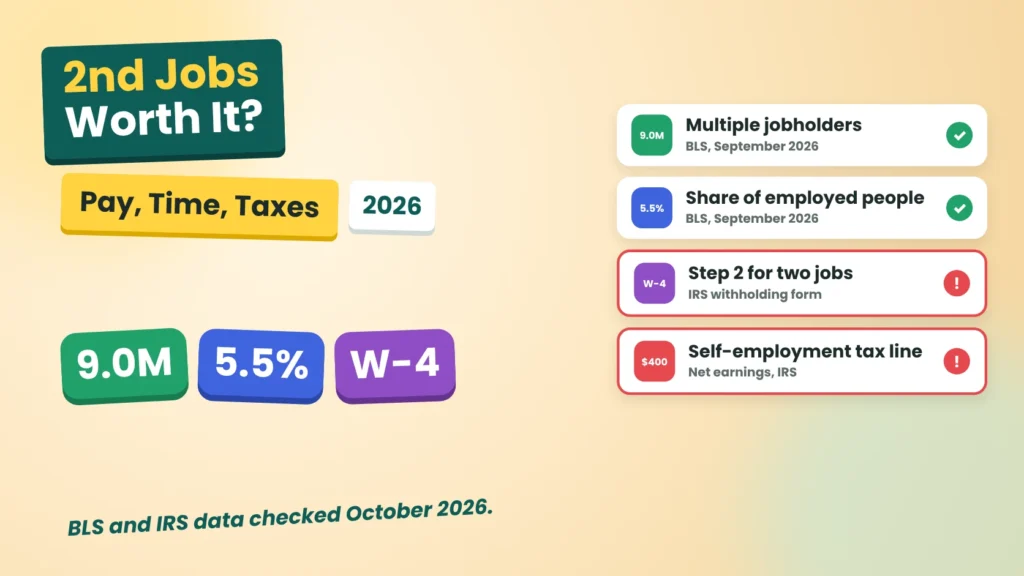
2nd jobs are common, and most of the people who take them keep a full-time job as the main one. The Bureau of Labor Statistics (BLS) counted about 9.0 million multiple jobholders in September 2026, which is 5.5% of everyone employed. So you are not unusual if you are thinking about adding income this way. The catch is that a second paycheck brings two costs people forget: your time and your tax withholding.
This guide is for you if you already have a job and want a second one without burning out or getting a surprise tax bill. I haven’t worked a second job myself while holding another, so I won’t invent a story. What I did was read the BLS employment data and the IRS withholding rules, then turn them into a short checklist you can use before you apply.
Quick heads-up: two links near the middle point to my own digital products, so I may earn something if you buy. Nothing in this guide depends on that.
Last updated: October 2026. Tax forms and employment numbers change, so check each source before you decide.
Key Takeaways
- 2nd jobs are a normal move. BLS reports 9.0 million multiple jobholders in September 2026, or 5.5% of employed people.
- Most start from a full-time job. About 5.2 million of them work full time on the main job and part time on the second.
- Withholding can fall short. The IRS says each job is withheld as if it were your only income, so two jobs usually need an adjustment on Form W-4.
- Time is the real price. A 2nd job that pays well on paper can drop fast once commuting and tired evenings are counted.
- Pick the schedule first. Choose the job that fits your free hours, then compare pay.
What Are 2nd Jobs and Who Takes Them?
A 2nd job is any paid work you do on top of your main job. It can be a part-time shift, a gig you pick up on weekends, or freelance work you do from home. Some people take 2nd jobs to pay off debt or build savings, and others use them to test a new career before leaving the first one.
What makes the choice hard is that every 2nd job competes with the same limited resource: the hours you have left after your main job. That is why I’d start any search by looking at your calendar, not at job boards.
How Many People Have 2nd Jobs?
A lot, and the split says something about how people use them. Here are the figures for September 2026 from BLS Table A-16, not seasonally adjusted.
| Group | September 2026 |
|---|---|
| All multiple jobholders | 9,000,000 (5.5% of employed) |
| Full-time main job, part-time second job | 5,199,000 |
| Both jobs part time | 2,250,000 |
| Both jobs full time | 421,000 |
| Hours vary on main or second job | 1,066,000 |
| Women (share of employed) | 6.4% |
| Men (share of employed) | 4.7% |
Two things stand out. First, a full-time main job with a part-time second job is the most common mix, so the typical person with 2nd jobs is stretching a standard work week, not replacing it. Second, the number rose from 8.79 million a year earlier, so this is a growing habit. What I take from that is a plain point: if you are tired already, a second job needs a plan, not just an application.
Which 2nd Jobs Fit Which Schedule?
The best 2nd jobs are the ones that match your free hours, not the ones with the highest hourly rate. I haven’t tested these myself, so treat the list as categories to explore, and check pay and rules on your own.
- Fixed evening or weekend shifts. Retail, food service and event work come with a schedule, which helps if your main job is rigid. Shifts are set by the employer, so you may have less say about when you work.
- Gig work on your own schedule. Delivery and rides let you pick your hours. My guide to driving for Uber Eats shows what that kind of work asks from you.
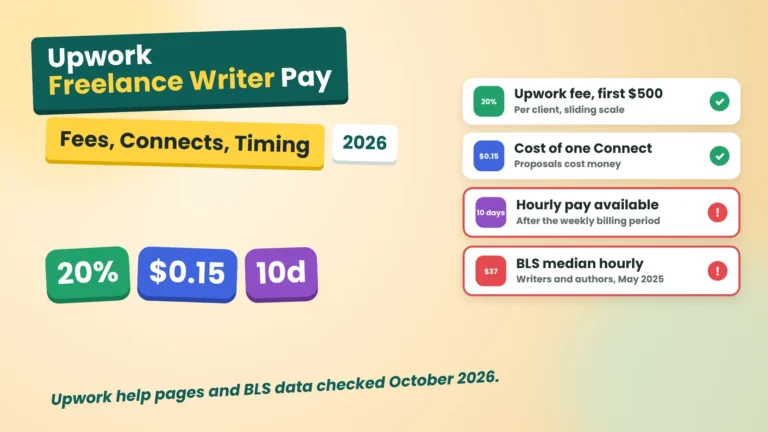
- Freelance work from home. Writing, design and admin tasks can fit around a main job. Read my breakdown of Fiverr jobs and the Upwork freelance writer guide before you sign up, because fees and payment delays matter.
- Remote part-time roles. These save commuting time. See my list of remote side jobs.
- Cash-flow-first options. If you need money within days, look at side hustles that pay daily.
If you also want a broader list of part-time options, my guide to the best part-time jobs compares them by pay and flexibility.
How Do Taxes Work With 2nd Jobs?
Each employer withholds as if that job were your only source of income, and that is the problem. The IRS explains that only one standard deduction applies to your return, and tax rates rise with income, so the combined pay from two jobs generally needs more withholding than either job would produce alone. If you don’t adjust, you will likely owe tax when you file, and penalties are possible.
Step 2 of the current Form W-4 gives you three options, and you use only one:
- The online estimator. The form says this is the most accurate choice, and it is the one to use if you or your spouse have self-employment income.
- The Multiple Jobs Worksheet. You run the worksheet and enter the result in Step 4(c).
- The checkbox. This applies only if there are two jobs total, and the other job’s W-4 must be checked too. The IRS says it cuts the standard deduction and tax brackets in half for each job, so it works best when the two jobs pay about the same.
The IRS Tax Withholding Estimator takes about 25 minutes and can generate a pre-filled Form W-4 for your employer. The form also says to complete Steps 3 and 4(b) on only one W-4, ideally for the highest-paying job.
And if your 2nd job is self-employment, the rules shift again. The IRS says you generally owe self-employment tax once net earnings from self-employment reach $400, so keep records from the first payment. My guide to financial planning for gig workers shows how to set money aside.
I’m not a tax advisor, so treat this as a starting point and use the estimator for your own numbers.
How Do You Pick the Right 2nd Job?
Start with hours and energy, then compare pay. Here is the order I’d follow.
- Count your free hours. Be honest about what is left after work, commuting, sleep and family. Ten hours a week is a lot for many people.
- Do the take-home math. Divide the pay by all the hours the job costs you, including travel and prep.
- Check the schedule rules. Ask whether shifts are fixed, how far ahead you get them and whether you can say no.
- Read your main job’s contract. Some employers limit outside work, so confirm yours before you accept anything.
- Set a stop date. Decide how long you will keep the second job, or what goal ends it. That makes it easier to quit when you hit it.
Here is an illustration (an example, not a promise). Say a 2nd job pays $18 an hour for 10 hours a week. That is $180 a week before tax, or about $780 a month. Now add 3 hours of commuting each week. You spend 13 hours to earn $180, which works out to about $13.85 an hour. The same job from home at 10 hours would keep the full $18. That gap is why I’d ask about the commute before the pay.
Not sure which idea deserves your limited hours? My Side Hustle Idea Validator helps you test an idea against demand, competition and startup cost, and the free 50 AI side hustle ideas list gives you more options to weigh.

What Are the Risks and Mistakes to Avoid?
The main risks with 2nd jobs are burnout, a tax surprise and a conflict with your main employer. Here are the mistakes I’d watch for.
- Skipping the W-4 update. Without it, you may owe tax at filing time because each job is withheld on its own.
- Counting only the hourly rate. Commuting, uniforms and recovery time lower what you earn per hour.
- Taking a job with unpredictable shifts. Last-minute schedules can clash with your main job and put it at risk.
- Ignoring your main employer’s rules. Check your contract on outside work and conflicts of interest.
- Going without rest. If you work seven days a week for months, quality drops at both jobs. Build a day off into the plan.
For more ways to earn without taking on a full second schedule, read my guide to extra income while working full-time.
FAQ
How many people have 2nd jobs?
BLS counted about 9.0 million multiple jobholders in September 2026, or 5.5% of employed people. About 5.2 million worked full time on their main job and part time on their second.
Do 2nd jobs change how much tax you pay?
They can change how much is withheld. Each employer withholds as if that job were your only income, so combined pay often needs extra withholding. Step 2 of Form W-4 and the IRS Tax Withholding Estimator help you adjust it.
What is the best way to handle Form W-4 with two jobs?
The IRS says to choose one option in Step 2: the online estimator, the Multiple Jobs Worksheet, or the checkbox if you have only two jobs. Complete Steps 3 and 4(b) on one form only, ideally for the highest-paying job.
Can your employer stop you from having a 2nd job?
It depends on your contract and company policy, so read yours before you accept a second job. I haven’t found a single official rule that covers every employer, which is why I’d ask HR or check the contract.
The Bottom Line
2nd jobs are a normal way to add income, but they cost more than the hourly rate suggests. The honest picture: the pay can be real, and so are the time cost, the tax adjustment and the risk of burning out at both jobs.
My advice: count your free hours, run the take-home math with commuting included, update your W-4 before the first paycheck, and set an end date for the second job. And if the BLS numbers or IRS forms have changed by the time you read this, send me a message through the contact page so I can update the guide.

Writes and tests every guide on hustle&passive. Everything here is something we have actually run — including the parts that did not work.