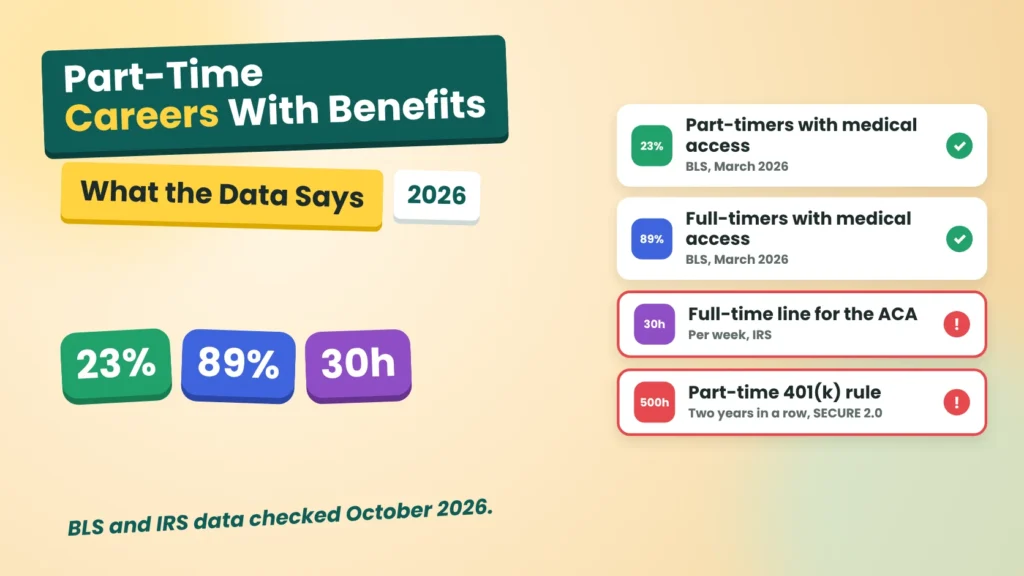
Part-time careers with benefits exist, but they are the exception. The Bureau of Labor Statistics (BLS) says 23% of part-time workers had access to employer medical coverage in March 2026, compared with 89% of full-time workers. So if you want a part-time job and health insurance in the same package, you need to know the rules before you apply.
This guide is for you if you work fewer than 40 hours and want to know where benefits come from, or if you are thinking about cutting your hours and don’t want to lose your coverage. I’m not a benefits advisor, so treat this as plain-English research, not advice. What I did was read the official BLS data, the IRS rules and the HealthCare.gov pages, then turn them into a checklist you can use.
Quick heads-up: there are no affiliate links in this guide. I’m not selling a plan or a job board here, so nothing depends on what you choose.
Last updated: October 2026. Benefit rules and thresholds change, so check each source before you decide.
Key Takeaways
- Part-time careers with benefits are rarer than full-time ones. BLS reports 23% of part-time workers had access to medical care benefits, versus 89% of full-time workers.
- Hours decide the rules. For health insurance, the IRS treats 30 hours a week (or 130 hours a month) as full-time.
- Retirement access is improving. Under the SECURE 2.0 Act, many part-timers who log 500 hours a year for two straight years can join a 401(k) deferral plan.
- You may have a backup. If your job offers no coverage, the HealthCare.gov Marketplace can be an option.
- Ask before you accept. Every employer sets its own hours threshold, so get it in writing.
What Counts as a Part-Time Career With Benefits?
A part-time career with benefits is a job under full-time hours that still gives you at least one benefit, such as health coverage, retirement savings or paid leave. The label depends on your employer’s policy, not on a universal rule, which is why two part-time jobs with the same hours can offer different packages.
Here is why that matters for anyone hunting part-time careers with benefits. Employer health coverage rules mostly key off one number: hours. Cross the line and you may be eligible. Stay under it and you probably aren’t. That is where I’d start any search.
How Common Are Part-Time Careers With Benefits?
Not common. BLS’s National Compensation Survey for March 2026, released on September 25, 2026, gives these numbers for medical care benefits and retirement benefits.
| Measure | Full-time | Part-time |
|---|---|---|
| Medical care access, all civilian workers | 89% | 23% |
| Medical care take-up, all civilian workers | 68% | 49% |
| Medical care access, private industry | 87% | 23% |
| Retirement access, state and local government | 99% | 44% |
| Retirement participation, state and local government | 88% | 37% |
Two things stand out. First, even when a part-timer is offered medical coverage, fewer take it (49% versus 68%), which hints that cost matters. That is my reading, not a BLS conclusion. Second, state and local government is a bright spot for retirement: 44% of part-time workers there had access. The BLS page I used gives no private-industry retirement figure to compare it with, so I can’t say how it stacks up.
How Many Hours Do You Need to Qualify for Benefits?
For health coverage under the Affordable Care Act, a full-time employee is someone with an average of at least 30 hours of service per week in a calendar month, or at least 130 hours in that month, according to the IRS. The rule applies to “applicable large employers,” which means those with an average of at least 50 full-time employees, counting full-time equivalents.
In plain terms: if you work for a large employer and average 30 hours a week, you may be on the list to be offered coverage. If you work 20 hours, you usually aren’t, though some employers set a lower bar on their own. Small employers aren’t covered by that rule, so what they offer is up to them.
Here is an example, not a promise. Say two part-time jobs pay the same. One caps you at 28 hours a week. The other lets you reach 30. The second may be the one that opens health coverage, even though the pay looks identical. That’s why I’d ask about the hours threshold before the hourly rate.
Can Part-Time Workers Join a 401(k)?
Increasingly, yes. Under the SECURE 2.0 Act, a long-term part-time employee who works at least 500 hours in each of two consecutive 12-month periods must be allowed to make deferrals into the employer’s 401(k) plan. IRS Notice 2024-73 says the rule applies to plan years beginning after December 31, 2024.
The catch: the employer doesn’t have to make matching or other employer contributions for these workers, only allow them to defer their own pay. So it opens the door to saving, but it doesn’t add free money. The IRS notice also says the final regulation applies no earlier than plan years beginning on or after January 1, 2026, so ask your plan administrator how your employer applies it.
What Should You Do If Your Part-Time Job Has No Health Benefits?
Look at the Marketplace. HealthCare.gov says you can lose savings if your job-based plan is both affordable and meets minimum standards, and that you won’t qualify for savings if you’re enrolled in a job-based plan. If the job doesn’t offer coverage, a Marketplace plan is a path to explore, and applying doesn’t automatically enroll you.
Rules about subsidies and enrollment windows are detailed and change, so I’d start at HealthCare.gov and read your own situation there. Don’t pick a plan based on a blog post, including this one.
How Do You Find Part-Time Careers With Benefits?
Search for part-time careers with benefits by employer policy, not by job title. I haven’t verified a list of specific companies, so I won’t name any, and I’d be wary of lists that do without dates. Here is the order I’d follow.
- Target large employers and government. Large employers are the ones the ACA rule applies to, and BLS reports 44% of part-time state and local government workers had retirement access.
- Check the benefits page before you apply. Look for words like “eligible” and “hours per week.”
- Ask the recruiter three questions. What is the weekly hours threshold for health coverage, when does coverage start, and does the 401(k) apply to part-timers?
- Get the answer in writing. A recruiter’s verbal promise isn’t a plan document.
- Compare the total package. A slightly lower wage with coverage can beat a higher wage without it, but only if you’d use the benefit.
If you are still choosing the job, my guide to the best part-time jobs lists options by pay and flexibility. And if you are weighing a move out of a full-time role, from side hustle to full-time income covers the health insurance side of that decision.
What Are the Risks and Mistakes to Avoid?
With part-time careers with benefits, the main risks are assuming a part-time job includes benefits, losing coverage when your hours drop, and paying for a plan you don’t need. Here are the mistakes I’d watch for.
- Assuming eligibility. Plans have waiting periods and hours thresholds, so confirm yours.
- Dropping below the hours line. A schedule cut from 30 to 25 hours can change your eligibility.
- Ignoring take-up costs. An offered plan still has a premium, and the Marketplace may cost less or more depending on your situation.
- Forgetting side income. If you also freelance, the IRS says you generally owe self-employment tax once net earnings reach $400, so plan for it.
- Skipping a safety net. My guide to financial planning for gig workers shows how to build one when your job has no benefits.
For more ways to earn on top of a job, see my guide to extra income while working full-time.
FAQ
Do part-time careers with benefits exist?
Some do, but most part-time jobs don’t offer them. BLS reports 23% of part-time workers had access to medical care benefits in March 2026, compared with 89% of full-time workers. Eligibility depends on the employer and the hours you work.
How many hours do you need to work to get health insurance from an employer?
Under the Affordable Care Act, the IRS defines a full-time employee as someone averaging at least 30 hours of service per week in a month, or 130 hours in the month. Large employers are generally expected to offer coverage to full-time employees, and some offer it at lower hours too.
Can a part-time employee get a 401(k)?
Often yes. Under SECURE 2.0, employees with at least 500 hours in each of two consecutive 12-month periods generally must be allowed to defer pay into the plan, for plan years beginning after 2024. Employers aren’t required to add matching contributions for them.
What can you do if your part-time job has no health insurance?
Check the HealthCare.gov Marketplace. You may qualify for savings if you aren’t offered affordable job-based coverage, and applying doesn’t automatically enroll you. Review your own situation on the site, since the rules and deadlines change.
The Bottom Line
Part-time careers with benefits are real, but they depend on your employer’s hours threshold more than on the job title. The honest picture: only 23% of part-time workers have access to medical benefits, so you’ll have to look for the jobs that offer them and ask the right questions first.
My advice: before you accept any of the part-time careers with benefits you find, get the hours threshold, the start date for coverage and the 401(k) rule in writing. And if the thresholds or the SECURE 2.0 guidance have changed by the time you read this, send me a message through the contact page so I can update the guide.

Writes and tests every guide on hustle&passive. Everything here is something we have actually run — including the parts that did not work.