
Disclosure: some links in this guide are affiliate links, so I may earn a commission if you buy through them, at no extra cost to you. Last updated: October 2026.
Knowing where to find virtual assistant clients matters more than any course or certificate. Most new VAs don’t struggle with the work; they struggle to find the first two or three people who’ll pay for it. And the places they’re told to look, mostly freelance platforms, are also where competition is highest and a cut of every payment disappears.
This guide compares 12 places to find VA clients and virtual assistant jobs, with the real fee or cost of each, who it suits, what it requires and how long it usually takes to land someone. Fees and requirements come from each platform’s own pages.
Key Takeaways
- Your first client often comes from people you know or a direct pitch, not from a job board.
- Platforms trade speed for fees: Upwork charges freelancers 0% to 15% per contract and Fiverr takes a flat 20%, while direct clients cost nothing but take longer to find.
- Paid job boards and agencies suit experienced VAs: most agency roles ask for prior professional experience.
- Consistency beats clever tactics: a few personal pitches every weekday and one follow-up each will outperform a burst of applications.
- Never pay to get a VA job. Real clients don’t charge you for training or equipment.
Still choosing your services? Our guide to becoming a virtual assistant with no experience covers what to offer and how to build samples first.
If writing is one of your services, our list of the best freelance writing websites compares 11 platforms that pay writers, with what each one pays.
Where to Find Virtual Assistant Clients: 12 Places Compared
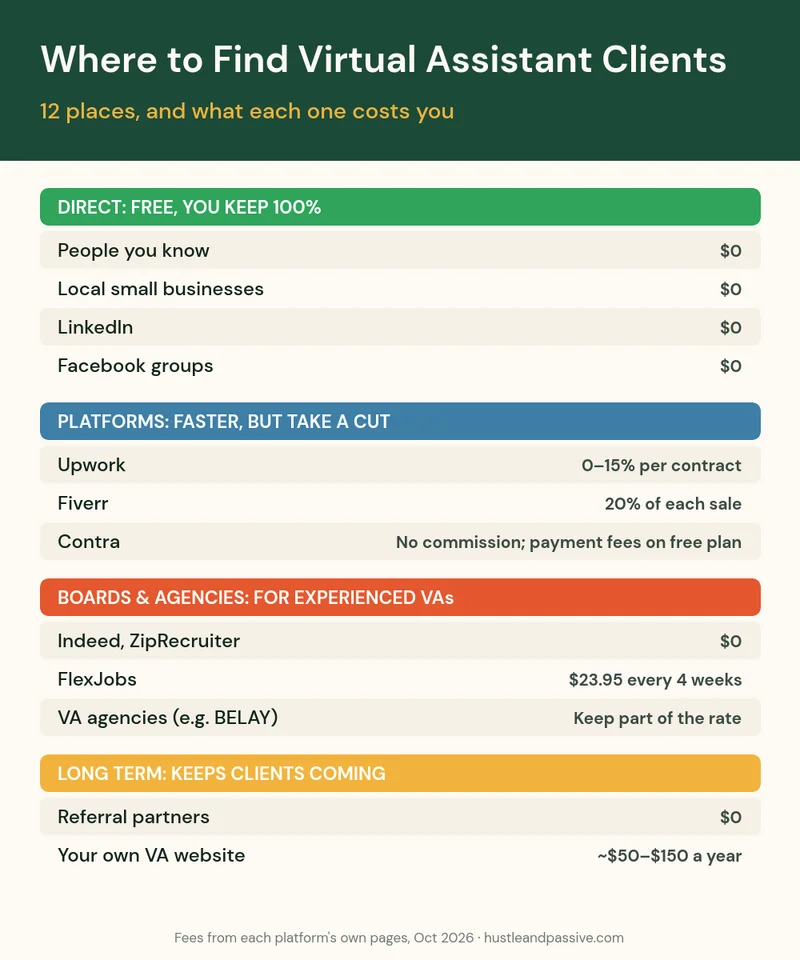
Here’s where to find virtual assistant clients, compared side by side.
| Where | Cost or fee | Requirements | Best for | Time to first client* |
|---|---|---|---|---|
| 1. People you already know | $0 | A clear offer | Your very first client | Days to 2 weeks |
| 2. Local small businesses | $0 | A specific pitch and samples | Steady monthly work | 2–6 weeks |
| 3. LinkedIn | $0 (Premium optional) | A clear headline and profile | Coaches, consultants, founders | 4–8 weeks |
| 4. Facebook groups | $0 | Following each group’s rules | Referrals and small jobs | 2–6 weeks |
| 5. Upwork | 0%–15% of each contract | 18 or older | Small, defined jobs | 2–6 weeks |
| 6. Fiverr | 20% of each sale | 18 or older (13–17 via a parent’s account) | Fixed-price mini services | 2–8 weeks |
| 7. Contra | Commission-free; payment fees on the free plan | A portfolio profile | VAs with design or tech skills | 4–8 weeks |
| 8. Free job boards (Indeed, ZipRecruiter) | $0 | A resume | Part-time employed admin roles | 2–6 weeks |
| 9. FlexJobs | $2.95 trial, then $23.95 every 4 weeks | A paid subscription | Vetted remote job listings | 2–6 weeks |
| 10. VA agencies (e.g. BELAY) | $0 to apply | Usually prior professional experience | Steady work without selling | Weeks to months |
| 11. Referral partners | $0 | A good relationship | Recurring warm leads | 1–3 months |
| 12. Your own VA website | About $50–$150 a year | A domain and hosting | Credibility and search leads | 3–6 months |
*Time to first client is our estimate, based on each channel’s setup and approval steps. Your niche, samples and outreach volume move it a lot.
Direct Channels: The Best Place for Your First Client
If you’re wondering where to find virtual assistant clients for free, start here. Direct channels cost nothing and have no middleman, so you keep everything the client pays. They take more effort to start, but they’re often the fastest route to client number one.
1. People you already know
A friend who runs a small business, a former manager who went freelance, a relative with a busy practice. They already trust you, which is the hardest thing to earn as a new VA. Send a personal message, not a mass post:
“Hi [Name], I’ve started offering virtual assistant support for small businesses: inbox cleanup, scheduling and simple social posts. You mentioned [a busy season]. If a few hours of help a week would take something off your plate, I’d be glad to do a short trial. Would a 15-minute call on [day] work?”
2. Local small businesses
Dentists, real estate agents, salons, coaches and trades businesses often need admin help but never post a job ad. Look for a specific gap you can fix, like unanswered reviews or no appointment reminders, and pitch that one thing with a sample of how you’d handle it.
3. LinkedIn
LinkedIn works best for VAs who serve coaches, consultants and founders. Make your headline say who you help and how (“Virtual assistant for real estate agents: inbox, calendar and CRM”), post short examples of your work, and comment usefully on posts by the people you’d like to work with. It’s slow to start, so treat it as a weekly habit.
4. Facebook groups
Small business, VA and industry groups are full of owners asking for help. Answer questions generously first; many groups ban direct self-promotion, so read the rules and use the weekly promo threads where they exist.
Freelance Platforms and Virtual Assistant Job Sites: Faster, but You Pay a Cut
Virtual assistant job sites like Upwork, Fiverr and Contra bring clients who are already looking to hire, which speeds things up. In exchange, they take part of every payment and competition is high. Know the fee before you set your rate.
5. Upwork
Upwork’s freelancer service fee ranges from 0% to 15% per contract, and you see the exact rate before you accept an offer, according to Upwork’s fee page. Users must be at least 18. Apply to small, clearly defined jobs and open each proposal by repeating the client’s exact task:
“You need [the task from the job post] done by [deadline]. Here’s how I’d handle it: [2–3 concrete steps]. I’ve attached a sample of a similar task. I can start on [day].”
6. Fiverr
Fiverr takes a flat 20% commission on every sale, including tips, so you keep 80%, according to Fiverr’s own guide. It works best for narrow, fixed-price services (“inbox cleanup in 48 hours”) rather than a general “I do everything” gig. Price with the fee in mind: a $25 task pays you $20.
7. Contra
Contra is commission-free for freelancers, according to Contra’s pricing page, though the free plan charges a fee on client payments and the Pro plan costs $29 a month. It suits VAs who also offer design, website or tech support and can show a strong portfolio.
Virtual Assistant Jobs: Job Sites, Job Boards and Agencies
8. Free job boards
Indeed and ZipRecruiter list part-time and remote administrative roles, often as employed positions rather than freelance clients. Filter for “part-time” and “remote,” and be careful: fake job listings are common. The FTC’s job scams guide is worth reading before you apply anywhere.
9. FlexJobs
FlexJobs is a paid job board that screens its remote listings. It costs $2.95 for a 14-day trial, then $23.95 every four weeks, or $71.40 a year, according to FlexJobs’ pricing page. It makes more sense for experienced VAs looking for steady part-time roles than for beginners.
10. VA agencies
Agencies find the clients and match you to them, so you spend less time selling. The trade-off is that they keep part of the client’s rate and usually want experience. BELAY, for example, says most roles require prior professional experience in administrative support or related fields, and it currently accepts contractors from US states except California, Colorado, Montana, New Jersey, New York and Pennsylvania, per its careers page. Apply once you have a few months of client work to point to.
Long-Term Channels That Keep Clients Coming
11. Referral partners
Web designers, bookkeepers, business coaches and marketing freelancers regularly meet clients who need admin help. Offer to refer work their way too, and a single partner can send you a steady stream of warm leads.
12. Your own VA website
A simple site with your services, samples and a booking link makes every other channel convert better, and over time it can bring in clients from search, especially with a niche like “virtual assistant for dentists.” A one-page site on a host like Hostinger is enough to start.
Host Your Own Storefront for Under $2.99/Month
Skip the marketplace cut entirely. Hostinger runs everything from landing pages to checkout, fast enough to handle a launch spike without falling over.
A Weekly Routine to Find VA Clients
How to find virtual assistant clients consistently comes down to a routine you can keep for a month, not a burst of effort. Here’s a simple one that fits around a job:
| Day | What to do | Time |
|---|---|---|
| Monday | List 10 new prospects: businesses, people you know, job posts | 30–45 min |
| Tuesday to Thursday | Send 5 personal pitches a day, each mentioning something specific | 30–45 min a day |
| Friday | Follow up once on every pitch from last week with no reply | 30 min |
| Weekend | Improve one sample or your profile | 1 hour |
The part most VAs skip is tracking. Without it, follow-ups get forgotten and warm leads go cold. A spreadsheet works; if you’d rather not build one, a free CRM like HubSpot keeps every contact, pitch and follow-up date in one place and reminds you when to reach out.

Own Your Buyer List
Marketplace traffic isn’t yours. It’s borrowed. HubSpot’s free CRM captures every buyer’s email from your own store so your next launch doesn’t start from zero.
Where to Find Virtual Assistant Clients First
- Brand new, no experience: people you know and local businesses first, with a small Upwork or Fiverr profile running alongside.
- Some experience, want steady work: VA agencies and FlexJobs, plus LinkedIn.
- Specialized skills (design, bookkeeping, tech): Contra, LinkedIn and referral partners, where specialists stand out.
- Working a full-time job: choose clients with deadline-based tasks. Our guide to extra income while working full-time covers how to fit client work around your hours.
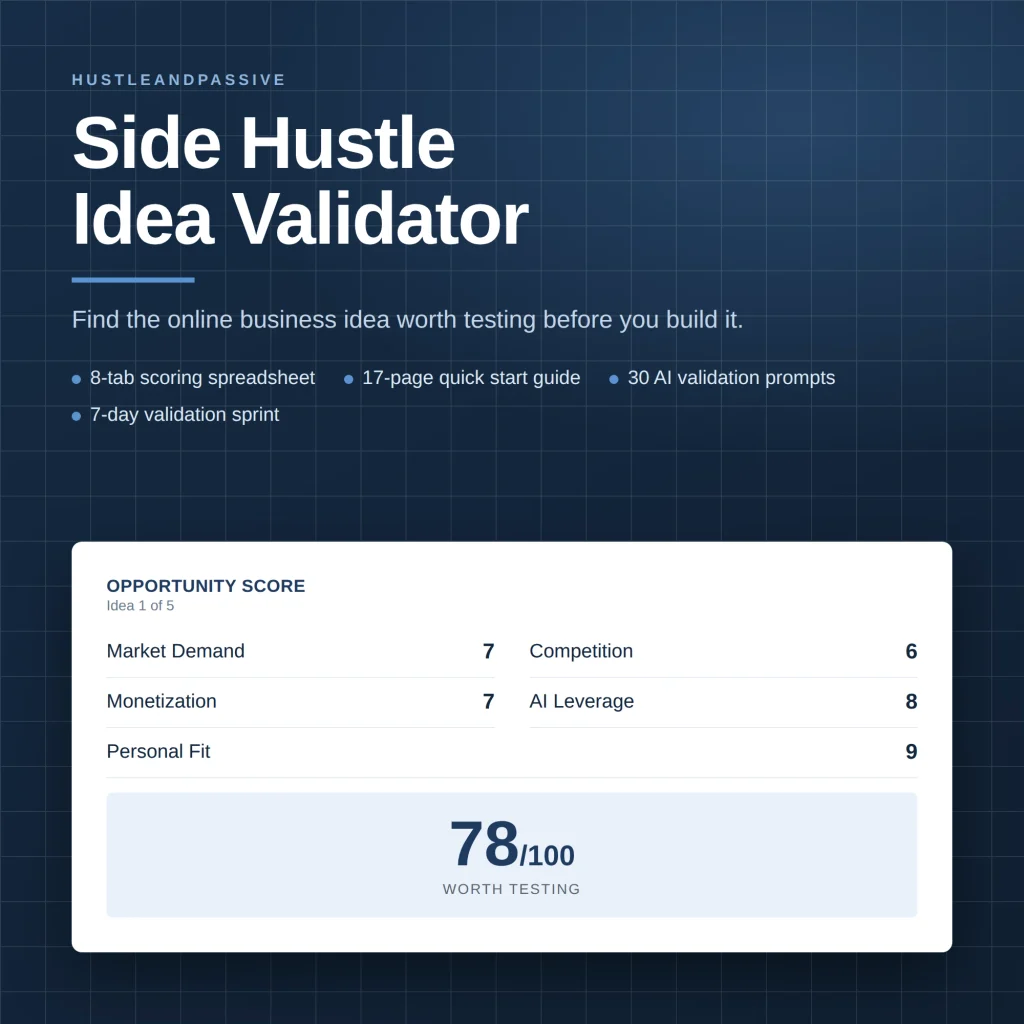
My Side Hustle Idea Validator ($9) scores each option on demand, competition, startup cost and personal fit, so you can choose one to test first.
Mistakes That Keep VAs From Finding Clients
Knowing how to find virtual assistant clients is half the job; avoiding these mistakes is the other half.
- Offering everything. “General admin support” is forgettable; “inbox and calendar management for coaches” is not.
- Only applying to job posts. The best clients often never post an ad.
- No samples. Three practice pieces beat a long list of skills.
- Not following up. Some replies only come after a polite second message.
- Pricing without fees in mind. On Fiverr, 20% of every sale goes to the platform.
For the tools you’ll need once clients arrive, see our guide to the best virtual assistant tools, and for other remote options, our list of remote side jobs.
Finding Virtual Assistant Clients FAQ
Where can I find virtual assistant jobs online?
You can find virtual assistant jobs online on freelance platforms such as Upwork, Fiverr and Contra, on free job boards, on paid boards like FlexJobs, and through VA agencies. For your first client, direct outreach to people you know, local small businesses and LinkedIn contacts usually works faster than applying to crowded job posts.
Where can I find virtual assistant clients?
Start with people you already know and local small businesses, where trust already exists, then add LinkedIn, Facebook groups and freelance platforms like Upwork, Fiverr or Contra. Experienced VAs can also apply to VA agencies or use a vetted job board like FlexJobs.
How do I get my first virtual assistant client with no experience?
Offer two or three specific services, create three practice samples, and send personal messages to people you know and local businesses, offering a short trial. Follow up once. A small Upwork or Fiverr profile can run alongside.
What are the best virtual assistant job sites for beginners?
Upwork is a good starting point for small, defined jobs, with a fee of 0% to 15% per contract. Fiverr suits fixed-price mini services but takes 20% of each sale. Most VA agencies and paid job boards suit VAs with some experience.
Is FlexJobs worth it for virtual assistants?
It can be for experienced VAs looking for steady part-time roles, since it screens its remote listings. It costs $2.95 for a 14-day trial, then $23.95 every four weeks or $71.40 a year, so beginners are usually better off with free channels first.
How can I tell if a virtual assistant job is a scam?
Be wary of any job that asks you to pay for training or equipment, sends you a check to deposit and forward, promises high pay for very little work, or only communicates through messaging apps. The FTC’s job scams guide covers the most common warning signs.
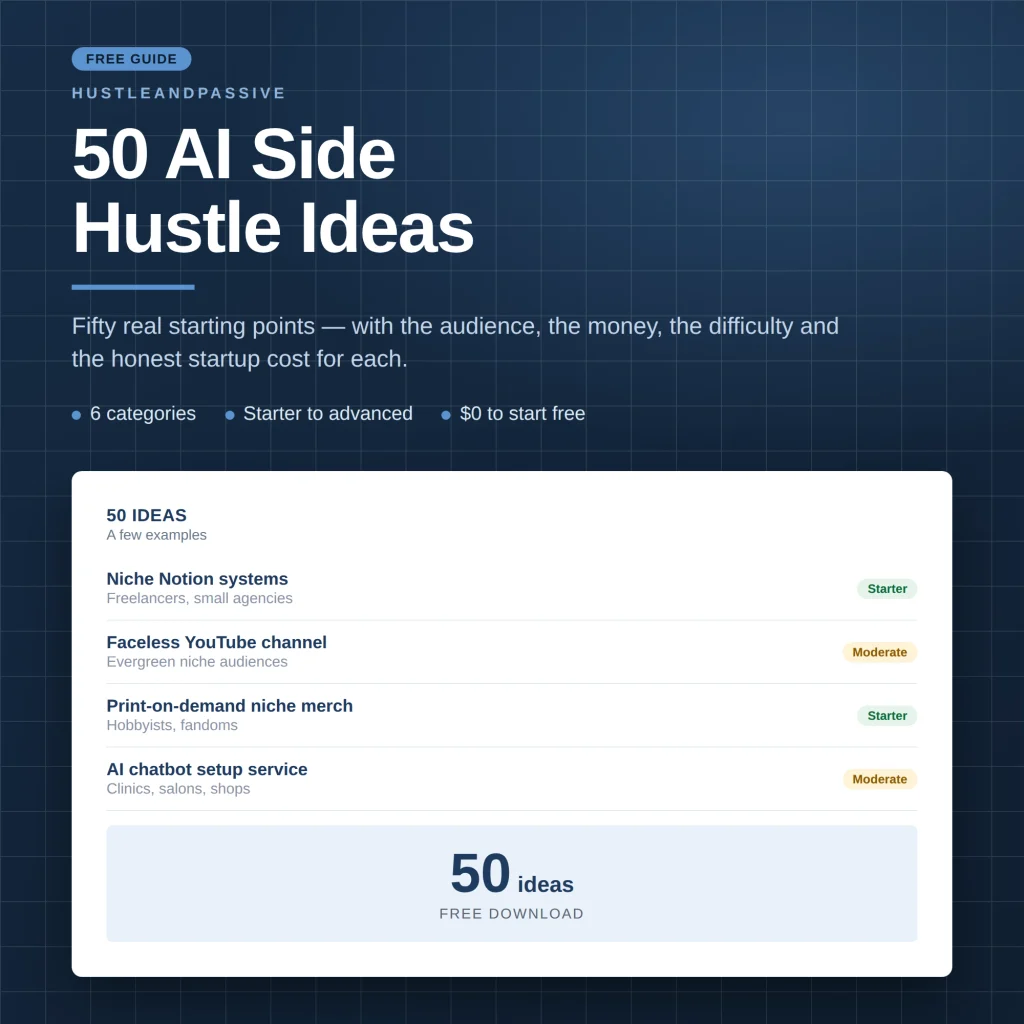
The free 50 AI Side Hustle Ideas list gives you fifty other starting points to compare.

Writes and tests every guide on hustle&passive. Everything here is something we have actually run — including the parts that did not work.