Disclosure: some links in this guide are affiliate links, so I may earn a commission if you buy through them, at no extra cost to you. Last updated: September 2026.
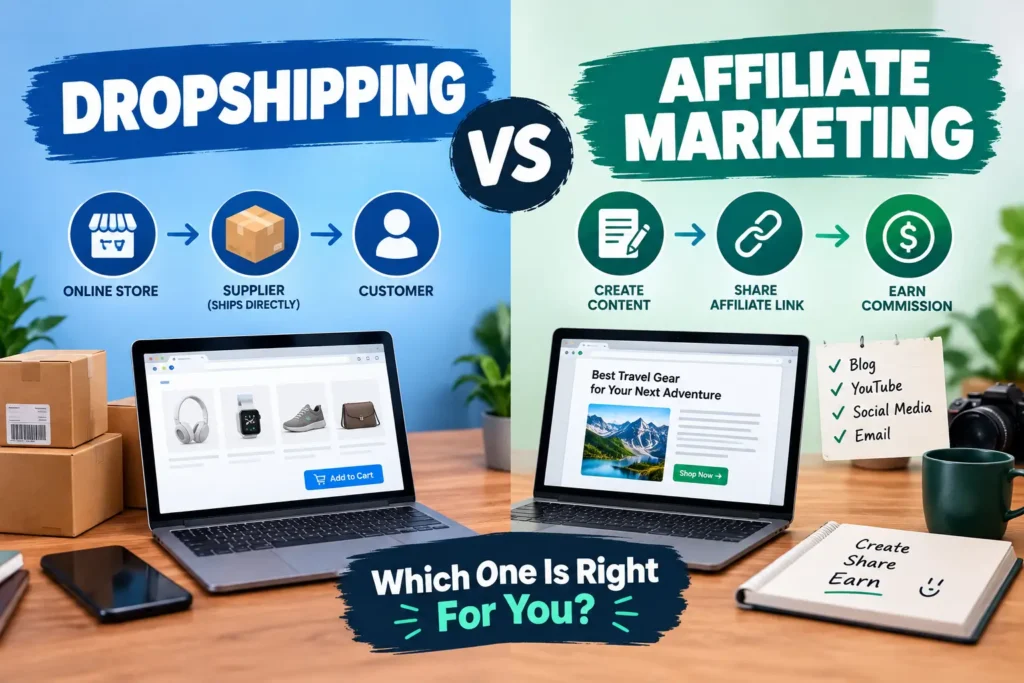
Both models let you sell products you didn’t make, and both get pitched as “easy passive income.” They’re not the same business at all. With dropshipping you run a store, own the customer and carry the risk when an order goes wrong. With affiliate marketing you recommend other companies’ products and earn a commission, but you control very little. This guide compares dropshipping vs affiliate marketing on startup cost, profit per sale, workload and risk, with two worked examples, so you can pick the one that fits you.
Dropshipping vs Affiliate Marketing: Key Takeaways
- Affiliate marketing is cheaper and lower-risk to start: you need content and an audience, not inventory, a store or customer service.
- Dropshipping earns more per sale but costs more to run: you pay for the store, payment fees and usually ads, and you handle refunds and delays.
- Affiliate income is slower to start because it depends on traffic, which often takes months; dropshipping can make a first sale sooner if you pay for ads.
- You own the customer in dropshipping, which lets you build a brand; in affiliate marketing, the merchant owns the customer.
- For most beginners with little money, affiliate marketing is the safer first step. Dropshipping suits people with a testing budget and time for customer service.
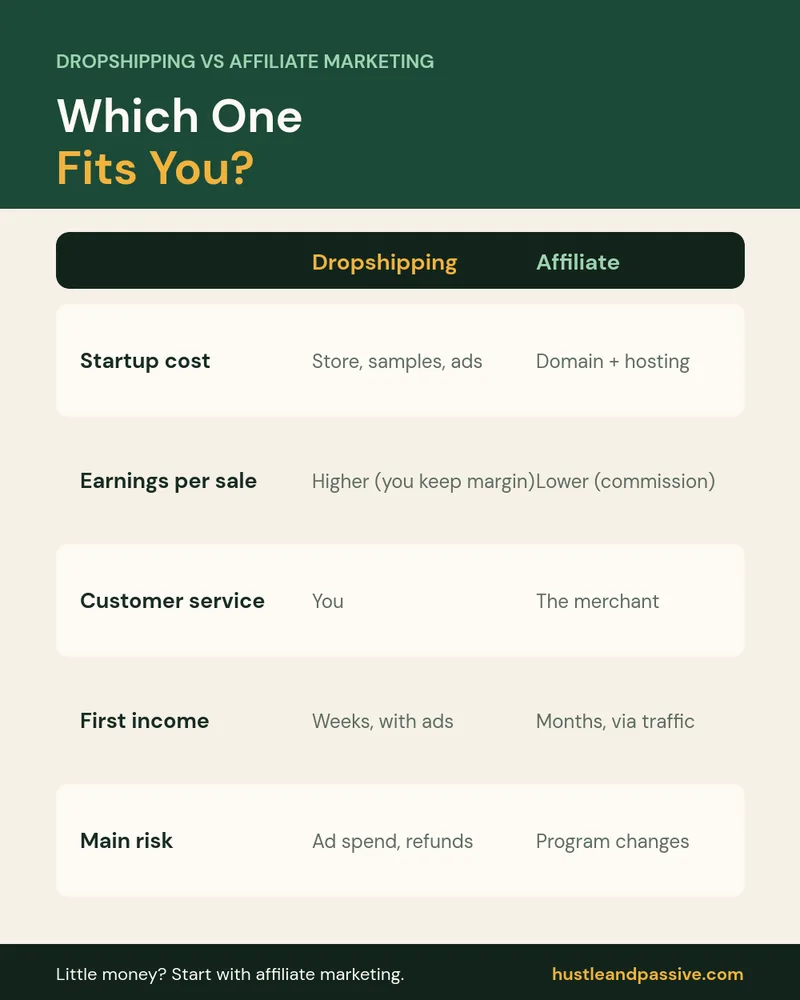
Dropshipping vs Affiliate Marketing at a Glance
| Factor | Dropshipping | Affiliate marketing |
|---|---|---|
| What you sell | Products shipped by a supplier, through your own store | Other companies’ products, through your links |
| Startup cost | Store plan, apps, samples, ad testing | Domain and hosting, or free social accounts |
| How you earn | Sale price minus product cost, fees and ads | A commission per sale or lead |
| Earnings per sale | Higher, you keep the margin | Lower, usually a percentage |
| Customer service | You handle it: delays, returns, refunds | The merchant handles it |
| Who owns the customer | You | The merchant |
| Main traffic source | Mostly paid ads, plus social | Mostly search, content and email |
| Time to first income | Can be weeks, with ad spend | Often months, as content gains traffic |
| Biggest risk | Losing money on ads and refunds | Program changes and commission cuts |
What Is Dropshipping?
Dropshipping is a store model where you sell products online and a supplier ships them directly to your customer, so you never hold inventory. You set the price, run the store and marketing, and keep the difference between your price and the supplier’s cost, minus fees.
Most dropshippers build their store on a platform like Shopify and connect a supplier app. Shopify’s Basic plan is $39 a month, or $29 a month billed yearly, with online card payments at 2.9% + 30 cents in the US, according to Shopify’s pricing page as of September 2026. New stores currently get 3 days free, then $1 a month for 3 months.
Start Your Online Store with Shopify
Turn your idea into a profitable online business with Shopify. Create a professional store, sell digital or physical products, manage payments, and grow your brand with powerful e-commerce tools trusted by millions of entrepreneurs.
What Is Affiliate Marketing?
Affiliate marketing means recommending another company’s product with a tracked link and earning a commission when someone buys. You don’t handle products, payments or customer service; your job is to create content that helps people decide, such as reviews, comparisons and tutorials.
Commissions vary widely by program. Amazon Associates pays between 0% and 20% depending on the category, with most everyday categories at 1% to 4.5% (see our Amazon affiliate marketing guide). Software and online services often pay higher percentages, and some pay recurring commissions for as long as the customer stays subscribed. Always check each program’s current terms.
Which Makes More Money Per Sale?
Dropshipping usually earns more per sale; affiliate marketing usually keeps more of what it earns because costs are lower. Two illustrative examples, with assumptions stated so you can plug in your own numbers:
| Example | Dropshipping: $35 product | Affiliate: $50 product on Amazon |
|---|---|---|
| Sale price | $35.00 | $50.00 (paid by the customer to Amazon) |
| Your product cost | $15.00 including shipping | $0 |
| Payment fees | $1.32 (2.9% + $0.30) | $0 |
| Ad cost per sale (assumed) | $12.00 | $0 if traffic is from search |
| Your earnings | About $6.68 | $2.25 (4.5% kitchen commission) |
| Customer service | Yours | Amazon’s |
The dropshipping store earns about three times more per sale here, but only if ads convert as assumed. If each sale costs $20 in ads instead of $12, the profit becomes a loss. The affiliate earns less per sale but risks almost nothing, so the question is traffic: an affiliate page needs visitors, often from search, which takes time to build. Our guide to ethical affiliate marketing covers how to choose programs that pay better than Amazon.
Dropshipping or Affiliate Marketing: Which Is Easier for Beginners?
Affiliate marketing is easier to start for most beginners because it needs less money and no customer service; dropshipping is easier to get a first sale quickly if you have a budget to test ads.
- Choose affiliate marketing if you have more time than money, enjoy writing or making videos, and are patient enough to wait months for search traffic.
- Choose dropshipping if you have a few hundred dollars to test products and ads, like marketing and numbers, and are ready to answer customer emails about shipping times and returns.
- Avoid both if you need reliable income within a few weeks. A service side hustle, like freelancing, pays faster; see our list of remote side hustles.
What Are the Risks and Rules?
Each model has its own risks, and both come with legal rules beginners often miss.
Dropshipping Risks
- Shipping delays are your responsibility. In the US, the FTC’s Mail, Internet, or Telephone Order Merchandise Rule requires you to ship within the time you state, or within 30 days if you don’t state one. If you can’t, you must tell the customer and offer a cancellation with a prompt refund.
- Ad costs can eat your margin before you find a winning product.
- Supplier quality is out of your hands, but bad reviews land on your store.
- Payment holds and chargebacks are common when customers are unhappy with delivery times.
Affiliate Marketing Risks
- Programs change their terms. Commission cuts or closed programs can reduce income overnight, so don’t rely on one program.
- Traffic can drop after search engine or platform changes.
- Disclosure is required. The FTC expects you to clearly disclose affiliate relationships; see its Endorsement Guides FAQ.
Can You Do Both?
Yes, and many online businesses do them in order. A common path is to start with affiliate content to learn what your audience buys, then launch your own products or a store once you know what sells. The content you build keeps sending visitors to both. If you later move to your own store, our guide on how to start an e-commerce store from scratch covers the setup and real costs.
How to Start Either One in 30 Days
Start Affiliate Marketing
- Pick one niche where people buy things regularly, and check search demand with a keyword tool like Keysearch.
- Set up a simple WordPress site on a host like Hostinger; our niche blog guide walks through it.
- Join two or three affiliate programs that fit the niche, not just one.
- Publish helpful comparisons and reviews with a clear disclosure, and manage your links with a plugin like ThirstyAffiliates so you can update them in one place.
Start Dropshipping
- Choose one product category, and order samples before you sell anything.
- Build your store on Shopify with honest shipping times on every product page.
- Set a fixed test budget for ads and a clear stop point if a product doesn’t sell.
- Write a clear refund and shipping policy, and answer customer messages within a day.
Dropshipping vs Affiliate Marketing FAQ
Is dropshipping or affiliate marketing better for beginners?
For most beginners, affiliate marketing is the safer start because it costs less and needs no inventory or customer service. Dropshipping can make a first sale sooner if you have a budget for ads and time for customer support.
Which is more profitable, dropshipping or affiliate marketing?
Dropshipping usually earns more per sale because you keep the margin, but ad costs, fees and refunds reduce it. Affiliate marketing earns less per sale but has very low costs, so it can be more profitable once you have steady traffic.
How much money do you need to start?
Affiliate marketing can start for the cost of a domain and hosting, or even free with social accounts. Dropshipping needs a store subscription, product samples and usually a few hundred dollars to test ads.
Do I need a website for affiliate marketing?
Not strictly, since you can share links on YouTube or social media where allowed, but a website gives you search traffic you own and makes it easier to build an email list.
The Verdict
In the dropshipping vs affiliate marketing decision, the deciding factor is usually money versus time. If you have more time than money, start with affiliate marketing: build helpful content in one niche, disclose your links and diversify programs. If you have a testing budget and enjoy marketing, dropshipping can work, as long as you order samples, state honest shipping times and set a strict ad budget. Either way, pick one model and give it at least three months before judging it.
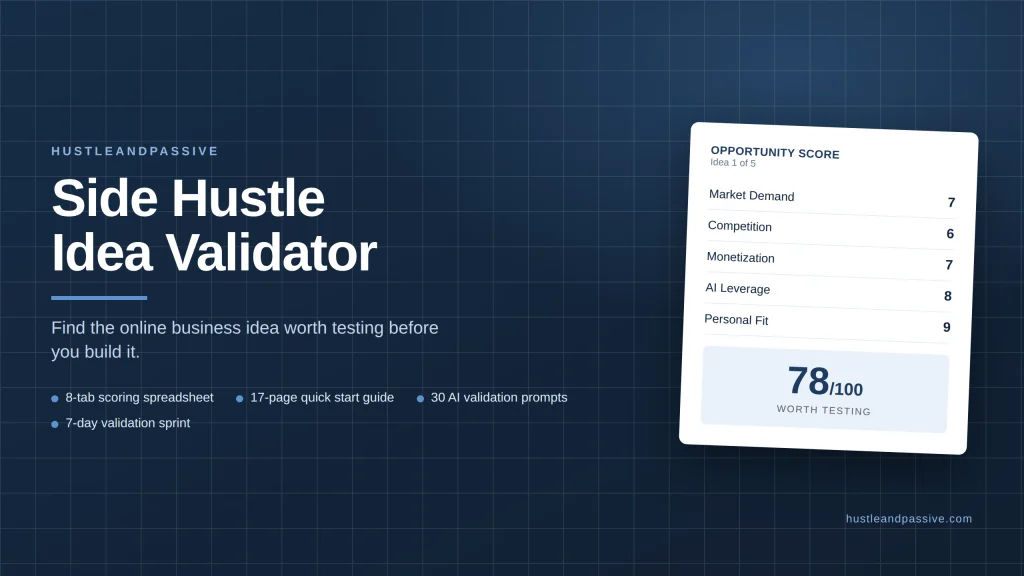
Still torn between the two? My Side Hustle Idea Validator ($9) scores each idea on demand, competition and startup cost so you can compare them side by side, and the free 50 AI Side Hustle Ideas list gives you more options.

Writes and tests every guide on hustle&passive. Everything here is something we have actually run — including the parts that did not work.