
Imagine this. It’s the 28th of the month.
You open your banking app, hoping to see a healthy buffer. Instead, you’re met with a number that makes your stomach drop.
You tell yourself you’ll save more next month. You promise to skip the takeout. You vow to have more willpower.
But here’s the problem. Willpower is a finite resource. It drains by 3 PM on a Tuesday.
Most beginners think saving money is about discipline. They think it requires endless sacrifice and tracking every single penny.
The reality is, saving isn’t about willpower. It’s about system design.
If I started over today, I wouldn’t rely on my own memory or motivation to save. Instead, I would build an automatic saving system that moves my money before I even have the chance to spend it.
This isn’t about getting rich overnight. It’s about removing friction. It’s about making the right financial choice the default choice.
In this guide, I’ll walk you through the exact, simple setup that makes saving automatic. No complex spreadsheets. No financial jargon. Just a clear, actionable blueprint you can set up this weekend.
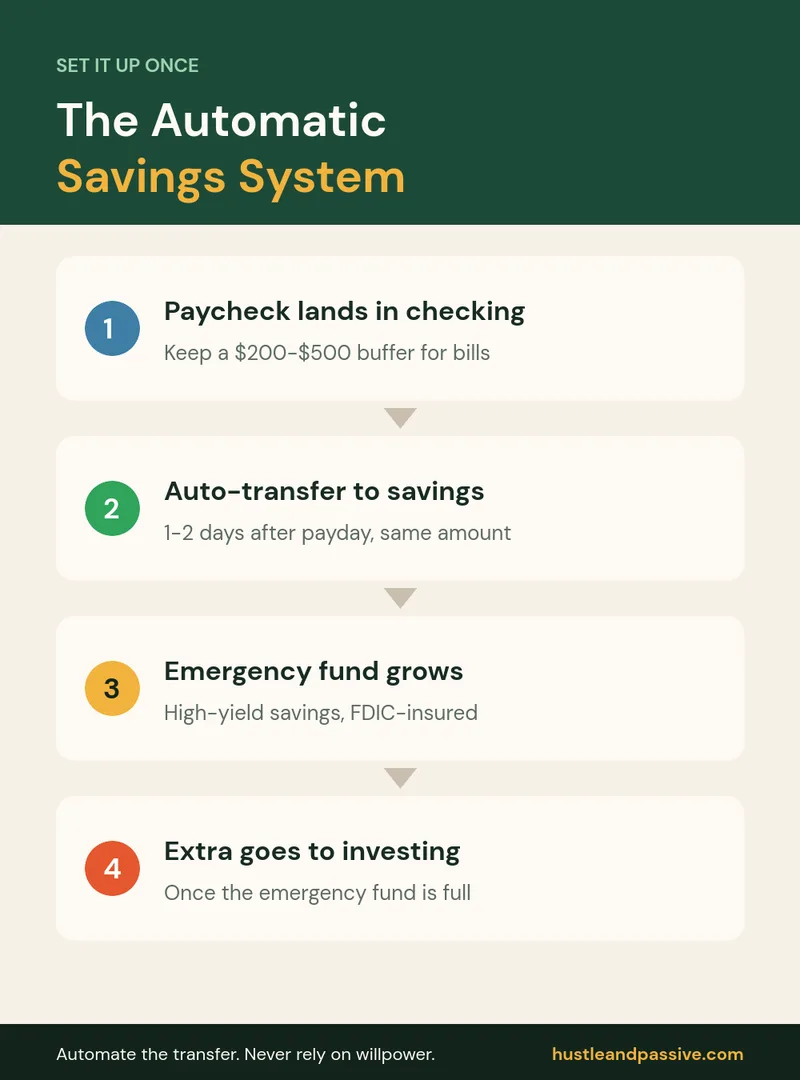
Why Willpower Fails (And Systems Win)
Let’s be honest. Relying on willpower to save money is a trap.
Think about your daily routine. You wake up, check your phone, go to work, and make dozens of micro-decisions. By the time you think about transferring $50 to savings, decision fatigue has already set in.
You tell yourself, “I’ll do it tomorrow.” Tomorrow becomes next week. Next week becomes never.
Here’s the key point: You cannot out-discipline a bad system.
When you leave saving to the end of the month, you are saving whatever is “left over.” And let’s face it, there is rarely anything left over. Life happens. Car repairs, birthday gifts, and unexpected dinners eat up that leftover cash.
An automatic saving system flips this script. It pays you first.
Notice something? When the money leaves your checking account automatically, you don’t miss it. Your brain adjusts your spending to the new, slightly lower balance. You adapt without even trying.
This is the foundation of passive wealth building. You set it up once, and it works for you in the background, 24/7. You remove the emotional weight from the transaction. The money moves while you sleep.
That’s why removing yourself from the equation is the most powerful financial move you can make.
The Core Components of an Automatic Saving System
Before we dive into the steps, let’s define what we are building.
An automatic saving system is a series of scheduled, recurring transfers that move your money from your income source into dedicated savings or investment accounts.
It requires three main components:
- A reliable income source: Your paycheck, freelance income, or side hustle revenue.
- A destination account: Ideally, a High-Yield Savings Account (HYSA) separate from your daily spending.
- The automation trigger: The scheduled transfer rule set up in your bank or a third-party app.
That’s it. No magic. No complicated financial engineering. Just a simple pipeline for your cash.
Manually transferring money every payday rarely lasts more than a few months. I’d forget. I’d get distracted. The system was broken because it relied on me.
Instead, I let the calendar and the banking apps do the heavy lifting.
Let’s build yours.
Step 1: Choose Your High-Yield Savings Account (HYSA)
The biggest mistake beginners make is keeping their savings in the same account as their spending money.
Out of sight, out of mind. That’s the goal.
But you also want your money to work for you. Traditional brick-and-mortar banks often offer savings accounts with interest rates around 0.01%. That means $1,000 earns you a whopping 10 cents a year.
Instead, you need a High-Yield Savings Account (HYSA). These online banks offer interest rates that are significantly higher, often 10 to 20 times the national average.
Why a HYSA?
- Higher Returns: Your money grows passively while it sits there.
- FDIC Insured: Your money is protected up to $250,000, just like a traditional bank. You can verify any bank’s insurance status directly through the official FDIC deposit insurance guidelines.
- Easy Access: You can still transfer money out when you truly need it, usually within 1–2 business days.
Top HYSA Options to Consider:
- Ally Bank: Known for excellent customer service, no monthly fees, and great mobile app features.
- Marcus by Goldman Sachs: Simple, straightforward, and highly competitive rates with no minimum deposit.
- SoFi: A fantastic all-in-one app if you want banking, investing, and loan consolidation under one roof.
Actionable Advice: Spend 15 minutes today comparing current HYSA rates. Choose one with no monthly maintenance fees and open the account. Do not get a debit card for this account if you can avoid it. Make it slightly inconvenient to spend from.
Automatic Savings Accounts and Apps Compared
Almost every bank lets you schedule a recurring transfer, but some automatic savings accounts go further, moving money for you based on your paycheck or your spending. Here’s how popular US options compare. Features are from each provider’s own pages as of September 2026; interest rates change often, so check the current APY before opening an account.
| Account | Automatic savings features | Needs |
|---|---|---|
| Ally Bank Savings | Recurring transfers, up to 30 savings buckets, Surprise Savings (moves up to $25 of safe-to-save cash, up to 3 times a week) and Round Ups | Ally checking for Surprise Savings and Round Ups |
| Chime Savings | Save When I Get Paid (a percentage of each direct deposit) and Round Ups on debit purchases | A Chime account |
| SoFi Checking and Savings | Vaults for separate goals and Roundups on debit purchases | A SoFi account; best rate needs direct deposit or other qualifying activity |
| Bank of America Keep the Change | Rounds debit card purchases up to the nearest dollar and moves the change to savings daily | Bank of America checking and savings |
| Capital One 360 Performance Savings | Automatic savings plans (scheduled transfers) and separate savings goals | A Capital One 360 account |
Sources: Ally, Bank of America and each provider’s website. Chime and some other apps are financial technology companies, not banks; their accounts are held at partner banks, so check that your money is FDIC-insured through that partner bank.
Which should you pick? If you want the money to move without any decisions, choose an account that saves a fixed share of every paycheck. Round-ups are a nice extra, but on their own they usually add only small amounts each month.
Want your phone to earn as well as save? Our guide to passive income apps compares cashback, round-up investing and other apps by fees and what $100 a month actually takes.
Step 2: Map Your Cash Flow (The “Pay Yourself First” Rule)
You can’t automate what you don’t understand.
Before setting up transfers, you need to know exactly when money comes in and when your essential bills go out.
If you have a traditional 9-to-5 job, this is easy. Your paycheck hits on the 1st and 15th.
If you’re a freelancer or gig worker, your income might fluctuate. That’s okay. We can still build an automatic saving system for irregular income. If your income varies month to month, you might want to read our guide on financial planning for gig workers to manage irregular cash flow effectively.
The “Pay Yourself First” Strategy:
Instead of paying your bills, then your credit card, and then saving what’s left, you reverse the order.
- Income arrives.
- A fixed percentage or dollar amount immediately routes to your HYSA.
- The remaining money is used for bills and spending.
How much should you automate?
Start small. The goal is consistency, not perfection.
- If you’re tight on cash, automate $25 per paycheck.
- If you have more breathing room, aim for 10% to 20% of your net income.
The reality is, a 1% improvement every month compounds into massive results over a year.
For example, automating just $50 a week adds up to $2,600 a year. Add in compound interest, and you have a genuine safety net without feeling the pinch.
Step 3: Set Up the Automation Triggers
Now comes the fun part. We are going to build the pipeline.
Most banks allow you to set up recurring, automatic transfers. You can do this directly through your primary bank’s website or app.
The Ideal Automation Timeline:
| Event | Timing | Action |
| Payday | Day 1 | Direct deposit hits your primary checking account. |
| The Sweep | Day 2 | Automatic transfer of $X to your High-Yield Savings Account. |
| Bill Pay | Day 3-5 | Automatic payments for rent, utilities, and subscriptions. |
| Guilt-Free Spending | Day 6+ | Whatever remains is yours to spend without guilt. |
How to set it up:
- Log into your primary checking account.
- Navigate to “Transfers” or “Scheduled Payments.”
- Select your new HYSA as the destination.
- Choose the amount and frequency (e.g., $100 every other Friday).
- Confirm and save.
Pro Tip: If your employer allows it, ask them to split your direct deposit. Have 90% go to your checking account and 10% go directly to your HYSA. This is the ultimate “invisible” save because the money never even touches your checking account.
Step 4: Optimize with Smart Budgeting Tools
An automatic saving system handles the heavy lifting, but you still need a dashboard to monitor your progress.
You don’t need to track every single coffee purchase. That’s a recipe for burnout. Instead, use a budgeting tool that gives you a high-level view of your cash flow.
Recommended Tools:
- Monarch Money: A powerful, ad-free budgeting app that syncs with all your accounts. It’s perfect for individuals who want a clear, holistic view of their net worth. (Highly recommended for its clean interface and robust reporting).
- YNAB (You Need A Budget): Excellent for giving every dollar a “job.” It has a steeper learning curve, but it completely changes how you think about money.
- Rocket Money: Great for tracking subscriptions and negotiating lower bills on your behalf.
To track your progress without micromanaging, a simple spreadsheet or your bank app’s savings goals feature is enough.
By connecting your accounts to one of these tools, you can see your savings grow in real-time. This visual progress is highly motivating. It reinforces the habit and makes you want to protect the system you’ve built.
If you want to dive deeper into foundational money management, our article on the beginner’s guide to understanding passive income breaks down how saved money eventually transitions into income-generating assets.
Step 5: What to Do When Your Income Fluctuates
A common concern is: “What if my paycheck isn’t the same every month?”
If you run a side hustle or work freelance, your income will naturally bounce around. The biggest mistake is trying to automate a fixed, high amount that you can’t consistently cover.
Instead, calculate your baseline. Look at your last six months of income. Identify the lowest-earning month.
Set your automatic transfer to a conservative, fixed amount that you can comfortably afford even in that worst-case scenario.
For example, if your lowest month brought in $2,000, automate $100 to savings. It might feel small, but it keeps the system alive.
In months where you earn more, you simply log in and manually transfer the surplus to your savings or investments.
This approach prevents overdrafts while still maintaining the core habit. If you want to structure your variable income better, building a weekly side hustle system can help you stabilize your cash flow and make automation much easier.
Common Mistakes to Avoid When Automating Your Money
Even the best systems can fail if you make a few common missteps. Here’s what to watch out for.
1. Automating Too Much, Too Soon
If you automate $500 a month but only have $200 of wiggle room, you will overdraft. Overdraft fees will destroy your progress. Start with an amount so small you don’t even notice it. You can always increase it later.
2. Forgetting About “Lifestyle Creep”
As your income grows, your spending tends to grow with it. This is called lifestyle creep. When you get a raise or land a new client, increase your automatic transfer amount before you adjust your lifestyle. Capture the raise in your savings, not your spending.
3. Ignoring Your Emergency Fund
Your first automatic saving goal should be a $1,000 starter emergency fund, followed by 3–6 months of living expenses. Don’t automate long-term investments until this safety net is in place. Life will throw curveballs, and your system needs to be able to absorb them.
4. Setting and Forgetting (Completely)
While the system should run on autopilot, you should still review it quarterly. Check your HYSA interest rates. If your bank drops its rate, move your money to a better one. Review your budget app to ensure your categories still make sense.
How to Boost Your Income to Fund Your System
Sometimes, the problem isn’t your system. The problem is the input.
If your current budget is too tight to automate meaningful amounts, you need to focus on increasing your income. You can only cut expenses so much before it impacts your quality of life.
Instead of stressing over a $5 coffee, focus on adding a new income stream.
If you are looking for flexible ways to earn more, consider exploring 15 proven ways to make money online to create extra breathing room in your budget.
Even an extra $200 a month from a simple side hustle can be entirely routed into your automatic saving system. That’s $2,400 a year, plus interest, without changing your daily spending habits at all.
One more guide worth a look: multiple passive income streams.
Conclusion
Building an automatic saving system isn’t about restricting your life. It’s about designing a life where your financial goals are met automatically, freeing up your mental energy for what truly matters.
You don’t need more willpower. You need a better system.
Here are your key takeaways:
- Willpower fails; systems win. Remove yourself from the decision-making process.
- Open a High-Yield Savings Account to make your money work for you safely.
- Pay yourself first by automating transfers on or right after payday.
- Use a budgeting app to monitor your progress without micromanaging every penny.
- Start small, stay consistent, and increase your savings rate as your income grows.
The best time to plant a tree was 20 years ago. The second best time is today.
Take 15 minutes this week to open that HYSA and set up your first automatic transfer. Your future self will thank you.
Automatic Savings FAQ
What is an automatic savings account?
It’s a savings account with built-in tools that move money for you, such as scheduled transfers, a set percentage of each paycheck, or round-ups on debit card purchases. Most online banks and apps offer at least one of these.
How much money should I automate into savings each month?
There is no one-size-fits-all answer. A common guideline is the 50/30/20 rule (50% needs, 30% wants, 20% savings). If you’re just starting, automate an amount that feels painless, even $25 per paycheck. Consistency matters more than the starting amount.
Can I build an automatic saving system with irregular income?
Yes. Work out your baseline monthly expenses and automate a conservative fixed amount you can cover even in your lowest-earning month. In better months, move the extra to savings or investments by hand.
What happens if an automatic transfer causes an overdraft?
Leave a buffer, such as $200 to $500, in your checking account, and schedule transfers 2 to 3 days after your paycheck clears so pending transactions have time to post.
Should I automate savings or pay off debt first?
Do both, but prioritize. Build a small emergency fund first to avoid new debt, then focus on high-interest debt like credit cards while keeping a small automated savings habit.
Is my money safe in a high-yield savings account?
Yes, if the bank is FDIC-insured (or NCUA-insured for credit unions). Deposits are protected up to $250,000 per depositor, per insured bank, for each ownership category.

Writes and tests every guide on hustle&passive. Everything here is something we have actually run — including the parts that did not work.