Product tester jobs from home sound simple: someone sends you a gadget, you try it, and you get paid. In practice the label covers three different things, and only one of them pays a wage. Some programs give you free products and nothing else. Some are paid research studies where you test a website, an app or an idea. And a lot of “jobs” with this name are scams built around a fake check. Knowing which product tester jobs from home are real saves you time and money.
This guide is for you if you want to earn small amounts from your couch and don’t want to be fooled doing it. I haven’t worked as a product tester myself, so I won’t quote my own earnings. What I did was read the Federal Trade Commission (FTC) scam guidance, the IRS rules on non-cash income, and the help pages of two paid research platforms, then sort the claims from the facts.
Quick heads-up: two links near the end point to my own digital products, so I may earn something if you buy. Nothing in this guide depends on that, and it has no affiliate links to testing sites.
Last updated: October 2026. Pay rules and scam tactics change, so check each source before you act.
Key Takeaways
- Product tester jobs from home are not one thing. Free-product programs, paid research studies and scams all use the same name.
- Never pay to get hired. The FTC says an upfront fee to become a mystery shopper is always a scam, and the same warning fits “tester” offers.
- A cleared check can still be fake. The FTC says fake checks can take weeks to be discovered, and you may owe the bank the full amount.
- Paid studies pay in bursts. Respondent says earnings are not guaranteed or daily, and Prolific sets a minimum of $8 an hour.
- Free products still have rules. The FTC says reviewers should disclose them, and the IRS treats bartered goods as income at fair market value.
What Are Product Tester Jobs From Home?
Product tester jobs from home are tasks where you try a product or service and give feedback, usually remotely. The pay can be cash, a gift card, a free item or nothing. The label depends on the company, not on a rule, which is why two offers with the same name can be completely different.
Here is how I’d sort them:
- Free-product programs. You get an item and are asked to review it. That is a perk, not a salary.
- Paid research and testing. You complete a study, a survey or an interview and get an incentive. This is the closest thing to a real product tester job.
- Scam offers. They promise pay for testing but ask for fees, deposits or your bank details first.
How Do You Spot a Fake Product Tester Job?
The most reliable test is whether the “employer” asks you to pay or to move money. The FTC’s mystery shopping guidance covers a close cousin of product testing, and its warning signs carry over almost word for word. I read it as mystery shopping, since the page doesn’t mention product testers, but the pattern is the same.
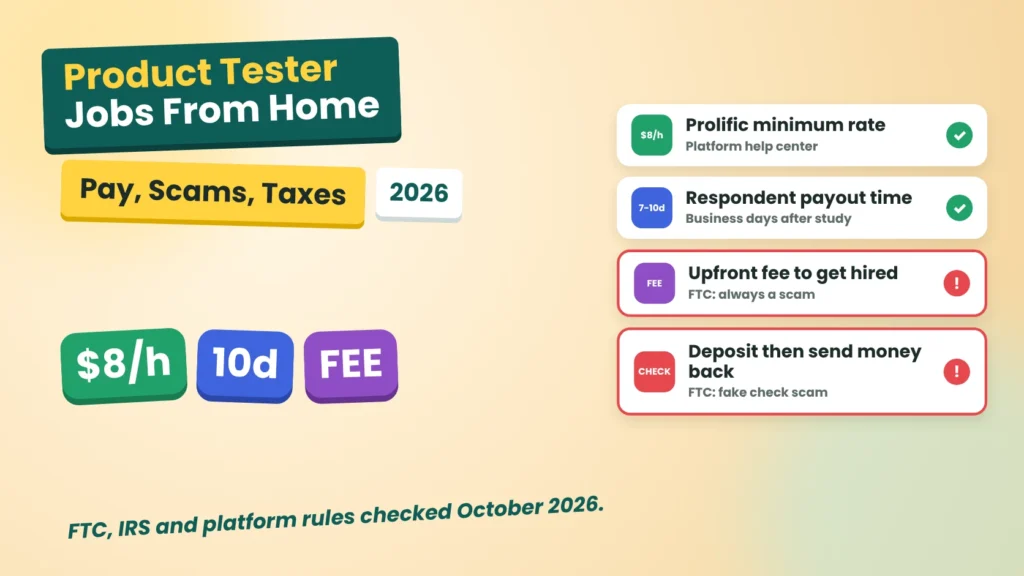
- Upfront fees. The FTC says any fee to become a mystery shopper is always a scam, including fees for training, certification or a guaranteed job.
- Paid job lists. The FTC says job lists are free from industry sources, so paying for one is a red flag.
- A check for “supplies.” A scammer sends a check, asks you to deposit it and has you send money back. That is a fake check scam.
- Wire transfers and gift cards. Once money leaves this way, it is usually gone.
- Income promises. Guarantees of high pay, or talk of quitting your job, are warning signs.
The FTC’s fake check page adds the part that catches people: banks must make deposited funds available quickly, but that does not mean the check is good. A fake can take weeks to be discovered, and you may then owe the bank the full amount. If you lose money, report it at ReportFraud.ftc.gov and to your state attorney general.
My rule of thumb: if a testing job needs you to spend your own money first and trust a check, walk away.
Which Paid Product Tester Jobs From Home Are Legit?
The closest real options are paid research platforms, where companies pay people to give feedback. I haven’t used them, so here are the rules as the platforms state them, not my results.
Prolific. Its help center says the minimum reward rate is $8 an hour (£6), and it recommends $12 an hour (£9) or more. The rate is based on the median actual completion time, not the researcher’s estimate. Here is an illustration (an example, not a promise). Say a study pays $4 and is estimated at 30 minutes, which is $8 an hour. If most people need 45 minutes, the effective rate drops to about $5.33, and the study counts as underpaying.
Respondent. Its help page lists illustrative incentives that vary by project and audience: about $5 to $25 for a 5 to 25 minute unmoderated task, about $40 to $150 for a 30 to 90 minute remote interview, and more for in-person sessions. Respondent says earnings are “not guaranteed or daily,” screeners are unpaid, and researchers choose who to invite. It takes a 5% fee with a $1 minimum, so a $60 incentive pays $57. Payment is issued through Tremendous, typically 7 to 10 business days after attendance is confirmed.
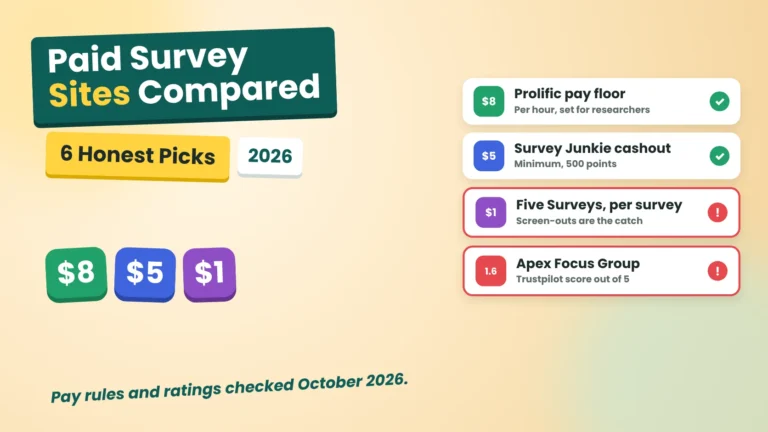
The honest picture: this is occasional side income, not a replacement for a job. If you want steadier small payouts, my guide to paid survey sites compares a few more options.
What About Free-Product Programs and Reviews?
Free products are real, but they are not wages. And they come with two obligations people forget: honesty and taxes.
On disclosure, the FTC’s endorsement guide says that if a free product could affect how readers weigh your review, you should say so, and it advises naming who gave it to you. Reviews must reflect your real experience, and a review with criticism in it is still an endorsement that needs a disclosure. In August 2024, the FTC announced a final rule on fake reviews that bars businesses from offering incentives that are conditioned on a review with a particular sentiment. So a legitimate program should not require a five-star rating.
On tax, the IRS treats bartered goods and services as taxable income at their fair market value, and you may need to make estimated payments. I haven’t found an IRS page about free review products specifically, so ask a tax professional if you receive items regularly.
How Much Can You Earn From Product Tester Jobs From Home, and How Do You Start?
Plan for pocket money, not a paycheck. Here is the order I’d follow.
- Set a goal. Decide if you want extra cash, free items or a way to test the waters. That decides which route fits.
- Use only platforms that pay you. Never pay a fee, and never accept a check you have to send money back from.
- Keep a clean profile. Respondent says your role, industry and profile completeness affect invites, so fill it out with accurate details.
- Do the hours math. Divide the incentive by the time the task takes, including screeners that don’t pay.
- Track what you earn. The IRS says you generally owe self-employment tax once net earnings from self-employment reach $400. For a plan to set money aside, see my guide to financial planning for gig workers.
- Disclose when you review. If you got an item free, say so in the review.
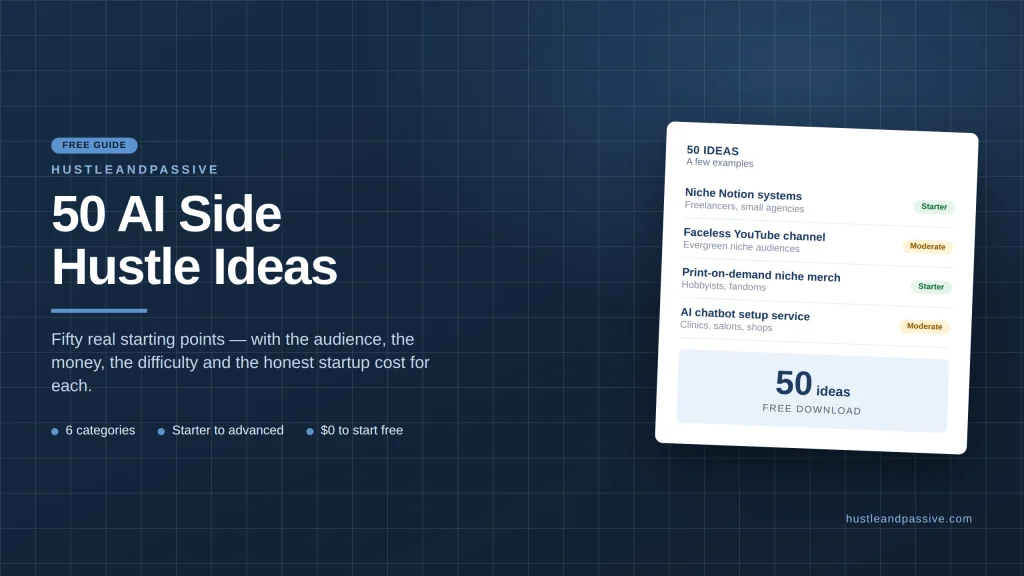
Wondering if this deserves your spare hours? I built the Side Hustle Idea Validator to score an idea before you commit time to it, and the free 50 AI side hustle ideas guide is a quick way to compare other routes. If you need cash faster, start with side hustles that pay daily.
What Are the Risks and Mistakes to Avoid?
The main risks with product tester jobs from home are scams, wasted time and unreported income. Here are the mistakes I’d watch for.
- Paying for a “guaranteed” job. Legitimate companies pay you, they don’t charge you.
- Depositing a check and sending money back. This is the classic fake check scam, and the loss is yours.
- Giving banking details to a stranger. Share them only with a platform you have checked.
- Skipping the disclosure. A free item can count as a connection you must mention.
- Counting screeners as paid time. Unpaid screening can drag your real hourly rate down.
For more remote options, read my guide to remote side jobs.
FAQ
Are product tester jobs from home real?
Some are, but most are not salaried jobs. Paid research platforms pay incentives for studies, and free-product programs give you items. Offers that charge a fee or send you a check to deposit are scams.
How much do product testers get paid?
It varies by platform. Prolific’s minimum is $8 an hour, and Respondent lists illustrative incentives from about $5 to $25 for short unmoderated tasks. Earnings are not guaranteed or daily.
How can you tell if a product tester job is a scam?
The FTC says an upfront fee is always a scam for mystery shopping, and the same logic applies here. Other signs are a check for “supplies,” requests to wire money or buy gift cards, and promises of big income.
Do you have to pay tax on free products you test?
The IRS says bartered goods and services are taxable at fair market value. I haven’t found an IRS page that covers free review products specifically, so check with a tax professional, and use the $400 self-employment threshold for cash earnings.
The Bottom Line
Product tester jobs from home can bring in small amounts, but they rarely behave like a job. The honest picture: paid studies are occasional, free products are a perk with rules, and any offer that asks for money or a check deposit is a scam.
My advice: pick one or two platforms that pay you, never pay to get hired, track every dollar from the first payment, and disclose any free product you review. And if a platform’s pay rules or the FTC guidance have changed by the time you read this, send me a message through the contact page so I can update the guide.

Writes and tests every guide on hustle&passive. Everything here is something we have actually run — including the parts that did not work.