Driving for Uber Eats looks simple from the outside. You open an app, accept an order, bring someone their dinner, and get paid. And it is that simple to start. The hard part is knowing what you’ll keep at the end of the week. Short answer: you can start at 18 on a bike or 19 with a car (21 in California and New York), and whether it’s worth it depends mostly on your car costs.
I haven’t delivered for Uber myself, so I’m not going to pretend I know what a Friday night feels like on the road. What I did was read Uber’s own pages line by line (requirements, pay, insurance) and the IRS pages on the tax side, and I’ll tell you where Uber’s pages stay vague. There are no affiliate links in this guide, so nothing here is trying to sell you a sign-up.
This guide covers who can start driving for Uber Eats, what you need, how the pay works, what Uber’s insurance does and doesn’t cover, and a simple way to check whether the money is worth your car and your time.
Last updated: October 2026. Uber changes its offers and rules by city, so check the sign-up page before you apply.
Key Takeaways
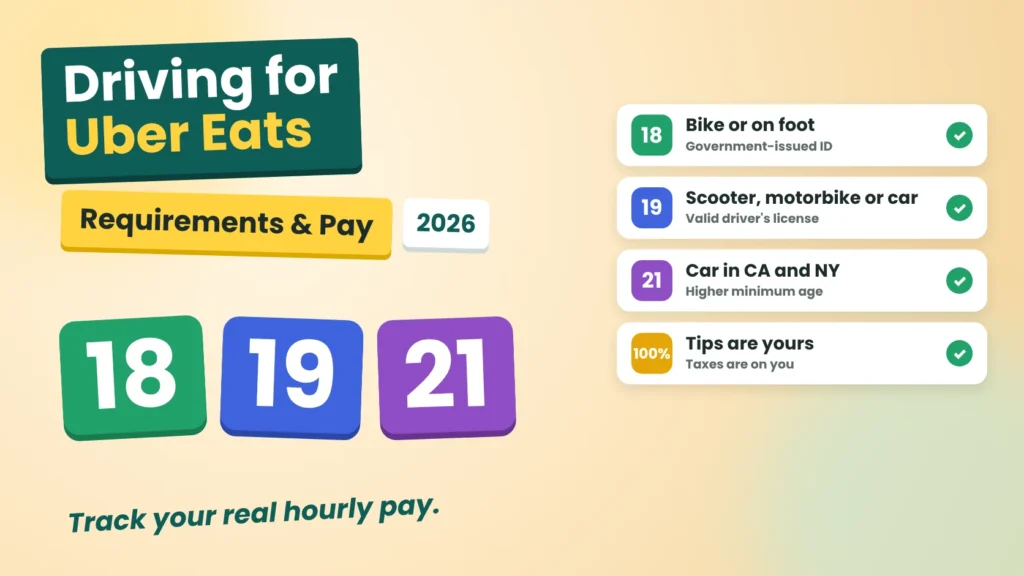
- The age depends on how you deliver. Uber’s page says 18 for a bike or on foot, 19 for a scooter, motorbike or car, and 21 for a car in California and New York State (Uber).
- You don’t need a fancy car. Uber says most 2-door and 4-door vehicles qualify, though you do need a valid driver’s license in your name.
- You keep 100% of tips. Uber shows the expected payout before you accept, and total earnings come from the base fare, promotions and tips (Uber).
- Uber’s insurance has gaps. It covers damage you cause to other people, but not repairs to your own car or your own injuries (Uber).
- Taxes are on you. After $400 of net self-employment income in a year, the IRS charges 15.3% on top of your regular income tax (IRS).
What Is Driving for Uber Eats, and How Does It Work?
Driving for Uber Eats means you deliver food and other orders as an independent contractor, using the Driver app. You decide when to go online, you see the offer before you accept it, and you’re paid per delivery rather than per hour. There’s no boss, no schedule, and no guaranteed income.
That freedom is the good part. The flip side is that you pay for your own car, your own gas and your own taxes. I’d think of it less as a job and more as a tiny business where the only product is your time. If you want a wider look at apps like this, my guide to best gig economy jobs compares a few of them.
What Do You Need to Start Driving for Uber Eats?
To start driving for Uber Eats you need to meet the minimum age for how you’ll deliver, pass a background screening, and upload your documents and a photo. Here’s what Uber’s page says for each way of delivering.
| How you deliver | Minimum age | What Uber asks for |
|---|---|---|
| Bike or on foot | 18 | Government-issued ID |
| Scooter or motorbike | 19 | Valid driver’s license in your name |
| Car | 19 (21 in California and New York State) | Valid driver’s license in your name; a 2-door or 4-door vehicle |
Source: Uber.
Those are the Uber Eats driver requirements in one place. On top of that, Uber says US delivery drivers must pass a background screening. For a car or motorbike that uses your Social Security number, and in many markets you also need proof of residency. Its page doesn’t say what the screening checks for, so I can’t tell you exactly what would stop an application.
If age is your sticking point, I wrote a separate guide on the DoorDash age requirement by state. It’s different from Uber’s, and the two together show you which app fits your age and your state.
How to Drive for Uber Eats: What Are the Sign-Up Steps?
You become an Uber Eats driver by signing up in the app, agreeing to the screening, and uploading your documents. Uber says activation generally takes anywhere from a few minutes to 48 hours, depending on how fast your documents and background check go through.
- Sign up as a delivery person on Uber’s site or in the app.
- Consent to the background screening.
- Upload the documents and a photo. The app asks for different documents depending on how you’ll deliver.
- Wait for activation. You’ll get a confirmation email.
- Go online in the Driver app and start receiving requests.
My advice is to do the paperwork on a day when you’re not in a hurry. My guess is that a blurry license photo is the kind of small thing that slows activation down, so take your time with the uploads.
How Does Uber Eats Pay Drivers?
Driving for Uber Eats pays per trip, and you see the expected payout before you accept it. Uber’s page says fares reflect the expected time and effort of the delivery, plus real-time conditions in your area. The fare includes the base fare and any tip the customer adds when they order.
Here’s what else can raise or protect your pay, according to Uber:
- Tips: You keep 100% of what customers give you. Trips marked “Guaranteed” pay at least the amount shown, and Uber covers a later tip reduction.
- Minimum earnings guarantee: In some markets Uber pays the difference if your earnings fall below a minimum rate for your time on trips. It isn’t everywhere.
- Promotions: Quest rewards you for completing a set number of trips. Boost+ adds extra pay for trips in a specific area.
- Uber Eats Pro: Gold, Platinum or Diamond status is said to bring higher earnings and priority access to better-paying deliveries.
Uber doesn’t publish a typical hourly wage, and its page says structures may differ by city. So any “you’ll make $X an hour” number you see online is someone’s guess, and I’m not going to add to the pile.
How fast do you get the money? You can cash out up to six times a day with Instant Pay for a small fee (Uber’s page doesn’t give the amount), set up Flex Pay for automatic withdrawals on a schedule of your choice, or wait for the weekly deposit, which Uber says usually lands on Thursdays.
What Does Driving for Uber Eats Pay After Costs?
What you keep is your payout minus your car costs, and the IRS puts a number on part of that. The standard business mileage rate for 2026 is 72.5 cents a mile (IRS).
Treat this as an example, not a promise, because the numbers are made up and round. Say a busy hour brings you $20 in payouts and tips, and you drive 12 miles during that hour. Twelve miles at 72.5 cents is $8.70. That leaves about $11.30 before taxes, and it doesn’t count the time you waited for the first order.
That’s the number to find for yourself. For the first two weeks, write down your online hours, your miles, your payouts and your tips. Then divide what you kept by every hour you spent, including the waiting. I explain the same formula in my guide to side hustles. If the result beats other things you could do with those hours, keep going. If it doesn’t, you’ve learned that cheaply.
What Does Uber’s Insurance Cover?
Uber covers other people when you’re at fault, but not your own car or your own injuries. According to its insurance page, Uber carries no coverage while you’re offline, and your personal auto policy applies. While you’re online and available, it provides third-party liability up to your state’s minimums. On a delivery trip, that goes up to $500,000 (or more where required) for damage or injury you cause to others.
What it doesn’t cover is repairs to your own car, your own injuries, or routine maintenance. It also doesn’t cover bicycles, e-bikes or walking deliveries unless the law requires it.
You still need your own personal auto insurance meeting your state’s minimum limits, kept active the whole time you’re on the app. Before your first delivery, call your insurer and ask how they treat delivery driving. Some personal policies don’t cover it, and Uber lists delivery endorsements as an optional extra you can ask about. Uber also lists optional injury protection in most states for your own medical expenses.
What About Taxes and Other Costs?
Nobody withholds tax from your payouts, because you’re an independent contractor. Once you’ve netted $400 in a year, the IRS charges self-employment tax of 15.3%: 12.4% for Social Security and 2.9% for Medicare, on top of regular income tax. It also lets you deduct the employer-equivalent part of that tax when you work out your adjusted gross income.
In practice, driving for Uber Eats comes with two tax habits. Keep a mileage log from day one, because it’s your biggest deduction if you use the standard rate. And set aside a share of every payout, so April doesn’t surprise you. The details are in my guide to financial planning for gig workers. I’m not a tax professional, so check your own situation with one or with the IRS.
The other costs are the ones you already know about: gas, maintenance, tires, phone data and, if you use it, the Instant Pay fee. They’re easy to forget when the app shows you a nice payout.
Is Driving for Uber Eats Worth It?
Driving for Uber Eats is worth it if you want flexible hours, you already have a reliable car, and the math from your first two weeks clears your own bar. It’s a poor fit if you need steady, predictable income or if your car is old and costly to run.
A few honest points before you decide:
- It’s a trade of time for money. There’s no passive income here. If you stop, the income stops.
- You can compare apps before you commit. Check each app’s own rules first, and see how DoorDash’s age rules differ from Uber’s. Packages are different again, as you’ll see in Amazon Flex.
- Your car is the real expense. The IRS rate gives you a rough sense of how fast miles add up.
- A small start beats a big commitment. Try one or two evenings, watch the numbers, then decide.
If you’d rather not drive at all, my list of odd jobs shows other ways to earn without a vehicle, and ways to make money covers the wider menu.
FAQ
Is driving for Uber Eats worth it?
Driving for Uber Eats can be worth it, but it depends on your car costs and how many hours you spend waiting. Uber doesn’t publish an hourly average, so track your own miles, hours and payouts for two weeks and divide what you keep by the hours you spent.
How old do you have to be to drive for Uber Eats?
You must be 18 for a bike or on foot, and 19 for a scooter, motorbike or car. Car drivers must be 21 in California and New York State, according to Uber’s delivery page.
Do you need a car to drive for Uber Eats?
No. Uber lets you deliver by bike or on foot at 18, with a government-issued ID. Scooter, motorbike and car delivery need a valid driver’s license in your name.
Do you keep your tips when driving for Uber Eats?
Yes. Uber says you keep 100% of the tips you receive. Trips marked “Guaranteed” also pay at least the amount shown, and Uber covers any later tip reduction.
How quickly do you get paid driving for Uber Eats?
You can cash out up to six times a day with Instant Pay for a small fee, or set up Flex Pay for automatic withdrawals. If you set up neither, Uber says funds usually arrive on Thursdays.
The Bottom Line
Driving for Uber Eats is easy to start and hard to judge until you’ve tracked your own numbers. Meet the age for your vehicle, get your insurance sorted, and expect to handle your own taxes. Then give it two weeks and let your own hourly figure decide.
My advice: don’t buy anything for it. Use the car you have, log every mile, and divide what you keep by every hour you spent. And if Uber has changed its rules by the time you read this, send me a message through the contact page so I can update the guide.

Writes and tests every guide on hustle&passive. Everything here is something we have actually run — including the parts that did not work.