Search for jobs that pay under the table and you’ll find lists of cash gigs with one big gap: almost none of them tell you what happens at tax time.
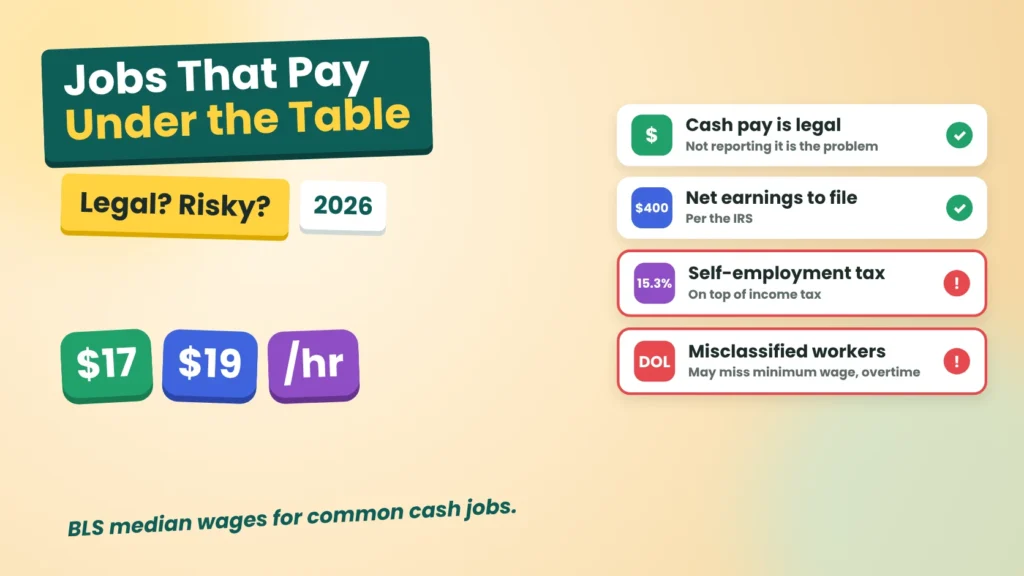
Here’s the short version. Getting paid in cash is legal. Not reporting it is the problem. And if an employer pays you cash and keeps you off the books, you may lose protections you didn’t know you had.
I haven’t worked cash jobs myself, so I’m not going to tell you what a good week pays. What I did was read the IRS pages on self-employment and reporting income, the Department of Labor on misclassified workers, and the Bureau of Labor Statistics (BLS) pay data for the jobs where cash work is common. I’m not a lawyer or a tax professional, so treat this as a map, not advice.
Quick heads-up: one link in this guide is an affiliate link. If you sign up through it, I may earn a commission at no extra cost to you.
Last updated: October 2026. Tax rules and pay data change, so check the sources before you rely on a number.
Key Takeaways
- “Under the table” describes how you’re paid, not a legal category. Cash work can be perfectly legal, but the income is taxable like any other.
- There’s no minimum amount you can skip. An IRS fact sheet says income is reportable even if the client doesn’t issue a Form 1099, whatever the amount.
- Self-employment tax starts at $400. After $400 of net self-employment earnings, the IRS charges 15.3% on top of regular income tax (IRS).
- Being off the books can cost you. Misclassified employees may miss minimum wage and overtime, according to the Department of Labor.
- The safer jobs that pay under the table are ones you run yourself. Think pet care, yard work or tutoring, where you’re a small business, not an employee with no paperwork.
What Does “Under the Table” Mean?
Jobs that pay under the table are jobs where you’re paid in cash, or in a way that never shows up on a pay stub or a tax form. The phrase covers two different situations, and mixing them up is how people get into trouble.
In the first, you’re self-employed. You walk a dog, mow a lawn or babysit, a client hands you cash, and you’re responsible for reporting it. That’s legal. In the second, an employer treats you like a regular worker but pays you cash and doesn’t withhold or report anything. That’s the risky one, and the person with the most to lose is usually you.
My take: if someone offers you a cash job and the first thing they say is “no paperwork,” slow down. A normal cash gig doesn’t need secrecy.
Is It Legal to Get Paid Under the Table?
Is it legal to get paid under the table? Getting paid in cash isn’t illegal. Failing to report the income is. The IRS says self-employment includes part-time businesses and gig work, and you generally need to pay estimated taxes quarterly because nobody withholds them for you.
On reporting, an older IRS fact sheet (it dates from 2007 and is marked as historical, and its $600 figures are out of date) makes a point that still matters: there’s no minimum amount you can leave out of gross income, and the income is reportable even if the client doesn’t send a Form 1099. It gives babysitting and lawn cutting as examples of cash side jobs that go on Schedule C. For the current threshold, the IRS self-employed tax center says you have to file a return if your net earnings from self-employment were $400 or more.
What Are the Risks of Being Paid Cash Off the Books?
The risks fall mostly on you. The IRS says employers generally must withhold income tax from employee wages and pay the employer share of Social Security and Medicare, plus unemployment tax. Independent contractors are different: the IRS says you don’t withhold or pay taxes on payments to them. If an employer treats you as a contractor when you’re legally an employee, the IRS says they may be liable for employment taxes for that worker.
The Department of Labor adds that misclassified employees may not receive the minimum wage and overtime pay they’re entitled to. So a cash job that looks like a favor can quietly cost you pay and protections. I’d ask one question before you accept: am I running my own small job here, or am I working for someone who is avoiding paperwork?
Which Jobs That Pay Under the Table Are Worth a Look?
Which jobs pay under the table? There is no official list, because cash work isn’t a job category. The jobs where it shows up most are small, local, self-employed services. Here are four, with the BLS figures for each. These are wage medians for employees, not what a cash client will pay you, so use them only as a rough check.
| Job | BLS median pay (May 2025) | Outlook 2025 to 2035 | Self-employed share |
|---|---|---|---|
| Childcare worker | $16.82 an hour ($34,980 a year) | -2%, a decline | Not stated |
| Grounds maintenance worker | $19.27 an hour ($40,080 a year) | 5%, faster than average | About 20% |
| Animal care worker | $17.08 an hour ($35,530 a year) | 11%, much faster than average | About 25% of caretakers |
| Janitor and building cleaner | $17.71 an hour ($36,840 a year) | 2%, slower than average | About 5% |
Source: BLS Occupational Outlook Handbook pages for childcare workers, grounds maintenance workers, animal care and service workers and janitors and building cleaners. BLS says its pay data for animal care excludes self-employed workers.
Which of These Fit You?
Animal care and yard work have the highest self-employed shares in the table, which makes them the most natural fit if you want to run your own small service. Childcare pays less on paper and is a shrinking field, but part-time work is common, and BLS says some states have no education requirement for entry-level roles. Cleaning has a low self-employed share, so it’s more often a job for someone else.
Here’s an example, not a promise, with made-up round numbers. Say you mow three lawns a week at $40 each for four weeks. That’s $480 a month in cash. If you also drive 10 miles per lawn, the IRS 2026 mileage rate of 72.5 cents is about $87 for 120 miles (IRS), so you keep about $393 before tax. The cash is real, and so is the tax bill on what’s left.
If you want more ideas for quick local work, my guide to odd jobs lists 15 you can start fast, and my guide to side hustles that pay daily covers faster payouts.
How Can You Find Cash Work Safely?
The safest jobs that pay under the table are the ones you find yourself and can walk away from. These are the habits I’d use, and they’re my opinions, not official rules:
- Start with people you can check. Neighbors, friends of friends and local groups are easier to vet than a stranger with an urgent request.
- Agree on the price and the job before you start. A short text that says what you’ll do and what it costs is a simple record for both sides.
- Never pay to get a cash job. A real client pays you. If someone asks for a fee up front, walk away.
- Keep your own log. Date, client, amount and costs, every time.
None of this is complicated, but it separates a small business from a favor that can’t be proven later.
How Do You Report and Track Cash Income?
You report cash income as self-employment income, and the best way to do it is to keep a record from the first payment. Write down the date, the client, the amount and your costs, and set aside part of every payment for taxes, since nobody withholds it for you. The IRS says self-employed people generally pay estimated taxes quarterly using Form 1040-ES, so don’t wait until April.
If you do this regularly, a paper trail saves you later. One tool I’d look at is FreshBooks, which handles invoices and expenses for freelancers. On its pricing page the Lite plan is $23 a month, though a $1-a-month first-year offer was showing when I looked, and there’s a 30-day free trial that needs no card. Lite caps you at 5 billable clients, so a longer customer list means the $43 Plus plan. For a handful of cash jobs, a notebook or a spreadsheet does the same work for free.

Ready to Simplify Your Business Finances?
Spend less time managing invoices and expenses and more time growing your online business. Try FreshBooks and streamline your accounting today.
A tax professional or the IRS can answer questions about your own situation, which I can’t. For the saving habits I’d start with, see my guide to financial planning for gig workers, and my best gig apps guide compares gig apps by real pay.
FAQ
Are jobs that pay under the table legal?
Getting paid in cash is legal, but you still have to report the income. The IRS says there’s no minimum amount you can exclude, and self-employed workers generally owe tax once net earnings reach $400.
Do you have to pay taxes on cash jobs?
Yes. Cash from a side job counts as self-employment income. Once your net earnings hit $400 in a year, the IRS adds a 15.3% self-employment tax to your regular income tax.
What are the risks of working off the books?
The Department of Labor says misclassified employees may not receive minimum wage and overtime pay, and the IRS says employers generally must withhold taxes and pay unemployment tax for employees. If your boss skips that paperwork, you may lose those protections.
What are the best jobs that pay under the table?
Small self-employed services like animal care, yard work and childcare are common examples. BLS shows median wages of about $17 to $19 an hour for these fields, though a cash client may pay more or less.
The Bottom Line
Jobs that pay under the table aren’t a loophole. Cash is a way of being paid, and the tax rules still apply. The jobs that pay under the table worth looking at are the ones where you work for yourself and keep your own records.
My advice: pick one small service you can run yourself, keep a simple log of every payment and mile, and set money aside for tax from the first dollar. And if the IRS thresholds or BLS figures have changed by the time you read this, send me a message through the contact page so I can update the guide.

Writes and tests every guide on hustle&passive. Everything here is something we have actually run — including the parts that did not work.