Paid focus groups are one of the few “get paid for your opinion” ideas that pay properly: $50, $100, sometimes more for an hour of talking.
The problem is everything around that hour. You apply through unpaid screeners, most of them say no, and payment can take weeks.
So where do you find paid focus groups that are legit? The short answer: join two or three real research platforms that match your profile.
Professionals do best on Respondent and User Interviews ($20 to $1,500+ per study). Patients and caregivers should add Rare Patient Voice ($120 an hour typical).
If you want steadier, smaller studies, Prolific guarantees at least $8 an hour. And anyone can try dscout ($25 to $150 per study) or UserTesting ($10 tests, up to $120 live sessions).
This guide is for anyone in the US who wants extra money from research studies without falling for fake listings.
I haven’t built an income from focus groups myself, so I won’t quote personal results. I built the list from each platform’s own help pages, read between October and November 2026, plus public reviews.
Some links on hustle&passive may be affiliate links. If you purchase through one of these links, we may earn a commission at no additional cost to you. Affiliate Disclosure
Last updated: November 2026. Pay and payout terms were checked on each platform’s own pages in October and November 2026. They change, so confirm on the study invitation before you take part.
Key Takeaways
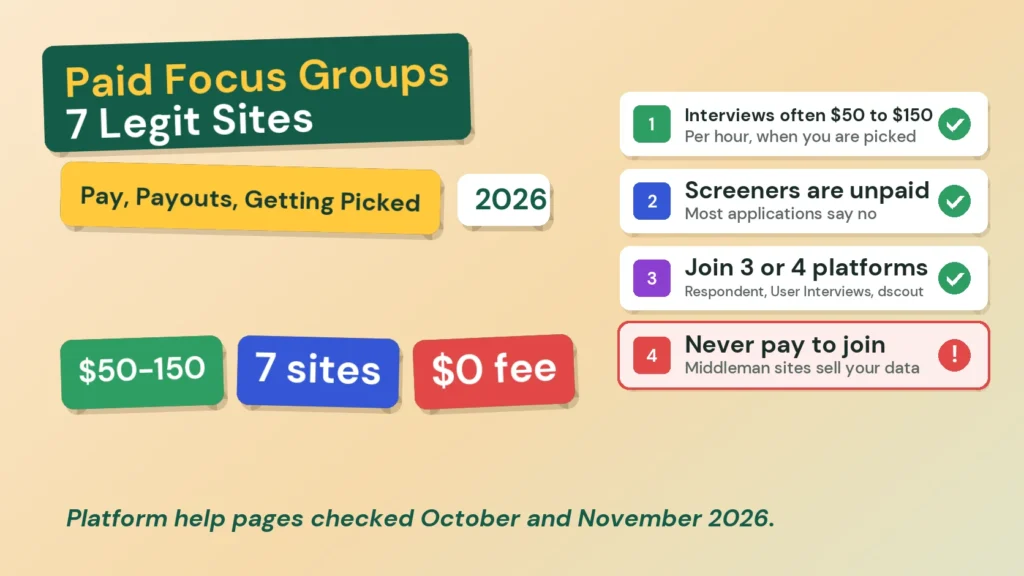
- Paid focus groups and research interviews often pay $50 to $150 an hour, far more than survey sites, but you only earn when a researcher picks you.
- Screeners are unpaid. On most platforms you answer a few questions first, and most applications don’t lead to a study.
- Join several platforms. Respondent, User Interviews, dscout, Rare Patient Voice, Prolific and UserTesting each reach different researchers.
- Payment is slower than you’d think. Expect anywhere from a few days to several weeks after the study, depending on the platform.
- Never pay to join. Legit research companies pay you. Sites that charge fees, or only refer you elsewhere, aren’t worth your data.
Paid Focus Group Sites Compared
Here are the seven options at a glance. “Typical pay” is what each platform states on its own pages, not a promise.
| Site | Typical pay | How you’re paid | When | Best for |
|---|---|---|---|---|
| Respondent | Set per study, shown before you apply | Visa prepaid or gift card via Tremendous, minus 5% fee | 7 to 10 business days after confirmation | Professionals |
| User Interviews | $20 to $1,500+ (average over $45) | Gift cards, Visa virtual card | After the study | Most adults |
| dscout | $25 to $150 per study | PayPal | Within 10 business days of close | Phone video diaries |
| Rare Patient Voice | $120 an hour typical | Check first, then ACH on request | A few weeks after study closes | Patients and caregivers |
| UserTesting | $10 per 15 to 20 min test; $30 to $120 live | PayPal | About 14 days | Quick website tests |
| Prolific | Minimum $8 an hour | PayPal | After approval | Steady small studies |
| Sago (FocusGroup.com) | Set per study, no public schedule | Digital reward wallet | After the study | In-person groups |
What Are Paid Focus Groups?
A paid focus group is a research session where a company pays a small group of people to discuss a product, ad or idea while a moderator asks questions. Today the term also covers one-to-one interviews, website tests and video diaries, most of them done online from home.
Companies pay well because the right opinions are hard to find. A software company might need 8 accountants who use a specific tool. A drug company might need 10 people living with a particular condition.
That’s why the best-paid studies go to people with specific jobs, health conditions or habits, and why you can’t simply log in and work.
1. Respondent: Best for Professionals
Respondent is a research marketplace where companies post paid interviews, focus groups and tests, and participants apply through screeners. It says it has more than 4.3 million verified members in over 150 countries.
The pay is among the best for people with specific job experience: a software buyer, a nurse, a small business owner. You see the incentive before you apply.
The catch is a participant fee: Respondent keeps 5% of each incentive, with a $1 minimum, so a $95 study pays you $90.25.
You’re paid only after the researcher confirms you took part. That usually takes 7 to 10 business days, and the reward is a Visa prepaid card or a gift card. My full Respondent review covers the fee and the screening process in detail.
2. User Interviews: Best All-Round Option
User Interviews connects researchers with consumers and professionals for interviews, surveys, usability tests and focus groups. It says the average study pays over $45, with studies ranging from $20 to $1,500 or more, and that participants have earned $60 million in total.
Most rewards come as gift cards, such as a Visa virtual card or Amazon card, though some researchers pay directly. It’s a good first platform because it reaches both everyday consumers and professionals.
UserTesting acquired it in January 2026; the company says participant accounts and payments didn’t change.
The honest catch: new members often wait a while for their first invite. Read the User Interviews review for payment details and common complaints.
3. dscout: Best for Video Diary Studies
dscout is an app where you record short videos, photos and answers about your everyday life for brands. It also runs live interviews. Its help center says most studies pay $25 to $150.
Rewards go to PayPal within 10 business days of the day the study closes, once the research team approves your entries. Applications are unpaid, and you’ll need to be comfortable on camera.
If you like sharing how you cook, shop or use apps, it suits you well. My dscout review walks through the studies and the payment rules.
4. Rare Patient Voice: Best for Patients and Caregivers
Rare Patient Voice recruits patients and family caregivers for healthcare research, from phone interviews to online surveys. It says it typically pays $120 an hour for studies you qualify for, and any condition counts, not only rare diseases.
It pays your first reward by check (you can ask for ACH direct deposit after that), usually a couple of weeks after a study closes. Because everyone in a study is paid at once, waits can be longer.
Konovo acquired the company in February 2026, describing it as a community of more than 200,000 patients and caregivers.
Here’s whether the wait is worth it: is Rare Patient Voice legit.
5. UserTesting: Best for Quick Website Tests
UserTesting pays you to use websites and apps while recording your screen and voice. Its Custom Network lists $10 for a standard 15 to 20 minute test, and live conversations pay $30, $60, $90 or $120 for 30 to 120 minutes.
Payment is PayPal only, normally 14 days after you complete a test. UserTesting says most contributors take one or two tests a week, so think of it as a small top-up rather than a focus group income.
6. Prolific: Best for Steady, Smaller Studies
Prolific is a research platform used mainly by universities and AI labs. It isn’t a focus group site in the classic sense, but it’s the most reliable way to fill the gaps between bigger studies. Researchers must pay at least $8 an hour.
Studies are short surveys and tasks, they fill fast, and there can be a waitlist to join. If you want something you can check most days, it’s the steadiest option on this list. My Prolific review explains how to protect your account from rejections.
7. Sago (FocusGroup.com): Best for In-Person Groups
Sago, formerly Schlesinger Group, is one of the large research recruiters for in-person and online focus groups. It also runs FocusGroup.com. This is where classic sit-around-a-table groups in a city facility still happen.
I couldn’t find an official pay schedule. User reviews describe in-person groups in the $75 to $200 range, paid through a digital reward wallet after the study. Recent reviews also complain about slow payments. Check the incentive on each invitation before you commit.
How Much Do Paid Focus Groups Really Pay?
Paid focus groups advertise $50 to $150 an hour, and per session that’s often true. Per month, it’s a different story, because you can’t control how many sessions you get.
Advertised versus realistic:
- Advertised: “$100 for a one-hour interview.”
- Realistic: a few studies a month if your profile is in demand, sometimes none for weeks if it isn’t.
Here’s an example, not a promise. Say you’re on four platforms, spend 30 minutes a day on screeners, and land two $75 studies and one $10 test a month. That’s $160 for about 18 hours including screeners, or roughly $9 an hour overall.
Good studies, modest total. Professionals and patients in demand do much better; general consumers usually land near this.
How to Qualify for More Paid Focus Groups
You can’t force invites, but you can stop missing the ones you fit:
- Fill out every profile field. Job title, industry, tools you use, health conditions if you’re comfortable sharing. Researchers filter on these before you ever see a screener.
- Answer screeners fast. Many studies fill within hours. Turn on notifications for the platforms you use most.
- Be honest and consistent. Don’t guess what a screener wants to hear. Researchers often re-check answers on the call, and being removed can get your account flagged.
- Show up on time with working tech. Test your camera and microphone before live sessions. A no-show can cost you future invites.
- Join three or four platforms, not ten. More accounts means more screeners, but past a few you spend more unpaid time than you earn.
How to Spot Fake Focus Group Listings
Some “focus group” sites aren’t research companies at all. Watch for:
- Any fee to join or to get your payment. The FTC warns that real employers don’t charge you for a job. Research is the same.
- Middleman sites. Some sites don’t run studies or pay you; they collect your details and refer you elsewhere. My Apex Focus Group review shows how that works.
- Checks for more than the promised amount, with a request to send the difference back. That’s a classic fake check scam.
- Pay that’s too good with no screener. Real studies always ask who you are first, because that’s what the client is paying for.
Do You Pay Taxes on Focus Group Money?
Yes. Focus group pay is taxable income in the US, whether it arrives as cash, a check or a gift card. For payments made from 2026, a company only has to send you a 1099 form once it pays you $2,000 or more in a year, but smaller amounts are still taxable.
If your study income is small and occasional, it’s often reported as other income; if you treat it like a business, self-employment rules can apply. The self-employment tax calculator gives a rough set-aside figure, and the IRS self-employed tax center explains the rules.
FAQ
Are paid focus groups legit?
Yes, when they’re run by real research companies such as Respondent, User Interviews, dscout, Rare Patient Voice or Sago. They pay you for your time and never charge a fee. Sites that ask you to pay, or only refer you elsewhere, aren’t real focus group providers.
How much do paid focus groups pay?
Online interviews and focus groups often pay $50 to $150 an hour, depending on how hard you are to find as a participant. Quick website tests pay less, such as $10 for a 15 to 20 minute UserTesting test. Screeners are unpaid.
How do I find paid focus groups near me?
Large recruiters like Sago (FocusGroup.com) still run in-person groups at research facilities in major US cities. Join their panel with your city and profile, and you’ll get invites for local sessions. Most studies today are online, though.
Do you have to pay taxes on focus group money?
Yes. All focus group pay is taxable income in the US, including gift cards. For payments made from 2026, a company only has to send a 1099 form once it pays you $2,000 or more in a year. You still owe tax on smaller amounts.
The Bottom Line
Paid focus groups are legit and pay far better per hour than surveys, but they’re occasional by nature. The money is in the sessions; the frustration is in the screeners and the payment waits.
My advice: pick the two or three platforms from this list that fit you best. Complete every profile field, and check for new studies once a day. Then let the good invites come to you, and treat every one as a bonus, not a paycheck.

I am a geotechnical engineer and I write every guide on hustle&passive. I check pay, fees and rules on official pages, and when I have not tried something myself, I say so and cite my sources.