$120 an hour to talk about your own health. That’s the headline rate Rare Patient Voice puts in front of patients and caregivers, and it’s why so many people search the name before signing up.
So, is Rare Patient Voice legit? Yes. It’s a real healthcare research recruiter that has been running since 2013, and it pays by check.
The catch is timing: you only get invited to studies that match your condition, and you’re paid when the whole study closes, which can take weeks or longer.
This guide is for patients and family caregivers in the US who want to know what Rare Patient Voice pays, how payment works and what people complain about.
I haven’t taken part in its studies myself, so I won’t quote personal earnings.
Everything below comes from Rare Patient Voice’s own pages, the company’s acquisition announcement and public reviews.
Some links on hustle&passive may be affiliate links. If you purchase through one of these links, we may earn a commission at no additional cost to you. Affiliate Disclosure
Last updated: November 2026. Facts were checked on Rare Patient Voice’s site, Konovo’s February 2026 announcement and the company’s BBB profile in November 2026.
Key Takeaways
- Is Rare Patient Voice legit? Yes. It’s a Towson, Maryland research recruiter founded in 2013 by Wes Michael, and it was acquired by Konovo in February 2026.
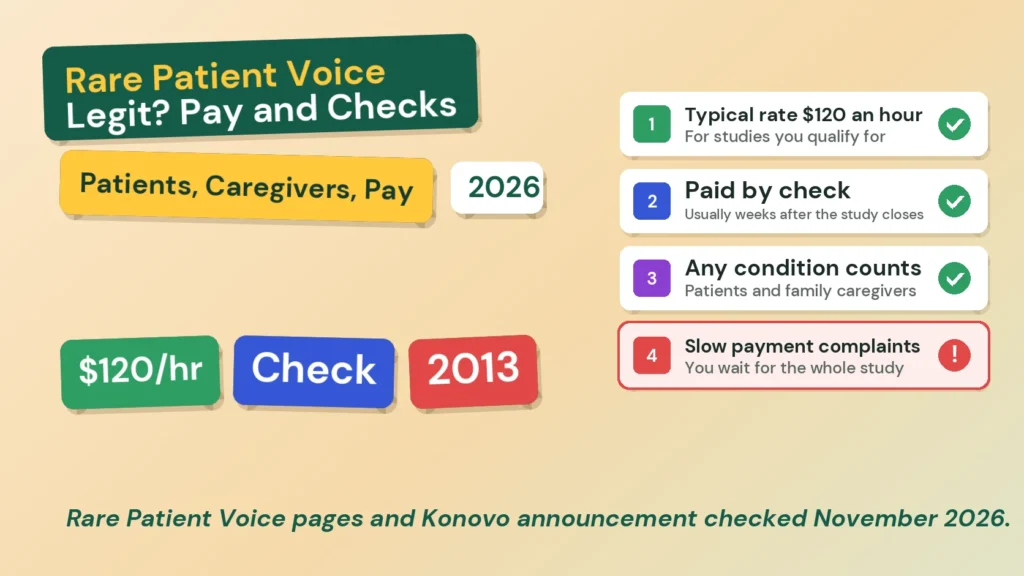
- The typical rate is $120 an hour for studies you qualify for and complete, according to Rare Patient Voice. You can’t log in and work whenever you want.
- Payment is by check, usually a couple of weeks after a study is completed. Everyone in a study is paid at once, so delays happen.
- It’s for patients and caregivers. Any condition counts, not only rare diseases, and you’re matched to studies by the conditions you list.
- The main complaints are slow payment and rejected survey answers. Few people call it a scam.
Is Rare Patient Voice Legit or a Scam?
Rare Patient Voice is legit. It’s a market research company that recruits patients and caregivers for studies run by healthcare companies, and it has a public address, phone number and a long track record.
Here’s what backs that up:
- A long history. Founder Wes Michael started the company in 2013, and its site says he has worked in rare and orphan diseases since 1998.
- A real owner. In February 2026, research firm Konovo announced it had acquired Rare Patient Voice, describing it as a community of more than 200,000 registered patients and family caregivers (Business Wire).
- Paid track record. In a 2025 reply on its BBB profile, the company said it had paid more than $15 million to patients and caregivers since it was founded.
- No fee to join. You never pay Rare Patient Voice anything. That alone rules out the most common research-job scam.
So it isn’t a scam. Whether it’s worth your time is a separate question, and that comes down to how often you qualify.
How Does Rare Patient Voice Work?
You sign up with your contact details and every condition you or the person you care for has. Rare Patient Voice then emails you invitations to confidential studies when a client needs someone with your profile.
According to Rare Patient Voice’s own explanation, studies come in three main formats:
- Phone or webcam interviews, usually one-to-one conversations with a researcher.
- Online surveys you complete on your own time.
- Online bulletin boards, where you answer questions over a few days.
Most studies happen from home. Participation is voluntary, you can say no to any study, and the company says it uses an ID code instead of selling your personal information.
One thing surprised me: it isn’t only for rare diseases.
The company accepts patients with any condition, from diabetes to cancer to chronic pain, plus family caregivers. More conditions on your profile means more chances to match a study.
How Much Does Rare Patient Voice Pay?
Rare Patient Voice says it typically pays $120 an hour for the surveys and interviews you qualify for. A 30-minute phone interview at that rate would pay about $60, and a 90-minute webcam session about $180.
That’s a strong rate. Most survey sites pay a few dollars an hour, as my guide to paid survey sites shows.
But the hourly rate is the wrong number to focus on. The number that decides what you earn is how many studies you match, and you don’t control it.
Someone with a condition that drug companies are researching right now might get several invites a month. Someone with a common or less-studied condition might go months without one.
Here’s an example, not a promise. Say you match one 60-minute interview every two months. At $120 an hour, that’s about $720 a year. Pleasant extra money, but not a side hustle you can plan around.
There’s also a referral bonus. Rare Patient Voice says it gives a $10 gift card for each patient you refer who joins.
How and When Does Rare Patient Voice Pay You?
Rare Patient Voice pays by paper check mailed to your address. The company says it usually pays a couple of weeks after a study is completed.
The detail most people miss is what “completed” means. A study closes when every participant has finished and the client has wrapped up the project, not when you finish your own interview.
The company pays everyone in a study at once, so if you take part early in a long study, you wait for the rest.
If a check doesn’t arrive, contact the company. Its site lists ContactUs@RarePatientVoice.com and (443) 986-1949, Monday to Friday, 9am to 5pm Eastern.
Remember the tax side too. Study pay is taxable income.
From tax year 2026, a company only has to send you a 1099-NEC once it pays you $2,000 or more in a year, according to the IRS instructions for Forms 1099-MISC and 1099-NEC, but you owe tax on smaller amounts too. The self-employment tax calculator shows roughly what to set aside.
What Do Users Complain About?
The complaints follow two patterns, and neither suggests a scam.
- Slow payment. This is the big one. Some participants on the company’s BBB page describe waiting months for a check, which fits the pay-when-the-study-closes model. Others say they were paid on time.
- Rejected surveys. Some people report survey answers rejected for “speeding,” meaning the system decided they answered too fast to be thoughtful, so they weren’t paid.
There are also very few public reviews overall. As of November 2026, the BBB profile showed only a small number of customer reviews with a mixed average, so I wouldn’t read much into the score either way.
My take: if you’re patient about payment and answer surveys carefully, the complaints are manageable. If you need money on a schedule, they’re a dealbreaker.
How Does Rare Patient Voice Make Money?
Rare Patient Voice is paid by its clients, usually pharmaceutical, medical device and healthcare research companies, to find patients and caregivers who match a study. It passes part of that fee to you as your incentive.
That’s why you never pay anything, and why your pay depends on who’s buying. Companies pay well for hard-to-find patients, which is where the $120 hourly rate comes from.
Pros and Cons
| Pros | Cons |
|---|---|
| High rate: $120 an hour typical | Invites depend on your condition |
| Free to join, no fees | Paid by check only |
| Any condition counts | You wait until the whole study closes |
| Most studies from home | Surveys can be rejected for speeding |
Is Rare Patient Voice Worth It?
Rare Patient Voice is worth joining if you’re a patient or caregiver in the US and don’t mind waiting for checks.
Signing up takes a few minutes, costs nothing, and the rare invite pays far better than any survey app.
Skip it, or at least don’t count on it, if you need regular income or a payout within days. It works best as one of several research panels, not your only one.
Rare Patient Voice Alternatives
If you want more chances to get paid for your opinion, these platforms run on the same idea: real companies paying for real feedback.
- Respondent pays for interviews and focus groups, takes a 5% fulfillment fee (minimum $1) out of your incentive, according to Respondent, and favors professionals. Read my Respondent review.
- User Interviews lets you choose a prepaid card, gift card or charitable donation, and the amount depends on the study (see its incentives page). See the full User Interviews review.
- Prolific pays less per study but requires researchers to pay at least $8 an hour (about £6), and studies are more frequent. Here’s my Prolific review.
FAQ
Is Rare Patient Voice a real company?
Yes. Rare Patient Voice is a healthcare market research recruiter based in Towson, Maryland, founded in 2013 by Wes Michael. Konovo acquired it in February 2026 and described it as having more than 200,000 registered patients and caregivers.
How much does Rare Patient Voice pay per hour?
Rare Patient Voice says it typically pays $120 an hour for surveys and interviews you qualify for and complete. What you earn in a year depends on how many studies match your condition, which can range from several a month to none for months.
How does Rare Patient Voice pay?
Rare Patient Voice pays by check mailed to you, usually a couple of weeks after the study is completed. Because everyone in a study is paid at once, the wait can be longer if the study runs for a while.
Do I need a rare disease to join Rare Patient Voice?
No. Despite the name, Rare Patient Voice accepts patients with any condition, plus family caregivers. You list all your conditions when you sign up, and the company matches you to studies that need people like you.
The Bottom Line
Rare Patient Voice is legit, it pays well per hour, and it doesn’t charge you anything.
The trade-off is control: you can’t choose when studies arrive, and checks come when the whole study closes, not when you finish.
My advice: sign up if you’re a patient or caregiver, list every condition honestly, and treat each check as a bonus. Then add one or two other research panels so you’re not waiting on a single source.
I write every guide on hustle&passive. I test what I can, and when I have not tried something myself, I say so and cite my sources.